Vietnamese scientist uses nano particles to make heat-reflective paint

The solar heat reflectivity of a new paint invented by a local scientist is up to 90 percent, while the concrete surface temperature reduction could be up to 8-9oC.

High durability is also a typical feature of the paint product using nano particles invented by Dr Nguyen Thien Vuong from the Institute of Tropical Technique, an arm of the Vietnam Science & Technology Academy.

Vietnam has an average heat radiation volume of 120 kcal per square centimeter per annum. According to Vuong, the intensity of direct radiation reaches its maximum level in June and August in the north, and in April, May, August and September in the south.
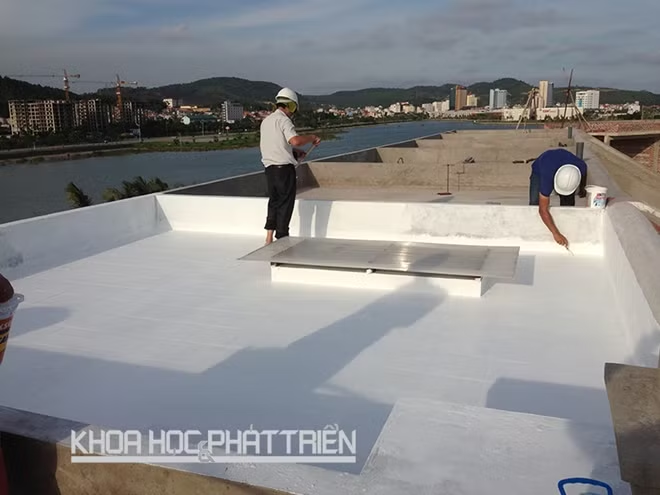
The solar heat reflectivity of a new paint invented by a local scientist is up to 90 percent, while the concrete surface temperature reduction could be up to 8-9oC.

Therefore, saving energy, cooling, and reducing the heat island effect is always a concern in the civil engineering industry. 

Previously, the Institute of Tropical Technique successfully fabricated a solar heat reflective paint, but the product caused environmental pollution because of the use of organic solvent. The weather durability was not high, only about 5-6 years.

The solar heat reflective paint products available in the market have two layers – the primer and solar heat reflective coating with reflectivity in the infrared range of 60-80 percent. 

The longevity and reflectivity to the sun's heat can be greatly reduced as a result of the direct effects of the weather.

Understanding the problems, Vuong and his co-workers from the Vietnam Science & Technology Academy decided to utilize nano particles to make a heatproof liquid coating, solar-heat reflective and weather durable.

They have successfully invented a generation of paints friendly to the environment with solar heat reflectivity of up to 90 percent witj high weather durability.

The paint consists of three layers: alkali-resistant primer, sun-reflective coating and UV-coated nano-coating.

According to Vuong, the reduction of concrete surface temperature by 8-9oC has a very important significance in easing the heat island effect in urban areas, thus helping reduce energy consumption to cool the environments inside buildings.

Due to the urban heat island effect, in the afternoon and evening, the temperature in urban areas is always 2-5oC higher than rural areas, thus creating hot climate zones. 

Nguyen Thi Bich Thuy from the Transport Technology University confirmed that the successful application of nano particles has created a generation of paints with high heat resistance capability.

Thuy said the paint not only can help resist heat for buildings, but it can be applied to petroleum tanks. As the tanks are put outdoors and influenced by weather conditions, petrol products are lost during evaporation.

“The nanoparticle coating can shield things from ultraviolet light and therefore, it can provide better protection than currently used paints," she said.

Vietnamnet

Other News

SK Group partners to build AI ecosystem in Vietnam

SK Group partners to build AI ecosystem in Vietnam

SK Innovation and SK Telecom signed MoUs with Nghe An province and the National Innovation Centre of Vietnam to advance AI ecosystem development and support the country’s long-term growth strategy.

Vietnam Research Excellence Fellowship for 2026-2030 approved

Vietnam Research Excellence Fellowship for 2026-2030 approved

Under the Vietnam Research Excellence Fellowship (VREF) for the 2026–2030 period, PhD students are identified as a core research force directly contributing to breakthroughs in sci-tech and innovation. Investing in top-tier doctoral candidates is more than workforce development, but a high-stakes strategic bet to forge a cohort of world-class scientists and technologists who can power Vietnam’s long-term economic ambitions.

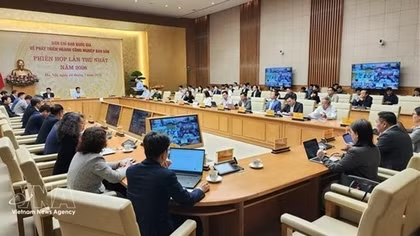
Strategic tech must address practical challenges: PM

Strategic tech must address practical challenges: PM

Prime Minister Pham Minh Chinh on March 28 said strategic technologies must tackle Vietnam’s practical challenges, while chairing a meeting of the Government’s Steering Committee for science and technology, innovation, digital transformation, and Project 06.

Ho Chi Minh City sets sights on becoming semiconductor hub

Ho Chi Minh City sets sights on becoming semiconductor hub

Ho Chi Minh City is stepping up efforts to attract investment from global leading groups and companies in the fields of electronic components, semiconductors and chip manufacturing as it seeks to position itself as a leading semiconductor industry hub in both the region and the world. 

Ho Chi Minh City launches upgraded technology exchange platform

Ho Chi Minh City launches upgraded technology exchange platform

The upgraded platform represents a comprehensive shift from a simple information-sharing model to a managed online technology trading system, enabling monitoring and measurement of real transaction outcomes. It is built on three pillars, namely new tradable technology products, a modern digital platform, and an improved operational model.

AI – unmissable opportunity for Vietnam: Experts

AI – unmissable opportunity for Vietnam: Experts

AI also emerges as a key enabler for Vietnam's ambition to build financial and technology hubs. Applications can boost efficiency, automate workflows, cut costs, and sharpen data analytics, which are essential pillars of a modern financial system.

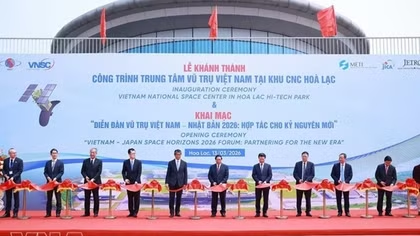
PM calls for accelerated space technology development in Vietnam

PM calls for accelerated space technology development in Vietnam

Vietnam aims by 2030 to achieve a mid-level position in space science and technology development within Southeast Asia, and after 2030 to build national capabilities to independently develop satellite technologies and apply space data to address global challenges and national security needs.

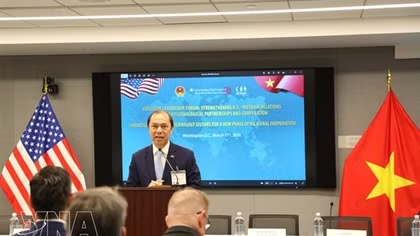
High-level forum advances Vietnam–US technological cooperation

High-level forum advances Vietnam–US technological cooperation

A high-level executive leadership forum focusing on strengthening Vietnam - US relations through technology cooperation was jointly held in Washington D.C. on March 11 by the Embassy of Vietnam in the US, the Weatherhead East Asian Institute of Columbia University, and the US -ASEAN Business Council (USABC). 

AI Law takes effect, anchors national governance framework

AI Law takes effect, anchors national governance framework

While many countries are still drafting policy blueprints or issuing non-binding guidance, Vietnam has moved ahead with a standalone Law on Artificial Intelligence (AI), effective from March 1, placing it among a select group of nations to adopt dedicated AI legislation at the parliamentary level. 

Vietnam International Defence Expo 2026 preparations move into high gear

Vietnam International Defence Expo 2026 preparations move into high gear

Vietnam International Defence Expo 2026, themed “Peace, Friendship, Cooperation and Development,” will be organised on a larger scale, featuring a wide array of weapons and technical equipment alongside product exhibitions, seminars and panel discussions, drills, live field demonstrations, and business networking activities.

Ministry requests urgent measures to counter UAVs threatening aviation safety

Ministry requests urgent measures to counter UAVs threatening aviation safety

Ministry of Construction requested the Ministry of National Defence, the Ministry of Public Security and provincial and municipal steering committees for counter-terrorism to strengthen the management, inspection and supervision of UAVs and other aerial devices, ensuring strict compliance with Decree No. 288/2025/ND-CP and relevant legal regulations.