150,000 children still at risk of malnutrition over a week after typhoon Damrey

An estimated 150,000 children under 5 years old are at risk of malnutrition and over 80,000 pregnant and nursing women in need special care. Children in poor remote areas are still underserved by relief efforts, according to UNICEF.

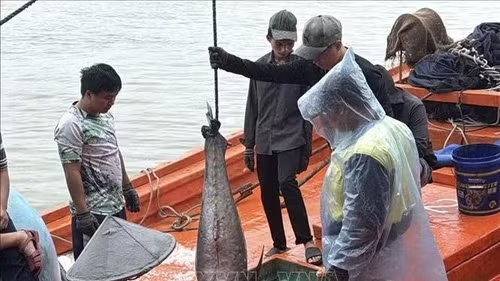
11 month-old Ngan lives in a small fishing community in Phu Yen province in southern Viet Nam, one of the worst hit areas by Typhoon Damrey. 

Her father works as causal worker on a fishing boat and the family is struggling to make ends meet in normal time. Ngan has suffered from malnutrition since her parents first consulted the district health centre. 

Lack of knowledge about proper feeding practices often leaves Ngan’s parents helpless when their daughter if not growing fast enough. 

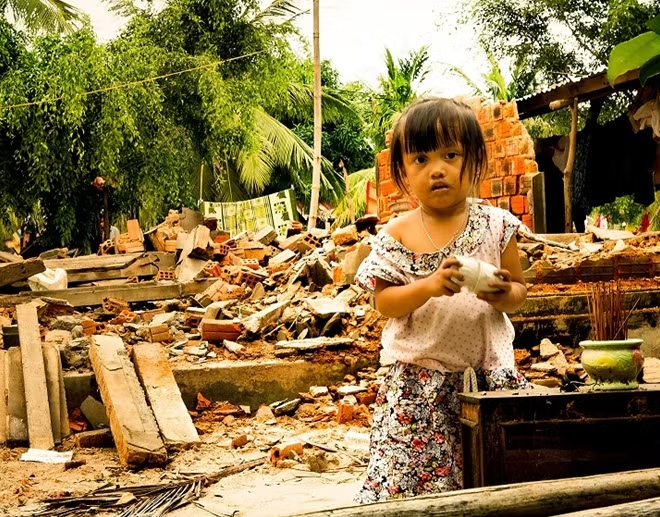
But this is not a normal situation for Ngan’s family. When Typhoon Damrey hit the village in the early hours everyone was still asleep and their house was severely damaged by the strong winds. Luckily no one in the family was hurt. 

In the chaos of the first two days after the storm Ngan’s parents were unable to get meet or fish on the local market and even though there is now food available for local purchase the family can’t afford to buy in large quantity so they have had to reduce portions. 

Ngan is not getting enough food, and her mother is also not eating enough and she has difficulty producing enough milk to keep breastfeeding her child.

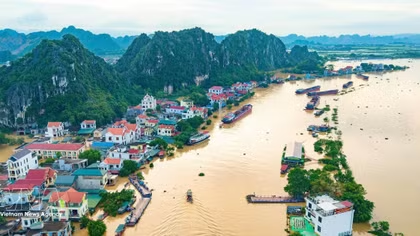
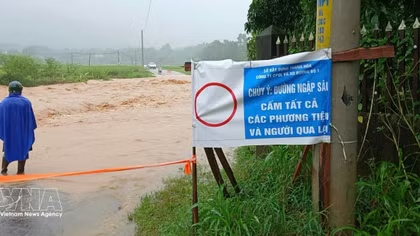
Typhoon Damrey, one of the worst storm to hit Viet Nam in years, swept through largely poor, rural areas of Viet Nam with deadly force. It hit poor communities where the nutritional status of children was already of concern with malnutrition rates above national average. 

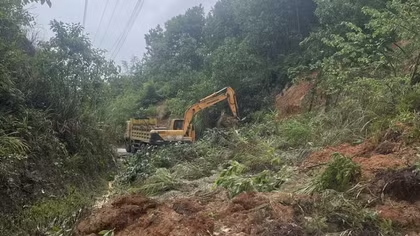
Populations in that region rely heavily on agriculture and fish farming for their livelihood and the storm also caused extensive damage to the agricultural infrastructures which is impacting the capacity of poor families to earn a decent living to care for their children. 

During the rapid assessment mission UNICEF staff has met with several vulnerable children like Ngan who are the ones who suffered much more from the ongoing consequences of the typhoon. 

This situation was compounded by lack of communication at community level ahead of the typhoon on how to prepare and protect themselves. 

In addition to malnutrition children are also exposed to an increased risk of waterborne diseases. Drinking water supply was interrupted for several days after the storm and people had to resort to unclean water for their consumption. 

The typhoon has also worsened the sanitation situation of the affected populations leading to increased open defecation as latrine facilities have been damaged. This leads to hygiene related risks for health. 

UNICEF is stepping up its efforts to support national relief efforts to help the most affected families and children. 

Specific interventions look at addressing the increased risk of malnutrition through micronutrients and calories supplements for children and breastfeeding mothers and by training health workers on how to detect and treat malnutrition. In addition, to address the acute risk of waterborne diseases the organisation will provide products to families for water purification at home. 

UNICEF has worked to raise public awareness in the affected region to ensure that people are aware of the risks and can also adopt good hygiene and sanitation behaviours. 

In the recovery phase, public communication campaigns in communities are critical to help families affected by the typhoon and promote important skills for parents to adopt to save lives. 

In addition, raising public awareness on the importance of disaster preparedness through mass and social media plays an important role to trigger support to affected people and to improve resilience against future natural disasters.

VietNamNet Bridge

Other News

Hanoi ready to implement Capital Law 2026, unlocking new development momentum

Hanoi ready to implement Capital Law 2026, unlocking new development momentum

The effectiveness of the Capital Law 2026 will be measured not by the number of legal documents issued but by tangible improvements in governance and public administration, better services for people and businesses, faster administrative procedures, stronger investment attraction and higher economic growth.

Vietnamese students earn honours at ROBOG Asia Cup 2026

Vietnamese students earn honours at ROBOG Asia Cup 2026

Three teams from Chu Van An Secondary School in Vietnam’s Thai Nguyen province have earned First Prize honours and advanced to the quarterfinals at the ROBOG Asia Cup 2026, a regional robotics and artificial intelligence (AI) competition for students held in Hong Kong, China.

Hanoi sets out new investment blueprint with century-long development vision

Hanoi sets out new investment blueprint with century-long development vision

As of early June, Hanoi had attracted 74.6 billion USD in foreign direct investment (FDI) through more than 9,250 valid projects. FDI inflows in the first six months were projected at 3.2 billion USD, surpassing the annual target by 116%, while nearly 16,000 new businesses were established in the first five months, up 34.4% year-on-year.

Vietnam promotes legal cooperation and rule of law at global forum

Vietnam promotes legal cooperation and rule of law at global forum

Vietnam’s development and international integration have gone hand in hand with the improvement of its legal system, the incorporation of international commitments into domestic legislation, and legal reforms aimed at fostering development, openness and global integration. The country regards international law as an essential instrument for building fair, mutually beneficial relations among nations.

Hanoi to hold investment promotion event on June 29

Hanoi to hold investment promotion event on June 29

At the event, Hanoi authorities plan to grant investment policy decisions and investment registration certificates to 20 exemplary projects in the fields of transportation infrastructure, industrial parks, urban development, social housing, environment, science and technology, and foreign investment attraction.

Hanoi's Red River urban area development draws widespread attention

Hanoi's Red River urban area development draws widespread attention

Located south of the Red River and extending from the historic inner city to newly developing areas in the south and the west, the central urban area along Red River’s right bank covers approximately 45,317 hectares and is projected to accommodate around 6.365 million residents by 2045 and 6.455 million by 2065.

Hanoi's Red River urban area development draws widespread attention

Hanoi's Red River urban area development draws widespread attention

Located south of the Red River and extending from the historic inner city to newly developing areas in the south and the west, the central urban area along Red River’s right bank covers approximately 45,317 hectares and is projected to accommodate around 6.365 million residents by 2045 and 6.455 million by 2065.

Regional cooperation strengthened to combat cross-border drug crime

Regional cooperation strengthened to combat cross-border drug crime

Vietnam, China, Laos and Myanmar face common challenges as drug syndicates increasingly exploit the Mekong River, cross-border transport networks, e-commerce platforms, international logistics services, cyberspace and cryptocurrencies to organise drug transactions and smuggling operations.