Amateur astronomer captures exact moment of supernova explosion

A plumber and astronomy enthusiast from Argentina has achieved something that the international astronomical community had failed to do: photograph the exact moment of a supernova’s emergence.

Today, the direct observation of a supernova is thought to be the only way to understand a key aspect of how a star evolves and what its structure is comprised of, because it is the best way to "see" what is happening inside the celestial body. The problem is that no one can predict when and where an supernova will occur, as the phenomena generally only happens two of three times a century in a single galaxy that can contain over 100 billion suns.
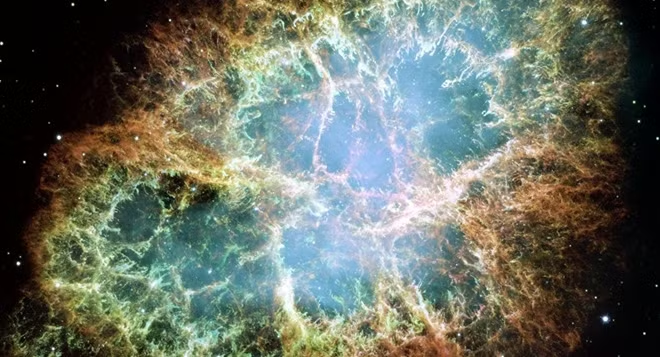
However, astrophysicists have confirmed a theoretical speculation according to which an explosion consists of three stages. To arrive at the speculation, astronomers used data recorded by amateur astronomer Victor Buso who, on September 20, 2016, was "in the right place at the right time," pointing his telescope to spiral galaxy NGC 613, located 70 million light years from Earth. During a single hour of observation, Buso made some forty images, informing the International Astronomical Union that something important is happening.

​Typically, a supernova accompanies the death of a very large star (at least ten times the size of our Sun). When this happens, the star explodes and disintegrates. Understanding how the supernova flash occurs would allow astrophysicists to understand how chemical elements are born and, to some extent, how a star's chemical makeup evolves.

Throughout almost all of its existence a star emits light, which emerges as a result of powerful energies created inside the celestial body. Nuclear fusion inside a star transforms lighter elements into those that are anatomically heavier. The energy released during this process makes the star more stable, increasing its lifespan. However, at a certain point the star burns through all of its fuel and stops emitting energy and, as there is no longer any powerful resistance the forces of gravity, the celestial body disintegrates in one last spectacular display of energy: a supernova.

​A supernova explosion happens inside the star and, as the flash occurs, the shockwave reaches the surface. At this moment most of the chemical elements produced by the star during its existence disintegrate.

Bersten pointed out that the process takes several hours, appearing like a slow-motion camera flash, but much more powerful.

Astrohobbyist Buso and his amatuer equipment captured the first of the three stages of a supernova flash during which an explosion occurs and the shockwave reaches the surface.

The second stage takes place over the following 72 hours, as the surface of the star cools. The last stage, sees the former star heat up again due to the process of nuclear fission brought on by the immense weight of the collapsing material, and can go on for several weeks.
Sputnik

Other News

SK Group partners to build AI ecosystem in Vietnam

SK Group partners to build AI ecosystem in Vietnam

SK Innovation and SK Telecom signed MoUs with Nghe An province and the National Innovation Centre of Vietnam to advance AI ecosystem development and support the country’s long-term growth strategy.

Vietnam Research Excellence Fellowship for 2026-2030 approved

Vietnam Research Excellence Fellowship for 2026-2030 approved

Under the Vietnam Research Excellence Fellowship (VREF) for the 2026–2030 period, PhD students are identified as a core research force directly contributing to breakthroughs in sci-tech and innovation. Investing in top-tier doctoral candidates is more than workforce development, but a high-stakes strategic bet to forge a cohort of world-class scientists and technologists who can power Vietnam’s long-term economic ambitions.

Strategic tech must address practical challenges: PM

Strategic tech must address practical challenges: PM

Prime Minister Pham Minh Chinh on March 28 said strategic technologies must tackle Vietnam’s practical challenges, while chairing a meeting of the Government’s Steering Committee for science and technology, innovation, digital transformation, and Project 06.

Ho Chi Minh City sets sights on becoming semiconductor hub

Ho Chi Minh City sets sights on becoming semiconductor hub

Ho Chi Minh City is stepping up efforts to attract investment from global leading groups and companies in the fields of electronic components, semiconductors and chip manufacturing as it seeks to position itself as a leading semiconductor industry hub in both the region and the world. 

Ho Chi Minh City launches upgraded technology exchange platform

Ho Chi Minh City launches upgraded technology exchange platform

The upgraded platform represents a comprehensive shift from a simple information-sharing model to a managed online technology trading system, enabling monitoring and measurement of real transaction outcomes. It is built on three pillars, namely new tradable technology products, a modern digital platform, and an improved operational model.

AI – unmissable opportunity for Vietnam: Experts

AI – unmissable opportunity for Vietnam: Experts

AI also emerges as a key enabler for Vietnam's ambition to build financial and technology hubs. Applications can boost efficiency, automate workflows, cut costs, and sharpen data analytics, which are essential pillars of a modern financial system.

PM calls for accelerated space technology development in Vietnam

PM calls for accelerated space technology development in Vietnam

Vietnam aims by 2030 to achieve a mid-level position in space science and technology development within Southeast Asia, and after 2030 to build national capabilities to independently develop satellite technologies and apply space data to address global challenges and national security needs.

High-level forum advances Vietnam–US technological cooperation

High-level forum advances Vietnam–US technological cooperation

A high-level executive leadership forum focusing on strengthening Vietnam - US relations through technology cooperation was jointly held in Washington D.C. on March 11 by the Embassy of Vietnam in the US, the Weatherhead East Asian Institute of Columbia University, and the US -ASEAN Business Council (USABC). 

AI Law takes effect, anchors national governance framework

AI Law takes effect, anchors national governance framework

While many countries are still drafting policy blueprints or issuing non-binding guidance, Vietnam has moved ahead with a standalone Law on Artificial Intelligence (AI), effective from March 1, placing it among a select group of nations to adopt dedicated AI legislation at the parliamentary level. 

Vietnam International Defence Expo 2026 preparations move into high gear

Vietnam International Defence Expo 2026 preparations move into high gear

Vietnam International Defence Expo 2026, themed “Peace, Friendship, Cooperation and Development,” will be organised on a larger scale, featuring a wide array of weapons and technical equipment alongside product exhibitions, seminars and panel discussions, drills, live field demonstrations, and business networking activities.

Ministry requests urgent measures to counter UAVs threatening aviation safety

Ministry requests urgent measures to counter UAVs threatening aviation safety

Ministry of Construction requested the Ministry of National Defence, the Ministry of Public Security and provincial and municipal steering committees for counter-terrorism to strengthen the management, inspection and supervision of UAVs and other aerial devices, ensuring strict compliance with Decree No. 288/2025/ND-CP and relevant legal regulations.