Better legal framework needed to attract foreign investors to road projects

Hanoi — Financial experts have called for a better legal framework to curb policy-related risks so that projects, particularly road projects in Vietnam, could be made more attractive to foreign investors.

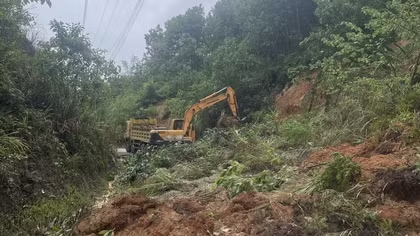
Financial experts have called for a better legal framework to curb policy-related risks so that projects, particularly road projects in Vietnam, could be made more attractive to foreign investors. — Photo baogiaothong.vn

A member of the National Advisory Council on Finance and Monetary Policies, Le Xuan Nghia, said at a talk last week that policy-related risks were the main issue concerning foreign investors to Vietnam.

The talk, organised by Giao thong (Transport) newspaper, highlighted the need to develop another North-South highway in Vietnam and suggestions to mobilize funding for the road project.

In the middle of this month, the Ministry of Transport submitted to the Government a scheme to build the North-South Highway from Hanoi to HCM City, with total investment of about VNĐ230 trillion (US$10.2 billion).

Deputy Minister Nguyen Nhat said that construction of the highway, which would begin from the capital city and stretch more than 1,620 kilometres along the east of the country, would be carried out from 2017 to 2022.

The investment would be mobilized from the State budget and private organizations and individuals. More than VNĐ136.2 trillion ($6.1 billion) would be mobilized from organizations and individuals, accounting for nearly 60 per cent, while the State budget would cover the remainder.

Nhat said the road sections, whose transport demand was forecast to reach 30,000-35,000 vehicles per day by 2030, would have four-lanes of at least 22 metres wide. Other road sections forecast to be less busy would have four-lanes of 17 metres wide.

Nghia said that under the proposed scheme, the Government would spend VNĐ93 trillion from selling Government bond instead of using Overseas Development Assistance (ODA) loans.

“It’s a bold and innovative proposal from the Transport Ministry and it’s likely the only way to implement the project,” Nghia said.

However, when the State’s contribution was from domestic resources, it would be difficult for private investors to access domestic commercial bank loans, Nghia said, suggesting that the funding should be from overseas.

“We could borrow from overseas investors, as I know that they have an interest in transport projects in Vietnam,” he said, as long as Vietnam could solve the bottleneck in frequently-changing policies.

Mechanisms on payback and funding allocation should be made as clear as possible, he said.

Head of Transport Ministry’s Private-Public Partnership Department, Nguyen Danh Huy, agreed with Nghia over foreign loans for the project but he said there remained difficulties to get foreign loans now.

“The Transport Ministry met about 20 foreign investors and banks but they worry about policy-related risks in Vietnam,” he said.

“They asked for guarantees in revenue and foreign exchange rates but we are unable to do so.”

Nguyen Van Tinh, General director of the Vietnam Infrastructure Development and Finance Investment Joint Stock Company (VIDIFI) said that when the company developed the Hanoi-Hai Phong Expressway Project, it had committed to have 39 per cent of the project investment contributed by the Government but, so far, the company had yet to receive any penny.

“VIDIFI negotiated to sell the project to an Indian partner for US$2 billion but the partner stopped negotiations as soon as they learned about delayed contributions from the Government,” he said.

Deputy Transport Minister Nguyen Nhat said that it was difficult to call for foreign investment at this time because the country does not have a specific law on Public-Private-Partnership contracts apart from the Prime Minister’s Decision, which has resulted in modest stability for related policies.


VNS

Other News

Hanoi ready to implement Capital Law 2026, unlocking new development momentum

Hanoi ready to implement Capital Law 2026, unlocking new development momentum

The effectiveness of the Capital Law 2026 will be measured not by the number of legal documents issued but by tangible improvements in governance and public administration, better services for people and businesses, faster administrative procedures, stronger investment attraction and higher economic growth.

Vietnamese students earn honours at ROBOG Asia Cup 2026

Vietnamese students earn honours at ROBOG Asia Cup 2026

Three teams from Chu Van An Secondary School in Vietnam’s Thai Nguyen province have earned First Prize honours and advanced to the quarterfinals at the ROBOG Asia Cup 2026, a regional robotics and artificial intelligence (AI) competition for students held in Hong Kong, China.

Hanoi sets out new investment blueprint with century-long development vision

Hanoi sets out new investment blueprint with century-long development vision

As of early June, Hanoi had attracted 74.6 billion USD in foreign direct investment (FDI) through more than 9,250 valid projects. FDI inflows in the first six months were projected at 3.2 billion USD, surpassing the annual target by 116%, while nearly 16,000 new businesses were established in the first five months, up 34.4% year-on-year.

Vietnam promotes legal cooperation and rule of law at global forum

Vietnam promotes legal cooperation and rule of law at global forum

Vietnam’s development and international integration have gone hand in hand with the improvement of its legal system, the incorporation of international commitments into domestic legislation, and legal reforms aimed at fostering development, openness and global integration. The country regards international law as an essential instrument for building fair, mutually beneficial relations among nations.

Hanoi to hold investment promotion event on June 29

Hanoi to hold investment promotion event on June 29

At the event, Hanoi authorities plan to grant investment policy decisions and investment registration certificates to 20 exemplary projects in the fields of transportation infrastructure, industrial parks, urban development, social housing, environment, science and technology, and foreign investment attraction.

Hanoi's Red River urban area development draws widespread attention

Hanoi's Red River urban area development draws widespread attention

Located south of the Red River and extending from the historic inner city to newly developing areas in the south and the west, the central urban area along Red River’s right bank covers approximately 45,317 hectares and is projected to accommodate around 6.365 million residents by 2045 and 6.455 million by 2065.

Hanoi's Red River urban area development draws widespread attention

Hanoi's Red River urban area development draws widespread attention

Located south of the Red River and extending from the historic inner city to newly developing areas in the south and the west, the central urban area along Red River’s right bank covers approximately 45,317 hectares and is projected to accommodate around 6.365 million residents by 2045 and 6.455 million by 2065.

Regional cooperation strengthened to combat cross-border drug crime

Regional cooperation strengthened to combat cross-border drug crime

Vietnam, China, Laos and Myanmar face common challenges as drug syndicates increasingly exploit the Mekong River, cross-border transport networks, e-commerce platforms, international logistics services, cyberspace and cryptocurrencies to organise drug transactions and smuggling operations.