Businesses in dire need of skilled workers

Vietnam’s labor market is in desperate need of high-qualified and skilled workers, experts have said.
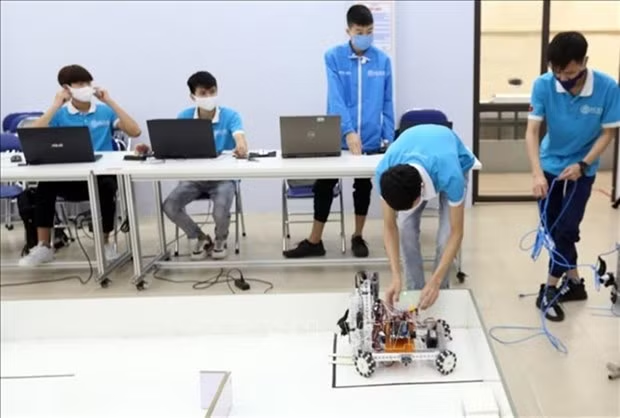
Students of Hanoi's Mechanical and Electric College in a robot control class. (Photo:VNA)

Students of Hanoi's Mechanical and Electric College in a robot control class. (Photo:VNA)

Vietnam’s labor market is in desperate need of high-qualified and skilled workers, experts have said.

The local labor market has long faced a paradox of many trained laborers being unable to find suitable jobs while businesses dealt with a labor shortage, as graduates often had to be retrained to be competent.

Vietnam is also one of the countries most heavily influenced by the Fourth Industrial Revolution (Industry 4.0), with many jobs set to become obsolete and many other new ones to appear.

Facing the trend of automation, Vietnamese workers must be trained to meet job requirements in this new situation.

According to Tran Tuan Anh, former vice director of Ho Chi Minh City’s Human Resource Forecast and Labour Market Information Center, businesses' demand for workers of all types would increase by 14.5 percent by 2025.

The demand for average-skilled jobs would generally rise at the fastest rate of about 28 percent while skilled workers would be at 13 percent, he told online newspaper baotintuc.vn.

The labor market in HCM City was always busy, he said.

“Only in the first quarter this year, businesses in HCM City still needed 65,430 employees although it was a time of difficulties for all economic sectors due to the impact of the COVID-19 pandemic,” he said.

In the second quarter, businesses would need about 47,000 workers in commerce, information technology, administration, health care, consulting service and customer care, he said.

The demand for trained laborers accounted for 81 percent of the total.

According to human resource experts, skilled and high-qualified human resources have not yet met labor market demand.

Many graduates were not well equipped with expertise, soft skills and foreign languages so they could not find jobs.

“In order to overcome the situation, training cooperation among education institutions and businesses should be enhanced to supply high-qualified human resource meeting businesses’ requirement as well as increase the prestige of educational institutions,” said Nguyen Hoan Hao, a lecture of HCM City’s Pedagogical University.

Businesses would decide how many qualified and capable employees they need every year while schools would be responsible for training students to the firms' requirements, said Hao.

Nguyen Hong Quang, vice president of C.T Group, said that close relations between schools and businesses via training courses and internship programs would help employers find suitable employees.

HCM City’s University of Economics has long had ties with businesses via workshops for evaluating students’ suitability for businesses’ needs, seminars on improving training courses, career festivals, and internship programs.

Since 2017, the percentage of newly-graduated students from the university who found jobs immediately after their studies has been 93.4 percent.

“After graduating, the students often looked for jobs from business recruitment ads, career fairs or job promotion centers,” said Dr Dinh Cong Khai, a lecturer of HCM City’s Economics University.

“Knowledge and skills are important requirements to recruiters,” said Khai.

“Lack of soft skills such as communication, time management and teamwork were reasons that made graduates fail to find jobs,” he said.

Cao Van Duong, an employee of KPMG Ltd Co Vietnam, said to meet the demands of the labor market, graduates must be strong in their expertise.

“Technology could change rapidly but basic knowledge of a professional is a solid foundation for employees to quickly grasp new knowledge in their working environment,” Duong said.

Additionally, recruiters now focused on soft skills such as communication skills, time management, teamwork, crisis management and personal life balance, he added.

VNA

Other News

Vietnam steps up implementation of ethnic affairs strategy through 2030

Vietnam steps up implementation of ethnic affairs strategy through 2030

To accelerate the implementation of the the Ethnic Affairs Strategy by 2030, with a vision toward 2045, the Prime Minister requested ministries, agencies and local authorities to continue thoroughly carrying out the Party and State’s policies on ethnic affairs, enhancing the effectiveness of State management and strengthening oversight of policy implementation.

Security preparations reviewed for APEC 2027 in Phu Quoc

Security preparations reviewed for APEC 2027 in Phu Quoc

The team examined the APEC 2027 Convention Centre, where main conference activities are scheduled; Sun Serenia Hospital, designated to provide healthcare and emergency medical services for delegates; provincial road DT.975, which connects Phu Quoc International Airport to the convention centre; and the area surrounding Phu Quoc International Airport.

Hanoi accelerates seven Red River bridge projects, many exceed 70% completion

Hanoi accelerates seven Red River bridge projects, many exceed 70% completion

According to the municipal Transport Construction Investment Project Management Board, the city is simultaneously implementing seven projects, namely Tu Lien, Ngoc Hoi, Tran Hung Dao, Thuong Cat, Van Phuc, Hong Ha and Me So bridges. Construction is being carried out on multiple fronts, focusing on bored piles, pile caps, piers and superstructure works.

Dien Bien battlefield legacy powers tourism revival

Dien Bien battlefield legacy powers tourism revival

Seventy-two years after the Dien Bien Phu Victory, its legacy still reverberates. The unity, self-reliance, and resilience forged in that historic triumph remain a powerful internal engine, now propelling Dien Bien toward fast and sustainable development.

Hanoi accelerates shift to green buses, targets 100% by 2030

Hanoi accelerates shift to green buses, targets 100% by 2030

In the 2027–2030 period, the city will accelerate the transition towards the complete phase-out of fossil fuel-powered buses. The share of electric and green energy-fueled buses is projected to reach 79–89% by 2029 and 100% by 2030.

36 fishermen safely rescued after boat breaks down near Truong Sa

36 fishermen safely rescued after boat breaks down near Truong Sa

At 8:00 the same day, KN475 began towing the disabled fishing boat toward Da Tay A island. The towing operation was carried out safely, and by 18:30 both the vessel and its crew had arrived at the island without incident, where repairs and additional support procedures were arranged.

Vietnamese language contest in Laos strengthens youth ties, bilateral friendship

Vietnamese language contest in Laos strengthens youth ties, bilateral friendship

Held in response to the launch of the Vietnamese Language Day among overseas Vietnamese communities, the event aimed to enhance the quality of Vietnamese language teaching and learning in Laos while contributing to the great friendship, special solidarity, comprehensive cooperation and strategic cohesion between the two countries.

Vietnamese language contest in Laos strengthens youth ties, bilateral friendship

Vietnamese language contest in Laos strengthens youth ties, bilateral friendship

Held in response to the launch of the Vietnamese Language Day among overseas Vietnamese communities, the event aimed to enhance the quality of Vietnamese language teaching and learning in Laos while contributing to the great friendship, special solidarity, comprehensive cooperation and strategic cohesion between the two countries.

Hanoi launches 10 electric bus routes from April 1

Hanoi launches 10 electric bus routes from April 1

By the end of April, the number of buses using electricity and other green energy sources in the city is expected to reach 822, including 683 electric buses and 139 compressed natural gas (CNG) buses, representing 42.1% of the total number of vehicles.