Compulsory social insurance required of foreign workers in VN starting from 2018

Social insurance authorities in Viet Nam are developing a compulsory social insurance scheme for foreign workers in the country, citing the need to follow international practices as the country deepens integration.


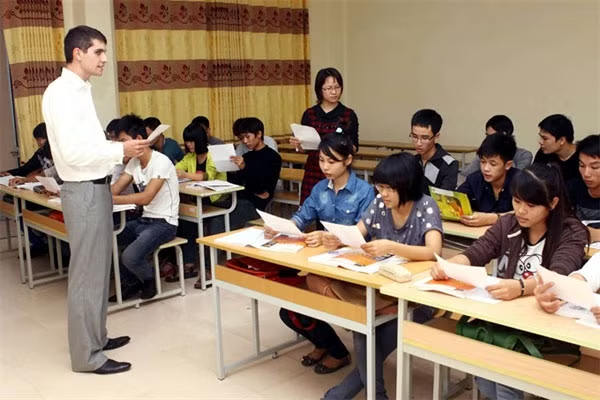
An Australian English teacher at Ha Noi Vocational College of High Technology
An Australian English teacher at Ha Noi Vocational College of High Technology 

Social insurance for foreign workers was made compulsory in the Social Insurance Law 2014, “both to protect the foreign workers’ rights in Viet Nam and to serve as a basis for bilateral and multilateral agreements in which workers’ rights, either Vietnamese or foreigners, are treated equally,” said Tran Dinh Lieu, deputy director of the Viet Nam Social Insurance (VSI) at a conference held earlier this week in Hai Phong to discuss a draft decree on the issue.

“However, the development of the decree is facing numerous issues, such as a consensus on the insurance premium and payout rates, a mutually accessible and synchronised database between countries, as well as currency conversion and tax issues,” he said.

Tran Hai Nam, deputy head of the Social Insurance Department under the Ministry of Labour, Invalids and Social Affairs (MoLISA), cited the increasing number of foreign workers in Viet Nam as justification for detailed legislation on obligatory social insurance.

According to Nam, the number of foreign workers in Viet Nam has jumped nearly sevenfold in more than a decade, from 12,600 in 2004 to the current figure of 84,000, most of whom are highly qualified and fully registered.

The 2014 Law on Social Insurance stipulates that employees who are foreign citizen working in Viet Nam with work permit or practice certificate/licence granted by a Vietnamese agency are entitled to compulsory social insurance.

Hiroshi Karashima, chairman of the Japan Business Association in Viet Nam, said a distinction must be made clear between foreign workers who are obliged to join the social insurance and those who can opt out. He also called for bilateral agreements on social insurance between Viet Nam and other countries so foreign workers won’t have to pay for social insurance in two countries.

According to many businesses, most labourers are on short-term employment or project-based contracts, so they would like to be able to opt for short-term coverage, like illness, maternity, and occupational accidents.

Labourers also want to know if they will receive insurance payouts quickly enough or in the currency of their choosing when their contract ends and they return home. Labourers also complained about the confusing terminology and language of the draft decree.

Pham Thanh Du, director of VSI’s Finance and Accounting Department, said the nature of social insurance for foreign workers would require social insurance staff to have a good command of foreign languages, IT knowledge, and familiarity with international practices, all of which would require State investment.

Former MoLISA Minister Pham Minh Huan said social insurance for foreign workers is a necessary move but would “not be easy to implement”, as it involves other countries’ laws. Bilateral agreements are a must, he said, otherwise, foreign workers would not be interested in the insurance, and the implementation would be met with resistance.

The mandatory social insurance decree for foreign workers in Viet Nam is expected to take effect from the beginning of next year, 2018.

Those subject to the decree include foreign workers with employment contracts longer than one month, or those who have obtained work permits from Vietnamese authorities. These workers are required to participate in all five social insurance regimes according to the Law on Social Insurance, which would include sickness, maternity/paternity, occupational accidents or occupational hazards, retirement, and death.

Foreign workers are also eligible for lump-sum payouts.

According to the draft decree, the monthly premium would be 8 per cent of the participant’s monthly salary.

Employers are to pay 18 per cent of their employees’ monthly salary, 3 per cent into sickness and maternity/paternity insurance, 14 per cent into the retirement and death insurance, and 1 per cent into the occupational accidents insurance. 

VNS

Other News

Vietnam steps up implementation of ethnic affairs strategy through 2030

Vietnam steps up implementation of ethnic affairs strategy through 2030

To accelerate the implementation of the the Ethnic Affairs Strategy by 2030, with a vision toward 2045, the Prime Minister requested ministries, agencies and local authorities to continue thoroughly carrying out the Party and State’s policies on ethnic affairs, enhancing the effectiveness of State management and strengthening oversight of policy implementation.

Security preparations reviewed for APEC 2027 in Phu Quoc

Security preparations reviewed for APEC 2027 in Phu Quoc

The team examined the APEC 2027 Convention Centre, where main conference activities are scheduled; Sun Serenia Hospital, designated to provide healthcare and emergency medical services for delegates; provincial road DT.975, which connects Phu Quoc International Airport to the convention centre; and the area surrounding Phu Quoc International Airport.

Hanoi accelerates seven Red River bridge projects, many exceed 70% completion

Hanoi accelerates seven Red River bridge projects, many exceed 70% completion

According to the municipal Transport Construction Investment Project Management Board, the city is simultaneously implementing seven projects, namely Tu Lien, Ngoc Hoi, Tran Hung Dao, Thuong Cat, Van Phuc, Hong Ha and Me So bridges. Construction is being carried out on multiple fronts, focusing on bored piles, pile caps, piers and superstructure works.

Dien Bien battlefield legacy powers tourism revival

Dien Bien battlefield legacy powers tourism revival

Seventy-two years after the Dien Bien Phu Victory, its legacy still reverberates. The unity, self-reliance, and resilience forged in that historic triumph remain a powerful internal engine, now propelling Dien Bien toward fast and sustainable development.

Hanoi accelerates shift to green buses, targets 100% by 2030

Hanoi accelerates shift to green buses, targets 100% by 2030

In the 2027–2030 period, the city will accelerate the transition towards the complete phase-out of fossil fuel-powered buses. The share of electric and green energy-fueled buses is projected to reach 79–89% by 2029 and 100% by 2030.

36 fishermen safely rescued after boat breaks down near Truong Sa

36 fishermen safely rescued after boat breaks down near Truong Sa

At 8:00 the same day, KN475 began towing the disabled fishing boat toward Da Tay A island. The towing operation was carried out safely, and by 18:30 both the vessel and its crew had arrived at the island without incident, where repairs and additional support procedures were arranged.

Vietnamese language contest in Laos strengthens youth ties, bilateral friendship

Vietnamese language contest in Laos strengthens youth ties, bilateral friendship

Held in response to the launch of the Vietnamese Language Day among overseas Vietnamese communities, the event aimed to enhance the quality of Vietnamese language teaching and learning in Laos while contributing to the great friendship, special solidarity, comprehensive cooperation and strategic cohesion between the two countries.

Vietnamese language contest in Laos strengthens youth ties, bilateral friendship

Vietnamese language contest in Laos strengthens youth ties, bilateral friendship

Held in response to the launch of the Vietnamese Language Day among overseas Vietnamese communities, the event aimed to enhance the quality of Vietnamese language teaching and learning in Laos while contributing to the great friendship, special solidarity, comprehensive cooperation and strategic cohesion between the two countries.

Hanoi launches 10 electric bus routes from April 1

Hanoi launches 10 electric bus routes from April 1

By the end of April, the number of buses using electricity and other green energy sources in the city is expected to reach 822, including 683 electric buses and 139 compressed natural gas (CNG) buses, representing 42.1% of the total number of vehicles.