Could Tiny, Stingless Bees Save the World’s Food Supplies?

Seeking to work around the alarming global decline of the traditional honey bee, new breeds and strains of the important insect, including a native Indian stingless bee, are being introduced in attempts to maintain world crop pollination.

As traditional honey bee populations around the world continue to drop, researchers with the Indian Council of Agriculture Research (ICAR), and at a honeybee research center at the Kerala Agricultural University (KAU), will collaborate with Australia's Western Sydney University to introduce the Kerala stingless honey bee (Tetragonula iridipennis) as an alternative pollinator.
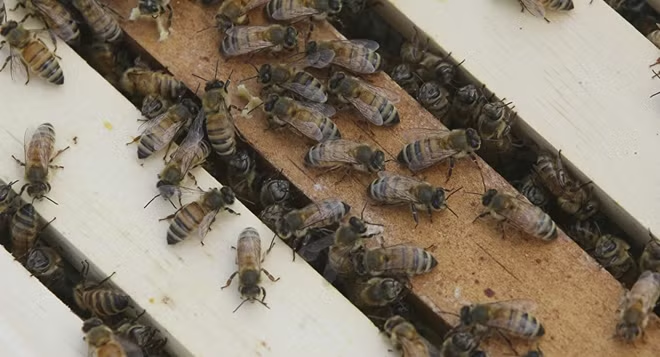
Found around the world, the stingless honey bee's Tetragonula variant, native to the southwest Indian state of Kerala, is smaller than the traditional honey bee (Apis genus) known to Westerners, and could be used as an alternative to dying traditional bee populations to pollinate crops in India and Australia.

The move comes not a moment too soon, as, according to prominent bee researcher and former KAU head S Devanesan, "The declining bee population could pose threat to global agriculture. [Colony collapse disorder] has wiped off a substantial chunk of honey bee colonies in Europe and America."

"The use of the neonicotinoid class of pesticides and effects of climate change are adversely impacting bees, which makes research on alternative pollinators relevant," he said.

According to the principal scientist at the All India Coordinated Research Project (AICRP) on honey bees and pollinators at KAU, K S Prameela, "Stingless bees have increased effectiveness as pollinators since they can enter smaller flowers. The main aim of the research here is to find out if stingless bees can be used for increased yield in fruits and vegetables in India and Australia," as reported by India Times.

The traditional honey bee, in spite of its tiny size, carries an outsize weight of responsibility, as the act of pollination carried out by the friendly little insect is responsible for an astonishing one-third of the entire food supply of Earth.

Colony collapse disorder (CCD) as a result of climate change and the widespread use of popular neonicotinoid pesticides — including products manufactured and sold by multinational agricultural giants Bayer, Syngenta and Sumitomo — have caused enormous numbers of the bees around the world to die, imperiling the world's food supply.

Currently the AICRP study has shown a 20 to 25 percent increase in cucumber and bitter gourd crop yields after stingless bees were introduced as pollinators in the region, according to KAU's Prameela.

Sputnik News

Other News

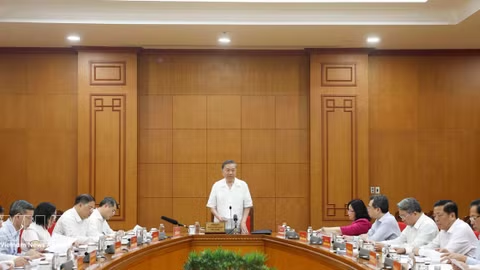
Vietnam steps up implementation of ethnic affairs strategy through 2030

Vietnam steps up implementation of ethnic affairs strategy through 2030

To accelerate the implementation of the the Ethnic Affairs Strategy by 2030, with a vision toward 2045, the Prime Minister requested ministries, agencies and local authorities to continue thoroughly carrying out the Party and State’s policies on ethnic affairs, enhancing the effectiveness of State management and strengthening oversight of policy implementation.

Security preparations reviewed for APEC 2027 in Phu Quoc

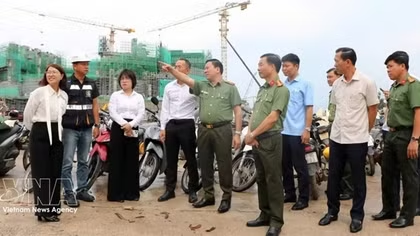
Security preparations reviewed for APEC 2027 in Phu Quoc

The team examined the APEC 2027 Convention Centre, where main conference activities are scheduled; Sun Serenia Hospital, designated to provide healthcare and emergency medical services for delegates; provincial road DT.975, which connects Phu Quoc International Airport to the convention centre; and the area surrounding Phu Quoc International Airport.

Hanoi accelerates seven Red River bridge projects, many exceed 70% completion

Hanoi accelerates seven Red River bridge projects, many exceed 70% completion

According to the municipal Transport Construction Investment Project Management Board, the city is simultaneously implementing seven projects, namely Tu Lien, Ngoc Hoi, Tran Hung Dao, Thuong Cat, Van Phuc, Hong Ha and Me So bridges. Construction is being carried out on multiple fronts, focusing on bored piles, pile caps, piers and superstructure works.

Dien Bien battlefield legacy powers tourism revival

Dien Bien battlefield legacy powers tourism revival

Seventy-two years after the Dien Bien Phu Victory, its legacy still reverberates. The unity, self-reliance, and resilience forged in that historic triumph remain a powerful internal engine, now propelling Dien Bien toward fast and sustainable development.

Hanoi accelerates shift to green buses, targets 100% by 2030

Hanoi accelerates shift to green buses, targets 100% by 2030

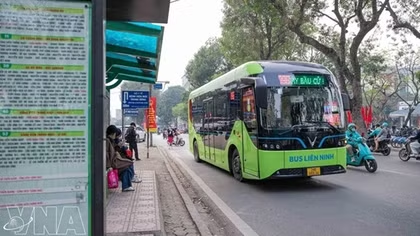
In the 2027–2030 period, the city will accelerate the transition towards the complete phase-out of fossil fuel-powered buses. The share of electric and green energy-fueled buses is projected to reach 79–89% by 2029 and 100% by 2030.

36 fishermen safely rescued after boat breaks down near Truong Sa

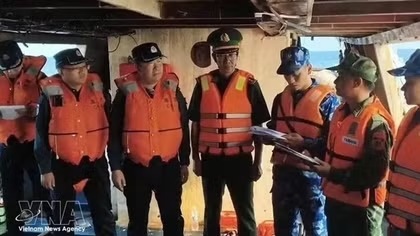
36 fishermen safely rescued after boat breaks down near Truong Sa

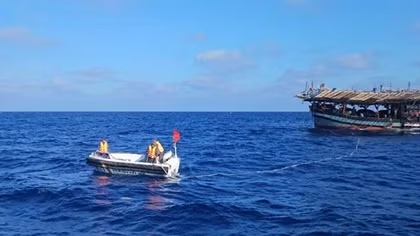
At 8:00 the same day, KN475 began towing the disabled fishing boat toward Da Tay A island. The towing operation was carried out safely, and by 18:30 both the vessel and its crew had arrived at the island without incident, where repairs and additional support procedures were arranged.

Vietnamese language contest in Laos strengthens youth ties, bilateral friendship

Vietnamese language contest in Laos strengthens youth ties, bilateral friendship

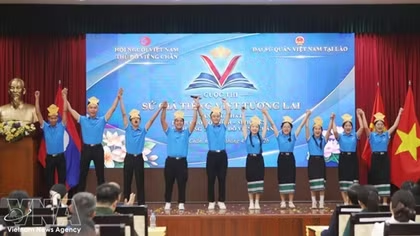
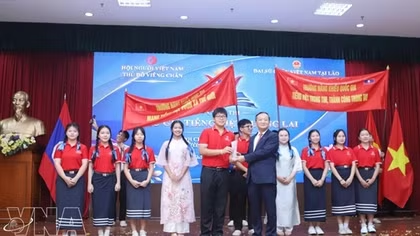
Held in response to the launch of the Vietnamese Language Day among overseas Vietnamese communities, the event aimed to enhance the quality of Vietnamese language teaching and learning in Laos while contributing to the great friendship, special solidarity, comprehensive cooperation and strategic cohesion between the two countries.

Vietnamese language contest in Laos strengthens youth ties, bilateral friendship

Vietnamese language contest in Laos strengthens youth ties, bilateral friendship

Held in response to the launch of the Vietnamese Language Day among overseas Vietnamese communities, the event aimed to enhance the quality of Vietnamese language teaching and learning in Laos while contributing to the great friendship, special solidarity, comprehensive cooperation and strategic cohesion between the two countries.

Hanoi launches 10 electric bus routes from April 1

Hanoi launches 10 electric bus routes from April 1

By the end of April, the number of buses using electricity and other green energy sources in the city is expected to reach 822, including 683 electric buses and 139 compressed natural gas (CNG) buses, representing 42.1% of the total number of vehicles.