COVID-19: The truth is always the strongest argument

International experts and media have been trying to explain Vietnam’s extraordinary success in fighting the COVID-19 pandemic.
covid-19: the truth is always the strongest argument hinh 0

Vietnam has gone more than 70 days with no new community transmissions, almost all of its COVID-19 patients have recovered, and there has not been a single COVID-19 death in Vietnam. The truth refutes those who try to deny Vietnam’s achievements. 

Most international media use phrases like “amazing Vietnam” and “role model” to describe Vietnam's successful battle against COVID-19, but there are a few who want to deny Vietnam’s undeniable achievements.

A tweet posted by Professor Steve Hanke of John Hopkins University on June 10 named Vietnam among a list of countries that "do not report COVID-19 data”, rejecting the statistics reported by worldometers.info.

Former BBC reporter Bill Hayton criticized Vietnam’s epidemic measures as a restriction of human rights.

The facts  

The opinions of the American professor and the BBC reporter are at odds with those of international organizations who have direct access to information in Vietnam.

covid-19: the truth is always the strongest argument hinh 1
The WHO and  CDC praise Vietnam's transparency in handling the COVID-19 pandemic. (Photo: WHO/VNA)  

Making public up-to-date information about the COVID-19 pandemic was one of the factors in Vietnam’s success. The World Health Organization and the US Centers for Disease Control and Prevention (CDC) say Vietnam has been transparent in its handling of the pandemic. CDC Director in Southeast Asia John MacArthur affirms there is no evidence that the numbers reported by Vietnam are not accurate. He said transparency and political determination are what made Vietnam a role model in fighting the disease.

The website Eastasiaforum.org said Vietnam has kept the public informed through TV news and text messages sent to mobile phones.

Germany’s Der Spiegel said the Vietnamese Health Ministry has sent daily messages to all mobile phone subscribers and used public loudspeakers to keep people informed about preventive measures to protect themselves.

David Hutt, a Southeast Asia columnist with The Diplomat, said the Vietnamese Party and State have been open in sharing up-to-date COVID-19 information, have acted responsibly, and have made public health their top priority.

The government’s quick, firm actions to control the epidemic and threat infected individuals have made people feel that they are protected and no one will be left behind. A global survey in May by Singapore’s Blackbox Research found that 94% of respondents said transparent information about the pandemic increased their trust in the government.

Undeniable success

Mark Ashwill, an educator who has lived in Vietnam for 15 years, called Bill Hayton’s criticism of Vietnam’s preventive measures a distortion by someone who knows nothing about Vietnam in 2020. Ashwill said that before discussing Vietnam’s epidemic prevention policy, Bill Hayton should have read an article in The Diplomat, which attributed Vietnam’s successful control of COVID-19 to its social cohesiveness and ability to mobilize resources quickly.

The Nation said Vietnam achieved the most effective response to COVID-19 through rapid mobilization of its health care system, public employees, and security forces, combined with an effective and creative public education campaign. 

Eastasiaforum.org said the military and the police inspired public cooperation by empathizing with them in the fight against the pandemic.

These assessments were borne out by statistics from daliaresearch.com in Berlin which showed that Vietnam has the highest percentage of people who say they believe in their government’s epidemic prevention policy.

A survey by YouGov, a British  market research and data analytics firm, showed that Vietnam has had the best public response to the epidemic and that 95% of its citizens are happy with the government’s public health policies.

Facts and figures posted by widely-respected media outlets refute the few skeptical or unfriendly denials of Vietnam’s successful fight against the COVID-19 epidemic

VOVWorld

Other News

Vietnam steps up implementation of ethnic affairs strategy through 2030

Vietnam steps up implementation of ethnic affairs strategy through 2030

To accelerate the implementation of the the Ethnic Affairs Strategy by 2030, with a vision toward 2045, the Prime Minister requested ministries, agencies and local authorities to continue thoroughly carrying out the Party and State’s policies on ethnic affairs, enhancing the effectiveness of State management and strengthening oversight of policy implementation.

Security preparations reviewed for APEC 2027 in Phu Quoc

Security preparations reviewed for APEC 2027 in Phu Quoc

The team examined the APEC 2027 Convention Centre, where main conference activities are scheduled; Sun Serenia Hospital, designated to provide healthcare and emergency medical services for delegates; provincial road DT.975, which connects Phu Quoc International Airport to the convention centre; and the area surrounding Phu Quoc International Airport.

Hanoi accelerates seven Red River bridge projects, many exceed 70% completion

Hanoi accelerates seven Red River bridge projects, many exceed 70% completion

According to the municipal Transport Construction Investment Project Management Board, the city is simultaneously implementing seven projects, namely Tu Lien, Ngoc Hoi, Tran Hung Dao, Thuong Cat, Van Phuc, Hong Ha and Me So bridges. Construction is being carried out on multiple fronts, focusing on bored piles, pile caps, piers and superstructure works.

Dien Bien battlefield legacy powers tourism revival

Dien Bien battlefield legacy powers tourism revival

Seventy-two years after the Dien Bien Phu Victory, its legacy still reverberates. The unity, self-reliance, and resilience forged in that historic triumph remain a powerful internal engine, now propelling Dien Bien toward fast and sustainable development.

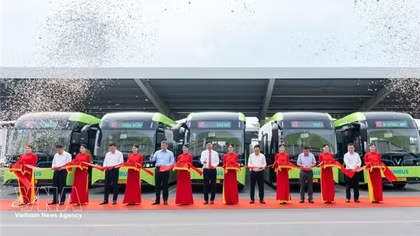
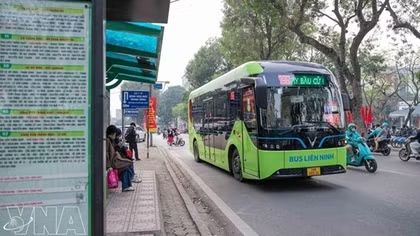
Hanoi accelerates shift to green buses, targets 100% by 2030

Hanoi accelerates shift to green buses, targets 100% by 2030

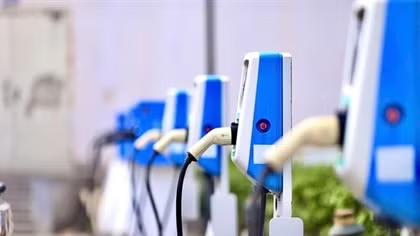
In the 2027–2030 period, the city will accelerate the transition towards the complete phase-out of fossil fuel-powered buses. The share of electric and green energy-fueled buses is projected to reach 79–89% by 2029 and 100% by 2030.

36 fishermen safely rescued after boat breaks down near Truong Sa

36 fishermen safely rescued after boat breaks down near Truong Sa

At 8:00 the same day, KN475 began towing the disabled fishing boat toward Da Tay A island. The towing operation was carried out safely, and by 18:30 both the vessel and its crew had arrived at the island without incident, where repairs and additional support procedures were arranged.

Vietnamese language contest in Laos strengthens youth ties, bilateral friendship

Vietnamese language contest in Laos strengthens youth ties, bilateral friendship

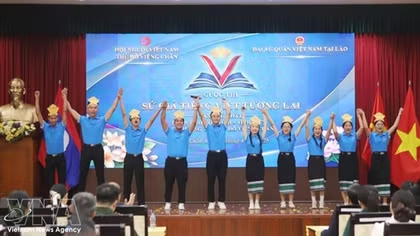
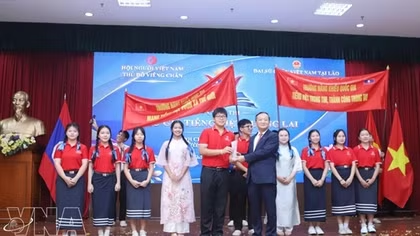
Held in response to the launch of the Vietnamese Language Day among overseas Vietnamese communities, the event aimed to enhance the quality of Vietnamese language teaching and learning in Laos while contributing to the great friendship, special solidarity, comprehensive cooperation and strategic cohesion between the two countries.

Vietnamese language contest in Laos strengthens youth ties, bilateral friendship

Vietnamese language contest in Laos strengthens youth ties, bilateral friendship

Held in response to the launch of the Vietnamese Language Day among overseas Vietnamese communities, the event aimed to enhance the quality of Vietnamese language teaching and learning in Laos while contributing to the great friendship, special solidarity, comprehensive cooperation and strategic cohesion between the two countries.

Hanoi launches 10 electric bus routes from April 1

Hanoi launches 10 electric bus routes from April 1

By the end of April, the number of buses using electricity and other green energy sources in the city is expected to reach 822, including 683 electric buses and 139 compressed natural gas (CNG) buses, representing 42.1% of the total number of vehicles.