Ethnic village turns into civilized community

An ethnic-minority village in the Central Highlands province of Lam Dong has become well-known for its title “village with 3-nos” (no drinking, no smoking and no social evils) thanks to a concerted communal effort that commenced over a dozen years ago.
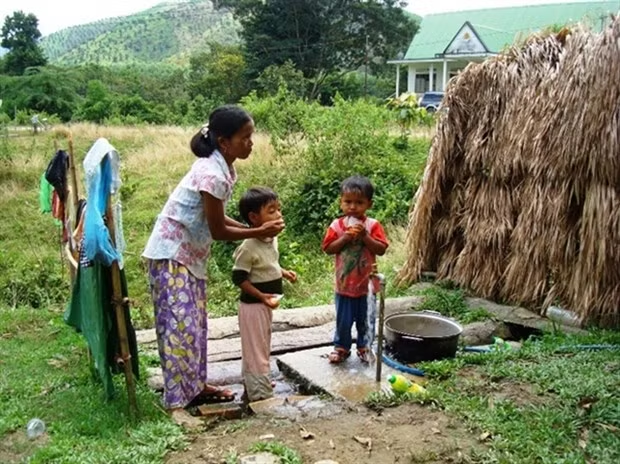
Villagers in Dam Rong district’s Ro Men commune can now access clean water. Life in the Mong ethnic minority village in the Central Highlands province of Lam Dong has changed a lot thanks to a concerted communal effort that commenced over a dozen years ago. (Photo: tintaynguyen.com)

Villagers in Dam Rong district’s Ro Men commune can now access clean water. Life in the Mong ethnic minority village in the Central Highlands province of Lam Dong has changed a lot thanks to a concerted communal effort that commenced over a dozen years ago. (Photo: tintaynguyen.com)

An ethnic-minority village in the Central Highlands province of Lam Dong has become well-known for its title “village with 3-nos” (no drinking, no smoking and no social evils) thanks to a concerted communal effort that commenced over a dozen years ago.

The village, home to 789 people of the Mong ethnic group, is in Dam Rong district’s Ro Men commune.

While drunkenness, smoking and social evils are rife in the countryside, the village has set a bright example of civilised society by stopping the sale of alcohol and tobacco. This has helped eliminate scenes of drunken men and gambling.

Sung A Sang, 40, head of the village, said every Mong person who wanted to settle there had to strictly follow the State’s laws and commit to not drinking or smoking, while avoiding social evils.

This has achieved security and order, and no one leaves their houses after 9pm anymore.

When a stranger comes to visit, they must inform the head of the village even if they are only staying for one night so the police can carry out the necessary procedures for them. If they don't, the family they are visiting must take responsibility in case any regulations are broken.

“During the Tet (Lunar New Year) holiday, local residents participate in games such as nem con (throwing a ball through a ring for good luck) and badminton. There’s a lot of fun. However, people never drink wine or smoke cigarettes. They only consume soft drinks,” Sang told Nong Thon Ngay Nay (Countryside Today) newspaper.

Giang Seo Pao, 55, a local resident, agreed.

“Everyone in the village gave up drinking and smoking because we are aware of its harmful effects,” he said.

Everybody knew that tobacco was harmful because it affected both smokers and their families in the long run, Pao said.

“It is easy for men to get drunk, but that can lead to domestic violence. That's why people decided to give up all these bad habits."

Pao said he was from the northern mountainous province of Ha Giang where there are only terraced fields and it was difficult for local residents to develop a well-rounded economy. Like many other people, they volunteered to go to areas like Lam Dong, Dak Lak and Dak Nong provinces to settle down with the hopes of a better future.

To start with back in 2004, they faced a lot of difficulties.

“We had to borrow rice seeds from residents in Da Tong, another commune in Dam Rong district, and dig dong (arrowroot) bulbs in the forest. We couldn't make ends meet,” he recalled.

With hard work, a passion for learning and support from the Party and Government, the living standards have gradually improved.

The district authorities have poured resources into building infrastructure and implemented social security polices for poor people to help them escape poverty.

They have also promoted restructuring crops and livestock, taking advantage of the region’s potential to boost sustainable socio-economic development.

Local authorities have strived to achieve the target of between 1,000-1,500 new jobs created each year, and the percentage of people who have access to clean water at 93 percent.

As Pao said: “My family now has 1 hectare for coffee cultivation. I will plant durian and avocado trees on that land to boost my income.”  

What’s more important is that villagers have access to clean water thanks to a facility which was put into operation in 2015.

In the past, they had to travel dozens of kilometers to take water from local streams.

The improvements have led to a change in awareness among the community.

Knowing that the Government had invested in building infrastructure for the commune, some people donated land for the construction of a 1,500 sq.m community house, Sang said.

Local residents have also contributed land for concrete roads built with Government funding. As a result, they don’t have to walk on dirt paths when it rains.

Their efforts have been paid off as Ro Men commune has been recognised as meeting the nation's new rural standards thanks to the contributions of the Mong community.

VNA

Other News

Vietnamese culture connects generations in Canada

Vietnamese culture connects generations in Canada

Beyond language skills, children learn about Vietnamese history, stories of filial devotion and national heroes, and the importance of respecting parents and teachers. Weekend classes begin with the national anthem, while festivals and traditional holidays offer opportunities to make greeting cards, prepare traditional cakes and learn to wrap 'banh chung' (square sticky rice cakes).

Vietnam Studies Centre opens in northeastern Thailand

Vietnam Studies Centre opens in northeastern Thailand

The centre would serve as a valuable academic hub for teaching and promoting Vietnamese language, culture and history, while fostering people-to-people exchanges and connecting younger generations of the two countries.

950 years of Quoc Tu Giam: A milestone in Vietnam's educational and cultural history

950 years of Quoc Tu Giam: A milestone in Vietnam's educational and cultural history

Russia’s senior researcher in Oriental studies Dr. Anatoly Sokolov said that although founded nearly a millennium ago, Quoc Tu Giam remains far more than a historical monument. It has continued to pass on the tradition of learning to successive generations and remained an integral part of Vietnam’s cultural and educational life.

Vietnam plans to go green by expanding ASEAN eco-schools model

Vietnam plans to go green by expanding ASEAN eco-schools model

At the launch ceremony, Deputy Minister of Agriculture and Environment Le Trong Yen said schools play an important role in shaping young people's knowledge, character, and habits. Daily practices such as saving electricity and water, sorting waste and caring for trees could help students understand the value of natural resources and their responsibility towards the environment, while spreading positive habits to families and communities.

Young generation helps strengthen Vietnam–RoK friendship

Young generation helps strengthen Vietnam–RoK friendship

Through the seminar and bilingual contest, VESAMO aimed to provide a platform for young people to share knowledge, pursue their aspirations and contribute to closer friendship and comprehensive cooperation between the two nations.

Vietnamese community in Japan is encouraged to further contribute to national development

Vietnamese community in Japan is encouraged to further contribute to national development

Welcoming the Vietnamese community's efforts and contributions, the General Secretary and President affirmed that the Party and State will continue improving institutions and policies to create favorable conditions for overseas Vietnamese to engage more deeply in the country's socio-economic development and play a proactive role as partners and co-creators in nation-building.

Ho Chi Minh City pushes English as a second language in schools

Ho Chi Minh City pushes English as a second language in schools

In 2027-2028, Ho Chi Minh City targets 20-30% of managers, teachers and staff in English proficiency training, 30% of establishments providing training in English/STEM/STEAM teaching methods, at least 30% of educational establishments with a complete English-speaking environment, and at least 15% of educational establishments teaching subjects in English.

Empowering people with disabilities to be immune to online scams

Empowering people with disabilities to be immune to online scams

Notably, it has organized online scam prevention training courses for more than 1,000 young people with disabilities. In coordination with the Hanoi Police, it has also run awareness campaigns and guided members on identifying fraudulent schemes, protecting their accounts and personal data, and verifying information before sharing it on social media.

New plan aims to empower people with disabilities, promote social inclusion

New plan aims to empower people with disabilities, promote social inclusion

By 2030, Vietnam aims to ensure social security and improve the quality of life of people with disabilities, with priority given to those facing hardship or unable to support themselves. It also aims to ensure their appropriate participation in elected bodies and enable them to benefit from the country's development achievements.

Vietnam advances towards high-quality, specialised healthcare

Vietnam advances towards high-quality, specialised healthcare

Recent developments in Hanoi and other localities highlight efforts to develop specialised treatment, standardise professional practices and apply artificial intelligence (AI) and advanced medical techniques, towards a more modern healthcare system.

Vietnam, US step up technology cooperation in search for war martyrs' remains

Vietnam, US step up technology cooperation in search for war martyrs' remains

Addressing a dialogue on war legacies in Southeast Asia organised by the Stimson Centre in Washington, D.C on October 21, Vietnamese Ambassador to the US Nguyen Quoc Dung briefed representatives of US government agencies, non-governmental organisations and experts on Vietnam’s efforts to address war consequences, while calling for international support and cooperation in urgent humanitarian work.