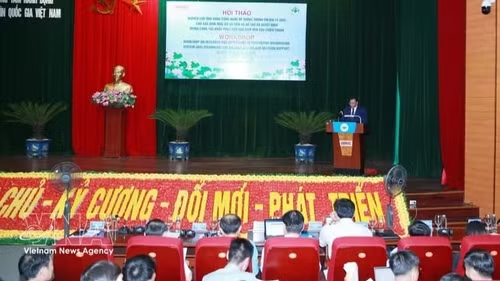
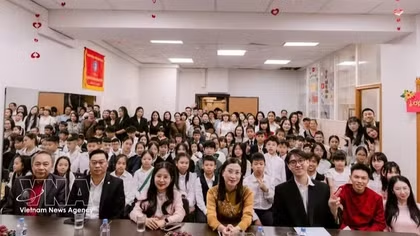
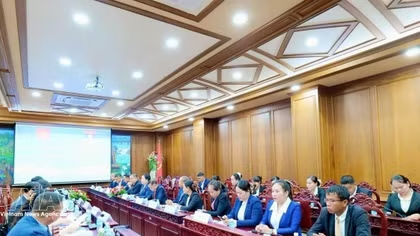
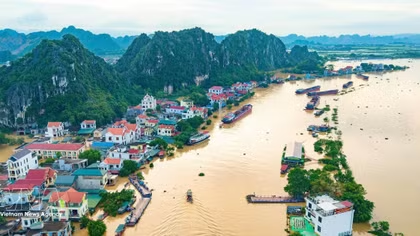
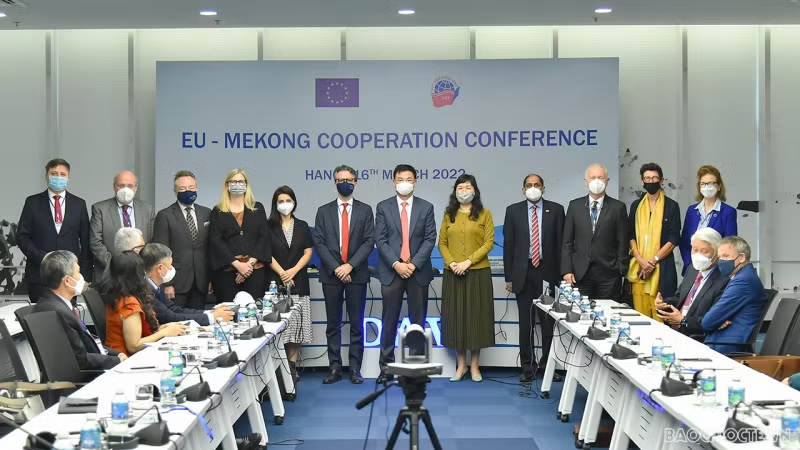
Held in Vietnam for the first time, the conference recognized many practical contributions of international diplomats and scholars on the challenges and potentials of the Mekong sub-region, towards sustainable development and strong integration of this region in the future. .
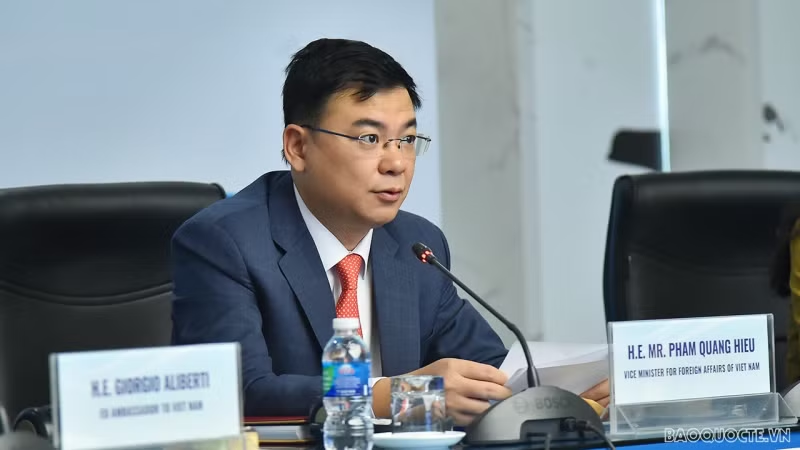
Addressing the event, Deputy Minister of Foreign Affairs Pham Quang Hieu reiterated that Vietnam welcomes the participation of development partners, including the EU, in the sustainable development of the Mekong subregion, expressing a hope for more effective collaboration and coordination in the coming time.
In a keynote address from EU headquarters in Brussels, Mr. Gunnar Wiegand, Managing Director for Asia-Pacific at the European External Action Service, said: “The EU would like to strengthen our involvement with the Mekong sub-region, and this conference can provide useful inputs for our further reflection. We will continue to promote public and private green investments in the Mekong sub-region and support a sustainable and just development and post-COVID-19 recovery of the region”.
In the meantime, EU Ambassador to Vietnam Mr. Giorgio Aliberti said: “Many global challenges come together in the Mekong, making it an interesting place for developing solutions in the field of climate action, water security, clean energy, agriculture, transport and infrastructure, among others, all areas where the EU has something to offer to our regional partners in line with the our Indo-Pacific Strategy and our more recently launched Global Gateway initiative for sustainable infrastructure development and connectivity”.
Discussions at the forum underscored contributions of the EU and member countries to the Mekong subregion’s sustainable development over the recent past. Countries in the Mekong River basin are advised to regulate development models towards inclusive and green growth while partners need to offer practical support for strengthening water management mechanisms in the region.
Last September the European Union published its Strategy for cooperation in the Indo-Pacific, the template for its future engagement with what is an increasingly important part of the world for the EU. It represents the future, where the world’s centre of gravity is moving, both in geo-economic and geo-political terms. And in this region, the countries through which the Mekong river flows, themselves, make up a very important sub-region, where both challenges and opportunities abound and which deserves even greater focus and engagement from the EU.
The EU and its member states have for many years been one of the major partners and supporters of the Mekong River Commission. As the only treaty based organisation, the EU sees the MRC as a driver for regional cooperation and integration. The EU is currently supporting the MRC through a five million euro grant, which runs until the end of this year. The overall objective is the integrated and sustainable management of natural resources in the Lower Mekong, contributing to sustainable development.
The EU is also a major donor to the individual countries of the region and has just adopted new seven-year development cooperation programmes with Cambodia, Laos, Thailand and Vietnam. The Mekong region also benefits from several EU-funded regional programmes focused on socio-economic development, connectivity, water and sanitation, migration, biodiversity, forest governance and wildlife trafficking, climate-smart agriculture and support to civil society organisations and indigenous people.