Facebook to be fined $5bn for Cambridge Analytica privacy violations

The Federal Trade Commission has reportedly voted to approve fining Facebook roughly $5bn to settle an investigation into the company’s privacy violations that was launched following the Cambridge Analytica revelations.

The Wall Street Journal and the Washington Post, both citing anonymous sources familiar with the matter, reported Friday afternoon that the settlement was approved by a 3-2 vote that broke along party lines, with Republicans in favor and Democrats opposed. The justice department is expected make a final approval of the fine.

Facebook and the FTC declined to comment.

The FTC’s investigation was launched in March 2018 after the Observer revealed that the political consultancy Cambridge Analytica had improperly obtained the private information of more than 50m Facebook users. Facebook had agreed under a 2012 consent decree stemming from a previous FTC investigation into privacy concerns to better protect user privacy. The investigation centered on whether this decree had been violated.
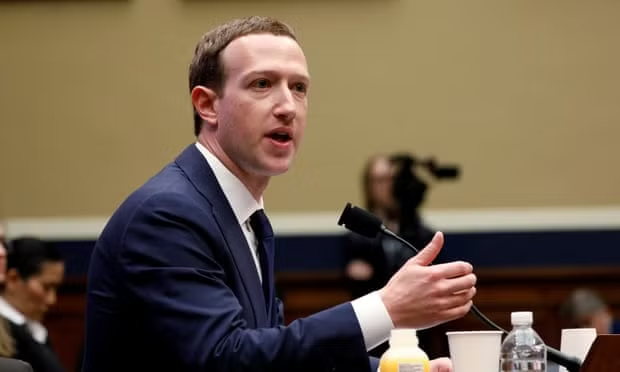
The fine will hardly make a dent in Facebook’s bank account; the company had more than $15bn in revenue in the first three months of 2019. Photograph: Aaron Bernstein/Reuters
 The fine will hardly make a dent in Facebook’s bank account; the company had more than $15bn in revenue in the first three months of 2019. Photograph: Aaron Bernstein/Reuters

The $5bn fine would be the largest ever levied by the FTC against a technology company, and the largest ever against any company for a privacy violation. It is at the upper limit of what Facebook said that it was expecting when it disclosed in April 2019 that it was nearing the end of negotiations with the FTC and expected a fine of between $3bn and $5bn.

As part of the agreement, Facebook will now reexamine the ways it handles user data, but the settlement will not restrict the company’s ability to share data with third parties, reports said.

Critics say the changes required of Facebook are not substantial enough, and the fine will hardly make a dent in Facebook’s bank account. The company had more than $15bn in revenue in the first three months of 2019.

“This isn’t a fine, it’s a favor to Facebook, a parking ticket which will clear them to conduct more illegal and invasive surveillance,” said Matt Stoller, a fellow at the Open Markets Institute who specializes in monopoly power. “Congress should start defunding the FTC and move the money to state enforcers like Karl Racine who believe in enforcing the law,” he added, referring to the attorney general of Washington DC, who is currently pursuing a lawsuit against Facebook over the Cambridge Analytica case.

Investors appeared to agree, and Facebook’s stock price jumped more than 1% when the news broke just before trading closed for the weekend.

David Cicilline, the Democratic congressman who chairs the House subcommittee on antitrust issues, reacted to the news on Twitter, saying: “The FTC just gave Facebook a Christmas present five months early. It’s very disappointing that such an enormously powerful company that engaged in such serious misconduct is getting a slap on the wrist.”

Cicilline will have an opportunity to express his concerns directly to a Facebook executive on Tuesday, when representatives of major Silicon Valley tech companies are set to testify at a hearing of the antitrust subcommittee. The hearing and fine come as Facebook faces increased scrutiny over antitrust concerns and its privacy practices. Senator Ron Wyden of Oregon said the fine shows Facebook’s size makes it difficult to hold accountable.

“This reported fine is a mosquito bite to a corporation the size of Facebook,” he said. “And I fear it will let Facebook off the hook for more recent abuses of Americans’ data that may not have been factored in to this inadequate settlement. The only way to assure Americans that our private data will be protected is to pass a strong privacy bill, like the one I plan to introduce in the coming weeks.”

The company is expected to come up against more regulatory challenges as it seeks to launch its new cryptocurrency Libra in 2020. On Thursday, Donald Trump tweeted Libra “will have little standing or dependability”. The House financial services committee is holding a panel on 17 July on Facebook’s plans for Libra.

Lawmakers say the ruling and relatively small fine show federal privacy laws are needed.

“Given Facebook’s repeated privacy violations, it is clear that fundamental structural reforms are required,” Senator Mark R Warner of Virginia said. “With the FTC either unable or unwilling to put in place reasonable guardrails to ensure that user privacy and data are protected, it’s time for Congress to act.


The Guardian

Other News

Hanoi approves controlled pilot of two technology projects

Hanoi approves controlled pilot of two technology projects

The two projects involve an intelligent autonomous transportation system developed by Phenikaa-X JSC and a technology for producing mixed rare-earth oxides with a purity of over 95% on a semi-industrial scale developed by the Mining Technology and Construction Consultancy JSC.

Banking industry in AI era: When data becomes competitive advantage

Banking industry in AI era: When data becomes competitive advantage

In just a few years, AI has evolved from an experimental technology into an “assistant” for many banks, supporting everything from customer service, credit approval, and fraud detection to risk management. However, as the technological gap between institutions narrows, a new question is emerging: What will determine banks' competitive advantage in the AI era?

Bac Ninh considers establishing AI centre of excellence

Bac Ninh considers establishing AI centre of excellence

A meeting has been held in Bac Ninh to discuss potential cooperation with Plug and Play in developing the northern province’s innovation ecosystem and establishing an artificial intelligence (AI) centre of excellence, with Standing Vice Chairman of the provincial People’s Committee Mai Son receiving a delegation from the global innovation platform.

Hanoi allows 24-month trial of autonomous vehicles at Hoa Lac

Hanoi allows 24-month trial of autonomous vehicles at Hoa Lac

The project aims to assess the safety, reliability and readiness of autonomous vehicles under real traffic conditions, as well as the effectiveness of autonomous public transport and compatibility with existing systems. Its results will contribute to developing technical standards, operating procedures and management models suited to Hanoi’s traffic conditions.

Singapore's experience suggests solutions to Vietnam's human resources challenge in AI era

Singapore's experience suggests solutions to Vietnam's human resources challenge in AI era

As Vietnam accelerates digital transformation and high-tech development, Singapore’s experience and the engagement of global technology companies demonstrate that human resources preparation must stay ahead of the curve. The ability to filter knowledge, collaborate, innovate and effectively use AI will increasingly become essential to helping workers adapt to a changing labour market and strengthening the competitiveness of Vietnam’s economy in the new era.

Protecting national security amid digital transformation, cyberspace

Protecting national security amid digital transformation, cyberspace

Cybersecurity, information security and data security risks must be identified and addressed early and from afar, with appropriate defensive measures ready to neutralise threats and protect national interests in cyberspace, said Lieutenant General Le Xuan Minh, Director of the Ministry of Public Security’s Department of Cybersecurity and Hi-tech Crime Prevention (A05).

Mekong Delta launches first robotics, AI research institute

Mekong Delta launches first robotics, AI research institute

Dr. Nguyen Van Quang, Rector of Nam Can Tho University, said the university is developing a value chain covering training, research, technology development, testing, technology transfer and commercialisation. The model is designed to link research more closely with practical needs, ensuring that technologies generate products and products create value for society.

Vietnam positioned to harness AI wave, World Bank report says

Vietnam positioned to harness AI wave, World Bank report says

The WB report identifies Vietnam as one of the few economies outside the European Union (EU) to have adopted a comprehensive AI regulatory framework as early as 2025. Vietnam applies a risk-tiered approach similar to that of the EU AI Act, imposing different obligations depending on whether an AI system poses “unacceptable,” “high,” “low” or “minimal” risks. The approach is viewed as a strategic step towards ensuring safe and transparent AI governance.

AI offers both opportunities, challenges for Vietnam's growth

AI offers both opportunities, challenges for Vietnam's growth

Dr. Ho Duc Thang, a full-time member of the National Assembly’s Committee for Cultural and Educational, said productivity is the key to sustaining double-digit economic growth, and AI has greater potential to improve productivity than any previous technology.

Top leader unveils people-centred vision for new development model

Top leader unveils people-centred vision for new development model

Vietnam's growth model, long fueled by low-cost labour, resource extraction, contract manufacturing, expanded investment, and capital accumulation, has run out of road. The country now needs a sweeping reform agenda to shift from extensive growth to a model driven by productivity, knowledge, science and technology, innovation, and digital transformation.