Furniture and forest exports face cloudy future

The furniture and forest segment of the Vietnam economy has experienced solid growth over the past few years and brighter days lie ahead, says the Vietnam Timber and Forest Product Association.
In 2015, exports jumped by 10.7% to US$6.9 billion, Nguyen Ton Quyen, chair of the association, told a recent conference, adding that he optimistically expects the segment to see annual growth of 15-20% over the next few years. 

Mr Quyen said that new free trade pacts such as the Vietnam-EU Free Trade Agreement and the Trans pacific Partnership (TPP) will help boost overseas consignments by slashing tariffs.

However, he failed to support his rather overly sanguine predictions with any hard facts or well-grounded logical reasoning, say many industry analysts.

As it currently stands, most analysts are in general agreement that the growth of the furniture industry in Vietnam is severely limited by the scarcity of raw materials, which must be imported from other countries, principally China.

As long as the industry continues to be dependent on Chinese raw materials, then neither exports to the EU or the US under either of the aforementioned trade pacts would qualify for the reduced tariffs Mr Quyen referred to.

Nor did he address the fact that with both current US presidential nominees opposed to the trade deal, ratification of the TPP appears highly unlikely at this time.  Clearly there are no realistic prospects for passage or implementation any time soon.

Lastly, even in markets where import tariffs are low or non-existent, non-tariff barriers (NTBs) can be a major impediment to trade and Mr Quyen failed to address how the segment plans to address these issues.
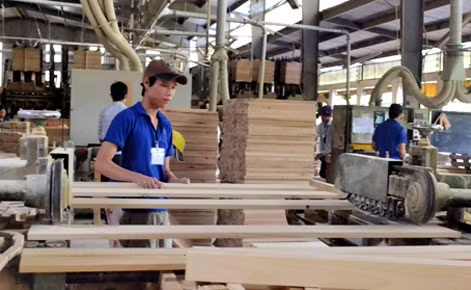
Furniture production

This is especially true as it relates to Vietnam exports of furniture and forest products to the EU, say analysts, which will undoubtedly face significant NTBs following implementation of the Vietnam-EU free trade pact.

Many of these barriers can easily be readily identified, but it is a great deal more difficult to calculate their precise impact on export returns and what their removal might mean for the furniture and forest industry.

NTBs are defined as government measures, other than tariffs, that distort international trade. Typically, they either protect domestically produced products from the full weight of foreign competition or artificially stimulate exports of those products.

They may include quantitative restrictions, administrative procedures, phytosanitary and technical regulations and standards, price control measures, subsidies, forest management certification and product labelling, and illegal activities.

According to the World Trade Organisation the number of reported NTBs has been steadily growing worldwide.

For the first nine months of 2016, Vietnam exports of furniture and forest products have stayed consistent with the prior year pace having reached US$4.9 billion, roughly the same figure as exports for the same corresponding nine-month period in 2015.

As it stands, the country is now the fourth largest wooden furniture and forest product exporter around the globe, trailing China, Germany and Italy in descending order of magnitude from first to third biggest.


VOV

Other News

Hanoi ready to implement Capital Law 2026, unlocking new development momentum

Hanoi ready to implement Capital Law 2026, unlocking new development momentum

The effectiveness of the Capital Law 2026 will be measured not by the number of legal documents issued but by tangible improvements in governance and public administration, better services for people and businesses, faster administrative procedures, stronger investment attraction and higher economic growth.

Vietnamese students earn honours at ROBOG Asia Cup 2026

Vietnamese students earn honours at ROBOG Asia Cup 2026

Three teams from Chu Van An Secondary School in Vietnam’s Thai Nguyen province have earned First Prize honours and advanced to the quarterfinals at the ROBOG Asia Cup 2026, a regional robotics and artificial intelligence (AI) competition for students held in Hong Kong, China.

Hanoi sets out new investment blueprint with century-long development vision

Hanoi sets out new investment blueprint with century-long development vision

As of early June, Hanoi had attracted 74.6 billion USD in foreign direct investment (FDI) through more than 9,250 valid projects. FDI inflows in the first six months were projected at 3.2 billion USD, surpassing the annual target by 116%, while nearly 16,000 new businesses were established in the first five months, up 34.4% year-on-year.

Vietnam promotes legal cooperation and rule of law at global forum

Vietnam promotes legal cooperation and rule of law at global forum

Vietnam’s development and international integration have gone hand in hand with the improvement of its legal system, the incorporation of international commitments into domestic legislation, and legal reforms aimed at fostering development, openness and global integration. The country regards international law as an essential instrument for building fair, mutually beneficial relations among nations.

Hanoi to hold investment promotion event on June 29

Hanoi to hold investment promotion event on June 29

At the event, Hanoi authorities plan to grant investment policy decisions and investment registration certificates to 20 exemplary projects in the fields of transportation infrastructure, industrial parks, urban development, social housing, environment, science and technology, and foreign investment attraction.

Hanoi's Red River urban area development draws widespread attention

Hanoi's Red River urban area development draws widespread attention

Located south of the Red River and extending from the historic inner city to newly developing areas in the south and the west, the central urban area along Red River’s right bank covers approximately 45,317 hectares and is projected to accommodate around 6.365 million residents by 2045 and 6.455 million by 2065.

Hanoi's Red River urban area development draws widespread attention

Hanoi's Red River urban area development draws widespread attention

Located south of the Red River and extending from the historic inner city to newly developing areas in the south and the west, the central urban area along Red River’s right bank covers approximately 45,317 hectares and is projected to accommodate around 6.365 million residents by 2045 and 6.455 million by 2065.

Regional cooperation strengthened to combat cross-border drug crime

Regional cooperation strengthened to combat cross-border drug crime

Vietnam, China, Laos and Myanmar face common challenges as drug syndicates increasingly exploit the Mekong River, cross-border transport networks, e-commerce platforms, international logistics services, cyberspace and cryptocurrencies to organise drug transactions and smuggling operations.