Global heating pushes tropical regions towards limits of human livability

The climate crisis is pushing the planet’s tropical regions towards the limits of human livability, with rising heat and humidity threatening to plunge much of the world’s population into potentially lethal conditions, new research has found.

Should governments fail to curb global heating to 1.5C above the pre-industrial era, areas in the tropical band that stretches either side of the equator risk changing into a new environment that will hit “the limit of human adaptation”, the study warns.

Humans’ ability to regulate their body heat is dependent upon the temperature and humidity of the surrounding air. We have a core body temperature that stays relatively stable at 37C (98.6F), while our skin is cooler to allow heat to flow away from the inner body. But should the wet-bulb temperature – a measure of air temperature and humidity – pass 35C, high skin temperature means the body is unable to cool itself, with potentially deadly consequences.
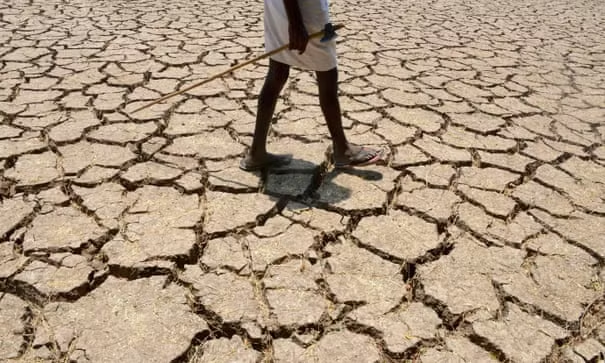
Research was centered on latitudes found between 20 degrees north, a line that cuts through Mexico, Libya and India, to 20 degrees south. Photograph: Noah Seelam/Getty Images
Research was centered on latitudes found between 20 degrees north, a line that cuts through Mexico, Libya and India, to 20 degrees south. Photograph: Noah Seelam/Getty Images

“If it is too humid our bodies can’t cool off by evaporating sweat – this is why humidity is important when we consider livability in a hot place,” said Yi Zhang, a Princeton University researcher who led the new study, published in Nature Geoscience. “High body core temperatures are dangerous or even lethal.”

The research team looked at various historical data and simulations to determine how wet-bulb temperature extremes will change as the planet continues to heat up, discovering that these extremes in the tropics increase at around the same rate as the tropical mean temperature.

This means that the world’s temperature increase will need to be limited to 1.5C to avoid risking areas of the tropics exceeding 35C in wet-bulb temperature, which is so-called because it is measured by a thermometer that has its bulb wrapped in a wet cloth, helping mimic the ability of humans to cool their skin by evaporating sweat.

Dangerous conditions in the tropics will unfold even before the 1.5C threshold, however, with the paper warning that 1C of extreme wet-bulb temperature increase “could have adverse health impact equivalent to that of several degrees of temperature increase”. The world has already warmed by around 1.1C on average due to human activity and although governments vowed in the Paris climate agreement to hold temperatures to 1.5C, scientists have warned this limit could be breached within a decade.

This has potentially dire implications for a huge swathe of humanity. Around 40% of the world’s population currently lives in tropical countries, with this proportion set to expand to half of the global population by 2050 due to the large proportion of young people in region. The Princeton research was centered on latitudes found between 20 degrees north, a line that cuts through Mexico, Libya and India, to 20 degrees south, which goes through Brazil, Madagascar and the northern reaches of Australia.

Mojtaba Sadegh, an expert in climate risks at Boise State University, said the study does “a great job” of analyzing how rising temperatures “can render portions of the tropics uninhabitable in the absence of considerable infrastructure investments.”

“If this limit is breached, infrastructure like cool-air shelters are absolutely necessary for human survival,” said Sadegh, who was not involved in the research. “Given that much of the impacted area consists of low-income countries, providing the required infrastructure will be challenging.”

“Theoretically no human can tolerate a wet bulb temperature of above 35C, no matter how much water they have to drink,” he added.

The study is just the latest scientific warning over severe dangers posed by heat. Extreme heatwaves could push parts of the Middle East beyond human endurance, scientists have found, with rising temperatures also posing enormous risks for parts of China and India.

The global number of potentially fatal humidity and heat events doubled between 1979 and 2017, research has determined, with the coming decades set to see as many as 3 billion people pushed beyond the historical range of temperature that humans have survived and prospered in over the past 6,000 years.

The Guardian

Other News

SK Group partners to build AI ecosystem in Vietnam

SK Group partners to build AI ecosystem in Vietnam

SK Innovation and SK Telecom signed MoUs with Nghe An province and the National Innovation Centre of Vietnam to advance AI ecosystem development and support the country’s long-term growth strategy.

Vietnam Research Excellence Fellowship for 2026-2030 approved

Vietnam Research Excellence Fellowship for 2026-2030 approved

Under the Vietnam Research Excellence Fellowship (VREF) for the 2026–2030 period, PhD students are identified as a core research force directly contributing to breakthroughs in sci-tech and innovation. Investing in top-tier doctoral candidates is more than workforce development, but a high-stakes strategic bet to forge a cohort of world-class scientists and technologists who can power Vietnam’s long-term economic ambitions.

Strategic tech must address practical challenges: PM

Strategic tech must address practical challenges: PM

Prime Minister Pham Minh Chinh on March 28 said strategic technologies must tackle Vietnam’s practical challenges, while chairing a meeting of the Government’s Steering Committee for science and technology, innovation, digital transformation, and Project 06.

Ho Chi Minh City sets sights on becoming semiconductor hub

Ho Chi Minh City sets sights on becoming semiconductor hub

Ho Chi Minh City is stepping up efforts to attract investment from global leading groups and companies in the fields of electronic components, semiconductors and chip manufacturing as it seeks to position itself as a leading semiconductor industry hub in both the region and the world. 

Ho Chi Minh City launches upgraded technology exchange platform

Ho Chi Minh City launches upgraded technology exchange platform

The upgraded platform represents a comprehensive shift from a simple information-sharing model to a managed online technology trading system, enabling monitoring and measurement of real transaction outcomes. It is built on three pillars, namely new tradable technology products, a modern digital platform, and an improved operational model.

AI – unmissable opportunity for Vietnam: Experts

AI – unmissable opportunity for Vietnam: Experts

AI also emerges as a key enabler for Vietnam's ambition to build financial and technology hubs. Applications can boost efficiency, automate workflows, cut costs, and sharpen data analytics, which are essential pillars of a modern financial system.

PM calls for accelerated space technology development in Vietnam

PM calls for accelerated space technology development in Vietnam

Vietnam aims by 2030 to achieve a mid-level position in space science and technology development within Southeast Asia, and after 2030 to build national capabilities to independently develop satellite technologies and apply space data to address global challenges and national security needs.

High-level forum advances Vietnam–US technological cooperation

High-level forum advances Vietnam–US technological cooperation

A high-level executive leadership forum focusing on strengthening Vietnam - US relations through technology cooperation was jointly held in Washington D.C. on March 11 by the Embassy of Vietnam in the US, the Weatherhead East Asian Institute of Columbia University, and the US -ASEAN Business Council (USABC). 

AI Law takes effect, anchors national governance framework

AI Law takes effect, anchors national governance framework

While many countries are still drafting policy blueprints or issuing non-binding guidance, Vietnam has moved ahead with a standalone Law on Artificial Intelligence (AI), effective from March 1, placing it among a select group of nations to adopt dedicated AI legislation at the parliamentary level. 

Vietnam International Defence Expo 2026 preparations move into high gear

Vietnam International Defence Expo 2026 preparations move into high gear

Vietnam International Defence Expo 2026, themed “Peace, Friendship, Cooperation and Development,” will be organised on a larger scale, featuring a wide array of weapons and technical equipment alongside product exhibitions, seminars and panel discussions, drills, live field demonstrations, and business networking activities.

Ministry requests urgent measures to counter UAVs threatening aviation safety

Ministry requests urgent measures to counter UAVs threatening aviation safety

Ministry of Construction requested the Ministry of National Defence, the Ministry of Public Security and provincial and municipal steering committees for counter-terrorism to strengthen the management, inspection and supervision of UAVs and other aerial devices, ensuring strict compliance with Decree No. 288/2025/ND-CP and relevant legal regulations.