- HCM City economic forum focuses on innovative urban area
- Vietnam Expo 2018 to open in HCM City
- HCM City’s electronics industry sees significant growth
- Vietnam-RoK literature exchange held in HCM City
- HCM City: 24,000 people join 22nd Terry Fox Run
- US-based 8VC seeks business opportunities in HCM City
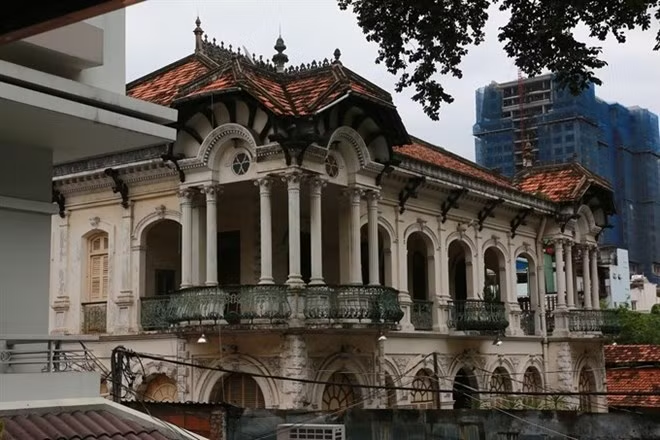 |
| One of the historic buildings in HCM City’s District 3. The city has about 3,000 valuable old houses and villas that could face demolition if they are not renovated. (Source: VNA). |
Every year, the city loses more heritage buildings to urbanisation, poor urban planning and a lack of awareness about their economic value.
Recently, many old or historic buildings, including villas in District 3 and Binh Thanh District, have been demolished to make way for new buildings.
Many other old buildings and villas have fallen into disrepair.
Under city regulations, if the villas are museums or state-owned houses, they can be maintained and preserved.
However, a large number that are private properties have not been taken care of properly. Some of the villas are so dilapidated they are no longer habitable.
Some old villas in HCM City are managed by the state, while others are privately owned.
Most of the villas, especially those located in expensive locations in the city centre, have been replaced with high-rises.
Many owners of privately owned villas and old buildings have sold them for various reasons.
The city does not have support or management policies to help owners preserve their houses.
To save the old villas, more research and evaluation should be done to determine the value of the old villas, experts have suggested.
Cultural agencies as well as independent professional associations and professionals in the field could undertake these tasks.
Owners who are considering dismantling or repairing their buildings would think twice about doing so if they were aware of the economic value of their buildings, according to experts.
In addition, information on heritage buildings should be available on websites and in the media, preservationists have said.
In 2010, the city created a steering committee to manage landscape conservation and draft evaluation criteria for villa classification.
But due to financial problems, lack of manpower, and other limitations, conservation work has faced various challenges.
Architect Nguyen Van Tat, chairman of the Architectural Council at the HCM City Association of Architects, said conservation must focus not only on development but profitability.
Tat said that preserved heritage buildings could earn profits.
However, he noted that a heritage site should be free for the public to visit, and that money for preservation must come from third parties.
For example, a heritage building used to exhibit pottery could be open to the public, but the full cost of the operation would be financed by a ceramic company.
In return, the company would receive promotion as well, according to Tat.
Le Quang Ninh, chairman of the Urban Architecture Landscape Conservation Programme in HCM City, said the ineffectiveness of the preservation of old buildings and villas has been due largely to the lack of involvement of economists.
Economic efficiency is considered a key issue in the preservation of heritage buildings.
Businesses and economists must work together to work out a conservation plan with local authorities and professionals in the field, Ninh said.
HCM City has about 3,000 valuable old houses and villas that could be preserved but could likely be demolished, according to the Architecture Research Centre at the city’s Department of Planning and Architecture.
Of that number, nearly 1,300 houses were built before 1975. About 168 of them are under State management and receive funds from the city for repair and preservation.
However, only eight houses remain in good condition, according to the Urban Research and Development Centre.
Valuable old buildings, mostly built during the French colonial period, include the HCM City People’s Court (built in 1881), King’s Palace or Revolutionary Museum (1885), Majestic Hotel and Notre Dame Cathedral (1887), Sai Gon Post Office (1886-1891), HCM City’s People’s Committee (1907), Opera House (1900) and Ben Thanh Market (1912-1914).
Many colonial villas have been renovated and now house schools, restaurants and coffee shops. Most of them are located in District 3 on Tu Xuong, Vo Van Tan, Nguyen Dinh Chieu, Le Quy Don, and Tran Quoc Thao streets.