Hmong people living in Central Highlands preserve traditional identity

It has been 40 years since the first group of the Hmong people departed their home land of Cao Bang in  Northern Vietnam for Ya Hoi commune, Dak Po district, the Central Highland province of Gia Lai.

Hmong people living in Central Highlands preserve traditional identity -0

Over the past four decades, the Hmong people in the Highlands have  preserved their cultural identities while making contributions to local socio-economic development.

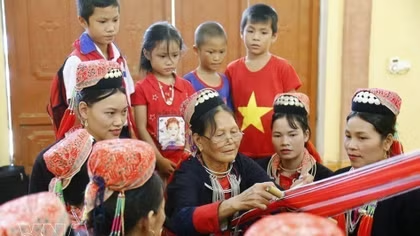
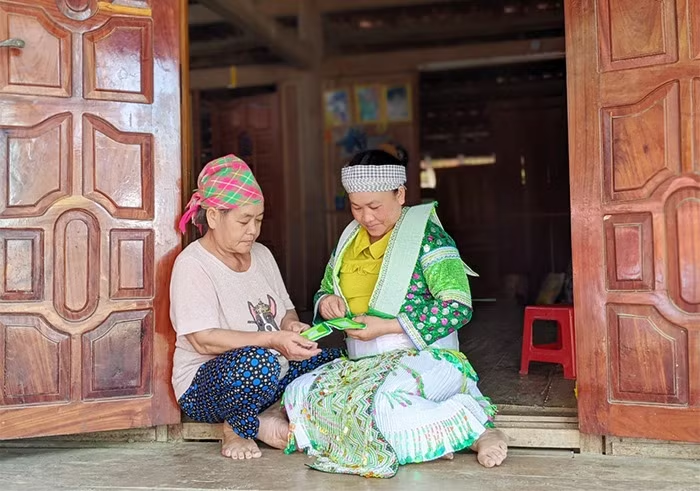
The Hmong people living in Ya Hoi keep their long-standing traditional features, including the way to build their houses, their typical costumes, as well as their fine traditional practices and beliefs.

Ly Nguyen Hung, a Hmong man living in Ya Hoi, says all Hmong people in the locality want to live in the traditional Hmong house as such a home helps the migrant Hmong people feel less homesick.

Linh Thi Pinh, a local woman, says Hmong girls learn to sew at the age of 8, and they are good at sewing by 18. Costumes for the Hmong women are more sophisticated and difficult to make than men's, so sometimes it takes a woman a year to finish a dress.

Since 2018, thanks to the support from local authorities, the Hmong people’s cuisine and cultural identity have been promoted and introduced at annual fairs and events hosted by the district of Dak Po.

The Hmong community in Ya Hoi now has 150 households with more than 730 people. Their living standards have been raised, so the rate of poor Hmong households is low.

The second and third generation of the Hmong people born in Ya Hoi have been well-educated, and many of them have graduated from universities and colleges. Of them, some are working in the police force or in education sector.

A group of 11 Hmong families with 100 people left their home land of Cao Bang to Ya Hoi in 1982, Ly Nguyen Hung, a member of the first generation of the Hmong in the Central Highlands, recalled.  As newcomers, they faced numerous difficulties at first, including language barriers, different weather conditions, shortage of food and malaria. “It was their nightmare, sai Hung.

Many local Bahnar people also died of malaria at that time. That horrified the newly-coming Hmong people. Many of them considered going back to their home province of Cao Bang. But it must have been the way to death because we would have died of hunger if we had returned to the place where we had had no soil to grow crops.

Fortunately, Dinh Ye, a local official of Ya Hoi commune at that time, had encouraged them to stay and help them a lot to settle down their lives.

The local official sai, “The Hmong and the Bahna are brothers in the Vietnamese family. Hmong people are welcome to the Bahna’s native land. Once the Bahna people have corn to eat, they will share the food with the Hmong.”

Since then the locals and newcomers have encouraged and shared both joy and hardship with each other. The Hmong people gradually overcame difficulties and built their second home village in the Central Highlands.

The Hmong people nowadays make various contributions to local movements and activities.

Some time ago, a number of Hmong people donated money and assisted the local authorities in building a rural road in the commune, facilitating transport and trade.

Duong Thai Thach, Chairman of the Ya Hoi Communal People’s Committee, says the Hmong people living in the commune have opportunities to raise their living standards while preserving their cultural identities thanks to the policies of the Party, State and support of the local authorities. Traditional festivals of the Hmong are held regularly with activities such as folk games, singing and dancing, national costume show.

Although not all Hmong have a prosperous life, all feel happy in their second home land.
By DT

Other News

Vietnam steps up implementation of ethnic affairs strategy through 2030

Vietnam steps up implementation of ethnic affairs strategy through 2030

To accelerate the implementation of the the Ethnic Affairs Strategy by 2030, with a vision toward 2045, the Prime Minister requested ministries, agencies and local authorities to continue thoroughly carrying out the Party and State’s policies on ethnic affairs, enhancing the effectiveness of State management and strengthening oversight of policy implementation.

Security preparations reviewed for APEC 2027 in Phu Quoc

Security preparations reviewed for APEC 2027 in Phu Quoc

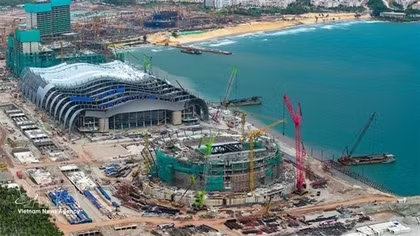
The team examined the APEC 2027 Convention Centre, where main conference activities are scheduled; Sun Serenia Hospital, designated to provide healthcare and emergency medical services for delegates; provincial road DT.975, which connects Phu Quoc International Airport to the convention centre; and the area surrounding Phu Quoc International Airport.

Hanoi accelerates seven Red River bridge projects, many exceed 70% completion

Hanoi accelerates seven Red River bridge projects, many exceed 70% completion

According to the municipal Transport Construction Investment Project Management Board, the city is simultaneously implementing seven projects, namely Tu Lien, Ngoc Hoi, Tran Hung Dao, Thuong Cat, Van Phuc, Hong Ha and Me So bridges. Construction is being carried out on multiple fronts, focusing on bored piles, pile caps, piers and superstructure works.

Dien Bien battlefield legacy powers tourism revival

Dien Bien battlefield legacy powers tourism revival

Seventy-two years after the Dien Bien Phu Victory, its legacy still reverberates. The unity, self-reliance, and resilience forged in that historic triumph remain a powerful internal engine, now propelling Dien Bien toward fast and sustainable development.

Hanoi accelerates shift to green buses, targets 100% by 2030

Hanoi accelerates shift to green buses, targets 100% by 2030

In the 2027–2030 period, the city will accelerate the transition towards the complete phase-out of fossil fuel-powered buses. The share of electric and green energy-fueled buses is projected to reach 79–89% by 2029 and 100% by 2030.

36 fishermen safely rescued after boat breaks down near Truong Sa

36 fishermen safely rescued after boat breaks down near Truong Sa

At 8:00 the same day, KN475 began towing the disabled fishing boat toward Da Tay A island. The towing operation was carried out safely, and by 18:30 both the vessel and its crew had arrived at the island without incident, where repairs and additional support procedures were arranged.

Vietnamese language contest in Laos strengthens youth ties, bilateral friendship

Vietnamese language contest in Laos strengthens youth ties, bilateral friendship

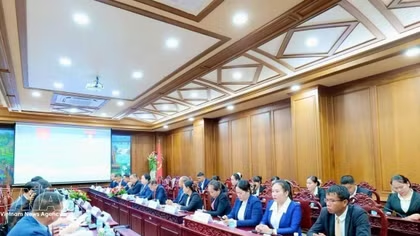
Held in response to the launch of the Vietnamese Language Day among overseas Vietnamese communities, the event aimed to enhance the quality of Vietnamese language teaching and learning in Laos while contributing to the great friendship, special solidarity, comprehensive cooperation and strategic cohesion between the two countries.

Vietnamese language contest in Laos strengthens youth ties, bilateral friendship

Vietnamese language contest in Laos strengthens youth ties, bilateral friendship

Held in response to the launch of the Vietnamese Language Day among overseas Vietnamese communities, the event aimed to enhance the quality of Vietnamese language teaching and learning in Laos while contributing to the great friendship, special solidarity, comprehensive cooperation and strategic cohesion between the two countries.

Hanoi launches 10 electric bus routes from April 1

Hanoi launches 10 electric bus routes from April 1

By the end of April, the number of buses using electricity and other green energy sources in the city is expected to reach 822, including 683 electric buses and 139 compressed natural gas (CNG) buses, representing 42.1% of the total number of vehicles.