How Russian PAK FA 5th Gen Fighter Evolved

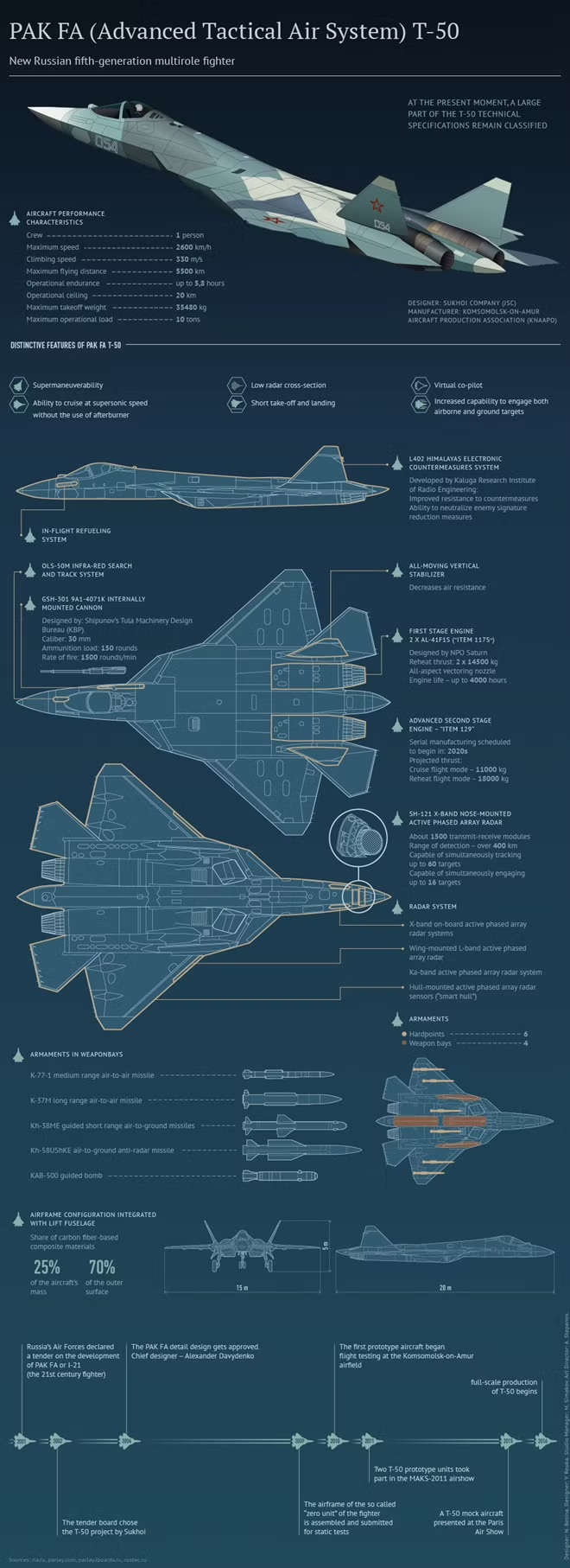
Russia’s fifth-generation fighter jet, formerly known as the Prospective Airborne Complex of Frontline Aviation (PAK FA), or Sukhoi T-50, has officially been named the Su-57. RIA Novosti contributor Andrei Kots takes a look at the evolution of Russia’s premier fighter jet.

Experts believe that the latest T-50-11 or the earlier T-50-10 variants of the original T-50 will inherit the onboard equipment of the T-50-9, which conducted its maiden flight on April 24, 2017.

The United Aircraft Corporation’s CEO, Yuri Slyusarev, earlier said that the initial batch of 12 such planes will be supplied to the Aerospace Forces in 2019.

Initial Tests

Presented to President Vladimir Putin in 2014, the scaled-down model of the T-50 was a combination of the latest technological know-how for the Sukhoi Su-47 and MiG-1.44 prospective fighter jets, designed back in the Soviet days.
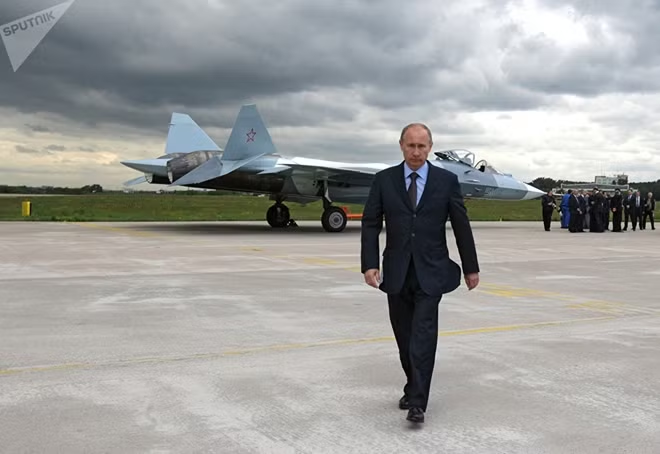
© SPUTNIK/ ALEXEI DRUZHININ Prime Minister Vladimir Putin at the test if a T-50 fifth generation fighter

© SPUTNIK/ ALEXEI DRUZHININ

Prime Minister Vladimir Putin at the test if a T-50 fifth generation fighter

When the production of the F-22 Raptor fifth-generation multirole fighter, which became a legislator of fashion in the field of next generation fighter planes, started in the US in 1997, it became clear that Russia needed to replace the Su-27 with a plane that would be up to par with its Western counterparts.

A T-50 fighter performs demonstration flight during the International Aerospace Salon (MAKS 2015) in Zhukovsky near Moscow

Since its first flight in the early 2010s, the T-50 has receiving a vast series of upgrades to its avionics, stealth and armaments, Andrei Kots wrote.

The T-50-1 prototype took to the skies on January 29, 2010, and the T-50-2 followed suit on March 3, 2011. After 40 successful flight tests the

T-50-2 took part in the MAKS 2011 air show. Before taking off, however, one of its engines caught fire forcing the pilot to abort. Engineers fixed the faulty engine and the T-50-2 flight tests resumed.

The T-50-3 flew on July 24, 2012. Unlike its predecessors, the new prototype carried onboard active phased-array radar. In December 2012, the T-50-4 took to the skies with the same radar array on board. Both prototypes proved fast and highly maneuverable and their state-of-the-art radar systems worked perfectly.

Second Stage

The T-50-6, T-50-8 and T-50-9 (maiden flights in April 2015, November 2016 and April 2017, respectively) were second-stage prototypes, enabling the use of upgraded AL-41F1 engines, similar to the ones powering the Su-35 fighters. 

The second-stage engine, dubbed “Item 30,” will feature a new fan and control mechanism; it will be more fuel-efficient and will have greater endurance.

PAK FA

A pilot version of the second-stage PAK FA with a new engine is slated to fly later this year.

The T-50-6, T-50-8 and T-50-9 also have stronger airframes, bigger wingspans and make wider use of composite materials.

“Flight tests are proceeding at full swing. Everything is going well. We are already testing in-flight missile launches and the plane is performing just fine,” Aerospace Forces Commander Viktor Bondarev told reported on the sidelines of the MAKS 2015 airshow.

All Set for Mass Production

In July, Viktor Bondarev said that the construction of the highly appraised ninth, 10th and 11th prototypes of the Su-57 was slated to begin shortly.

"I see no physiological limits whatsoever for PAK FA pilots. The designers are working to make sure that much of the pilot’s work is done by the plane itself,” Bondarev added.

With six Su-57s scheduled for delivery to the Aerospace Forces by next year, with mass production beginning shortly afterwards, Andrei Kots concluded.
Sputnik

Other News

SK Group partners to build AI ecosystem in Vietnam

SK Group partners to build AI ecosystem in Vietnam

SK Innovation and SK Telecom signed MoUs with Nghe An province and the National Innovation Centre of Vietnam to advance AI ecosystem development and support the country’s long-term growth strategy.

Vietnam Research Excellence Fellowship for 2026-2030 approved

Vietnam Research Excellence Fellowship for 2026-2030 approved

Under the Vietnam Research Excellence Fellowship (VREF) for the 2026–2030 period, PhD students are identified as a core research force directly contributing to breakthroughs in sci-tech and innovation. Investing in top-tier doctoral candidates is more than workforce development, but a high-stakes strategic bet to forge a cohort of world-class scientists and technologists who can power Vietnam’s long-term economic ambitions.

Strategic tech must address practical challenges: PM

Strategic tech must address practical challenges: PM

Prime Minister Pham Minh Chinh on March 28 said strategic technologies must tackle Vietnam’s practical challenges, while chairing a meeting of the Government’s Steering Committee for science and technology, innovation, digital transformation, and Project 06.

Ho Chi Minh City sets sights on becoming semiconductor hub

Ho Chi Minh City sets sights on becoming semiconductor hub

Ho Chi Minh City is stepping up efforts to attract investment from global leading groups and companies in the fields of electronic components, semiconductors and chip manufacturing as it seeks to position itself as a leading semiconductor industry hub in both the region and the world. 

Ho Chi Minh City launches upgraded technology exchange platform

Ho Chi Minh City launches upgraded technology exchange platform

The upgraded platform represents a comprehensive shift from a simple information-sharing model to a managed online technology trading system, enabling monitoring and measurement of real transaction outcomes. It is built on three pillars, namely new tradable technology products, a modern digital platform, and an improved operational model.

AI – unmissable opportunity for Vietnam: Experts

AI – unmissable opportunity for Vietnam: Experts

AI also emerges as a key enabler for Vietnam's ambition to build financial and technology hubs. Applications can boost efficiency, automate workflows, cut costs, and sharpen data analytics, which are essential pillars of a modern financial system.

PM calls for accelerated space technology development in Vietnam

PM calls for accelerated space technology development in Vietnam

Vietnam aims by 2030 to achieve a mid-level position in space science and technology development within Southeast Asia, and after 2030 to build national capabilities to independently develop satellite technologies and apply space data to address global challenges and national security needs.

High-level forum advances Vietnam–US technological cooperation

High-level forum advances Vietnam–US technological cooperation

A high-level executive leadership forum focusing on strengthening Vietnam - US relations through technology cooperation was jointly held in Washington D.C. on March 11 by the Embassy of Vietnam in the US, the Weatherhead East Asian Institute of Columbia University, and the US -ASEAN Business Council (USABC). 

AI Law takes effect, anchors national governance framework

AI Law takes effect, anchors national governance framework

While many countries are still drafting policy blueprints or issuing non-binding guidance, Vietnam has moved ahead with a standalone Law on Artificial Intelligence (AI), effective from March 1, placing it among a select group of nations to adopt dedicated AI legislation at the parliamentary level. 

Vietnam International Defence Expo 2026 preparations move into high gear

Vietnam International Defence Expo 2026 preparations move into high gear

Vietnam International Defence Expo 2026, themed “Peace, Friendship, Cooperation and Development,” will be organised on a larger scale, featuring a wide array of weapons and technical equipment alongside product exhibitions, seminars and panel discussions, drills, live field demonstrations, and business networking activities.

Ministry requests urgent measures to counter UAVs threatening aviation safety

Ministry requests urgent measures to counter UAVs threatening aviation safety

Ministry of Construction requested the Ministry of National Defence, the Ministry of Public Security and provincial and municipal steering committees for counter-terrorism to strengthen the management, inspection and supervision of UAVs and other aerial devices, ensuring strict compliance with Decree No. 288/2025/ND-CP and relevant legal regulations.