Human-robot interactions take step forward with 'emotional' chatbot

An “emotional chatting machine” has been developed by scientists, signalling the approach of an era in which human-robot interactions are seamless and go beyond the purely functional.

The ECM, as it is known for short, was able to produce factually coherent answers whilst also imbuing its conversation with emotions such as happiness, sadness or disgust.

The paper found that 61% of humans who tested the machine favoured the emotional versions to the neutral chatbot. Similar results have been found in so-called “Wizard of Oz” studies in which a human typing responses masquerades as advanced AI.

Minlie Huang, a computer scientist at Tsinghua University, Beijing and co-author, said: “We’re still far away from a machine that can fully understand the user’s emotion. This is just the first attempt at this problem.”
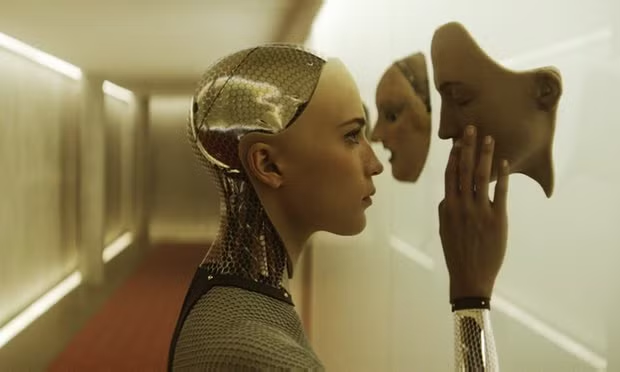
The chatbot signals the approach of an era of sophisticated human-robot interactions - although perhaps not quite as sophisticated (or sinister) as that seen in Ex Machina. Photo: Publicity image

Huang and colleagues started by creating an “emotion classifying” algorithm that learned to detect emotion from 23,000 posts taken from the Chinese social media site Weibo. The posts had been manually classified by humans as sad, happy and so on.

The emotion classifier was then used to tag millions of social media interactions according to emotional content. This huge dataset served as a training ground for the chatbot to learn both how to answer questions and how to express emotion.

The resulting program could be switched into five possible modes – happy, sad, angry, disgusted, liking – depending on the user’s preference. In one example conversation a user typed in: “Worst day ever. I arrived late because of the traffic.”

In neutral mode, the chatbot droned: “You were late”. Alternative responses were: “Sometimes life just sucks!” (disgust mode), “I am always here to support you” (liking) or “Keep smiling! Things will get better” (happy – or, some might say, annoyingly chipper).

In the future, the team predict the software could also learn the appropriate emotion to express at a given time. “It could be mostly empathic,” said Huang, adding that a challenge would be to avoid the chatbot reinforcing negative feelings such as rage.

Until recently chatbots were widely regarded as a sideshow to more serious attempts at tackling machine intelligence. A chatbot known as Eugene Goostman managed to convince some judges they were talking to a human – but only by posing as a 13-year old Ukrainian boy with a limited grasp of English. Microsoft’s disastrous chatbot Tay was supposed to learn to chat from Twitter interactions, but was terminated after becoming a genocide-supporting Nazi less than 24 hours after being let loose on the internet.

The latest study shows that chatbots, driven by a machine learning approach, are starting to make significant headway. Sandra Wachter, a computer scientist at the Oxford Internet Institute, said that in future such algorithms are likely to be personalised. “Some of us prefer a tough-love pep talk, others prefer someone to rant with,” she said. “Humans often struggle with appropriate responses because of the complexity of emotions, so building technologies that could decipher accurately our ‘emotional code’ would be very impressive.”

As the stilted computer interactions of today are replaced by something approaching friendly chit-chat, new risks could be encountered.

The Guardian

Other News

SK Group partners to build AI ecosystem in Vietnam

SK Group partners to build AI ecosystem in Vietnam

SK Innovation and SK Telecom signed MoUs with Nghe An province and the National Innovation Centre of Vietnam to advance AI ecosystem development and support the country’s long-term growth strategy.

Vietnam Research Excellence Fellowship for 2026-2030 approved

Vietnam Research Excellence Fellowship for 2026-2030 approved

Under the Vietnam Research Excellence Fellowship (VREF) for the 2026–2030 period, PhD students are identified as a core research force directly contributing to breakthroughs in sci-tech and innovation. Investing in top-tier doctoral candidates is more than workforce development, but a high-stakes strategic bet to forge a cohort of world-class scientists and technologists who can power Vietnam’s long-term economic ambitions.

Strategic tech must address practical challenges: PM

Strategic tech must address practical challenges: PM

Prime Minister Pham Minh Chinh on March 28 said strategic technologies must tackle Vietnam’s practical challenges, while chairing a meeting of the Government’s Steering Committee for science and technology, innovation, digital transformation, and Project 06.

Ho Chi Minh City sets sights on becoming semiconductor hub

Ho Chi Minh City sets sights on becoming semiconductor hub

Ho Chi Minh City is stepping up efforts to attract investment from global leading groups and companies in the fields of electronic components, semiconductors and chip manufacturing as it seeks to position itself as a leading semiconductor industry hub in both the region and the world. 

Ho Chi Minh City launches upgraded technology exchange platform

Ho Chi Minh City launches upgraded technology exchange platform

The upgraded platform represents a comprehensive shift from a simple information-sharing model to a managed online technology trading system, enabling monitoring and measurement of real transaction outcomes. It is built on three pillars, namely new tradable technology products, a modern digital platform, and an improved operational model.

AI – unmissable opportunity for Vietnam: Experts

AI – unmissable opportunity for Vietnam: Experts

AI also emerges as a key enabler for Vietnam's ambition to build financial and technology hubs. Applications can boost efficiency, automate workflows, cut costs, and sharpen data analytics, which are essential pillars of a modern financial system.

PM calls for accelerated space technology development in Vietnam

PM calls for accelerated space technology development in Vietnam

Vietnam aims by 2030 to achieve a mid-level position in space science and technology development within Southeast Asia, and after 2030 to build national capabilities to independently develop satellite technologies and apply space data to address global challenges and national security needs.

High-level forum advances Vietnam–US technological cooperation

High-level forum advances Vietnam–US technological cooperation

A high-level executive leadership forum focusing on strengthening Vietnam - US relations through technology cooperation was jointly held in Washington D.C. on March 11 by the Embassy of Vietnam in the US, the Weatherhead East Asian Institute of Columbia University, and the US -ASEAN Business Council (USABC). 

AI Law takes effect, anchors national governance framework

AI Law takes effect, anchors national governance framework

While many countries are still drafting policy blueprints or issuing non-binding guidance, Vietnam has moved ahead with a standalone Law on Artificial Intelligence (AI), effective from March 1, placing it among a select group of nations to adopt dedicated AI legislation at the parliamentary level. 

Vietnam International Defence Expo 2026 preparations move into high gear

Vietnam International Defence Expo 2026 preparations move into high gear

Vietnam International Defence Expo 2026, themed “Peace, Friendship, Cooperation and Development,” will be organised on a larger scale, featuring a wide array of weapons and technical equipment alongside product exhibitions, seminars and panel discussions, drills, live field demonstrations, and business networking activities.

Ministry requests urgent measures to counter UAVs threatening aviation safety

Ministry requests urgent measures to counter UAVs threatening aviation safety

Ministry of Construction requested the Ministry of National Defence, the Ministry of Public Security and provincial and municipal steering committees for counter-terrorism to strengthen the management, inspection and supervision of UAVs and other aerial devices, ensuring strict compliance with Decree No. 288/2025/ND-CP and relevant legal regulations.