Humans and volcanoes caused nearly all of global heating in past 140 years

Emissions from fossil fuels and volcanoes can explain nearly all of the changes in Earth’s surface temperatures over the past 140 years, a new study has found.

The research refutes the popular climate denial myth that recent global warming is merely a result of natural cycles.

Those arguments have always suffered a key physical flaw, namely that cycles are cyclical. For example, El Niño events, which temporarily raise global surface temperatures by bringing warm water up to the shallow ocean layer, are offset by La Niña events, which have the opposite effect. While a given decade might have more El Niño or La Niña events, resulting in a short-term surface warming or cooling, over the long term their effects cancel out.

However, climate scientists have had a difficult time explaining exactly what caused a warming event in the early 20th century, between about 1910 and 1945. The average of the climate model runs incorporated in the last IPCC report only accounted for about half of the measured global surface warming trend during that period, and a study published last year suggested the other half could be due to natural cycles.
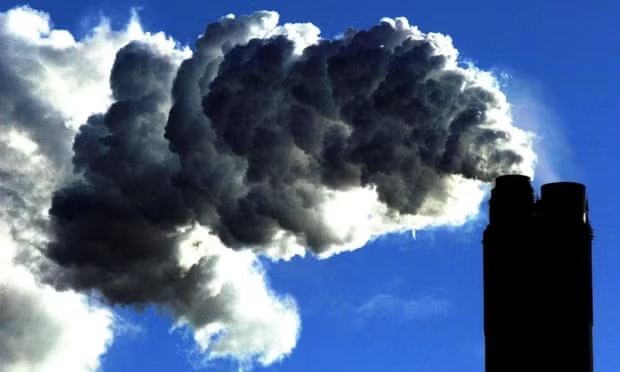
The research’s findings also reaffirmed IPCC’s conclusion that humans are responsible for all the rapid global heating since 1950. Photograph: John Giles/PA

Contrarian scientists like Judith Curry, who is frequently invited by Republicans to testify before US Congress, have often used this discrepancy to cast doubt on the expert consensus on human-caused global warming, arguing that “until we can explain the early 20th century warming, I have little confidence IPCC and [National Climate Assessment] attribution statements regarding the cause of the recent warming.”

The new study, published in the Journal of Climate, tackles the discrepancy in part by addressing an issue with ocean temperature data during the second world war, when measurements were more often made from warmer engine room intakes than from buckets lowered over the side of ships. This has resulted in a bias, inflating estimated surface temperatures in the early-to-mid 1940s. The new study removed this bias by focusing on temperatures along continental and island coastlines.

Arctic temperature data has also long been problematic. There are relatively few temperature monitoring stations in the region due to its remoteness, but due largely to disappearing sea ice decreasing the region’s reflectivity, the Arctic is the fastest-warming part of the planet.

Two of the co-authors of the new study, Kevin Cowtan and Robert Way, previously made strides in addressing these coverage gaps by using improved statistical interpolation methods. The new study goes further, by incorporating Met Office Hadley Centre Arctic sea ice data.

Accounting for the area of Arctic ocean covered by sea ice is an important factor, as lead author Karsten Haustein explains: “If sea ice is treated as ocean, the temperature cannot go below zero (per definition). If it is treated as land, the temperature can fall as low as -50C in winter given there is virtually no interaction with the ocean water anymore. Since warming trends over the Arctic are higher than anywhere else, overall land warming trends will be higher too if sea ice is treated as land. This is by virtue of winter temperatures not falling as low as they used to anymore.”

The authors then compared the improved global surface temperature data to climate model runs incorporating influences from human greenhouse gas and aerosol pollution, volcanic eruptions, and changes in solar activity. Overall they were able to explain more than 90% of the temperature variation over the 140-year record.

They found that the 0.4C warming from 1910 to 1945 could be accounted for by 0.2C warming from human greenhouse gases offset by 0.08C cooling from human aerosol pollution, 0.2C warming from natural factors (mostly a quiet period for volcanic activity plus a small contribution from increased solar activity), and a bit of natural variability plus some remaining uncertainty in the data.

Since 1950, the authors found that the 0.8C temperature rise is due to 1.2C warming from greenhouse gases offset by 0.3C cooling from human aerosol pollution and 0.1C cooling from volcanoes and the sun.

These findings are important because they improve global surface temperature estimates, explain the causes of the early-20th century warming, and reaffirm that as the IPCC concluded in 2013, humans are responsible for all of the rapid global heating since 1950.


The Guardian

Other News

SK Group partners to build AI ecosystem in Vietnam

SK Group partners to build AI ecosystem in Vietnam

SK Innovation and SK Telecom signed MoUs with Nghe An province and the National Innovation Centre of Vietnam to advance AI ecosystem development and support the country’s long-term growth strategy.

Vietnam Research Excellence Fellowship for 2026-2030 approved

Vietnam Research Excellence Fellowship for 2026-2030 approved

Under the Vietnam Research Excellence Fellowship (VREF) for the 2026–2030 period, PhD students are identified as a core research force directly contributing to breakthroughs in sci-tech and innovation. Investing in top-tier doctoral candidates is more than workforce development, but a high-stakes strategic bet to forge a cohort of world-class scientists and technologists who can power Vietnam’s long-term economic ambitions.

Strategic tech must address practical challenges: PM

Strategic tech must address practical challenges: PM

Prime Minister Pham Minh Chinh on March 28 said strategic technologies must tackle Vietnam’s practical challenges, while chairing a meeting of the Government’s Steering Committee for science and technology, innovation, digital transformation, and Project 06.

Ho Chi Minh City sets sights on becoming semiconductor hub

Ho Chi Minh City sets sights on becoming semiconductor hub

Ho Chi Minh City is stepping up efforts to attract investment from global leading groups and companies in the fields of electronic components, semiconductors and chip manufacturing as it seeks to position itself as a leading semiconductor industry hub in both the region and the world. 

Ho Chi Minh City launches upgraded technology exchange platform

Ho Chi Minh City launches upgraded technology exchange platform

The upgraded platform represents a comprehensive shift from a simple information-sharing model to a managed online technology trading system, enabling monitoring and measurement of real transaction outcomes. It is built on three pillars, namely new tradable technology products, a modern digital platform, and an improved operational model.

AI – unmissable opportunity for Vietnam: Experts

AI – unmissable opportunity for Vietnam: Experts

AI also emerges as a key enabler for Vietnam's ambition to build financial and technology hubs. Applications can boost efficiency, automate workflows, cut costs, and sharpen data analytics, which are essential pillars of a modern financial system.

PM calls for accelerated space technology development in Vietnam

PM calls for accelerated space technology development in Vietnam

Vietnam aims by 2030 to achieve a mid-level position in space science and technology development within Southeast Asia, and after 2030 to build national capabilities to independently develop satellite technologies and apply space data to address global challenges and national security needs.

High-level forum advances Vietnam–US technological cooperation

High-level forum advances Vietnam–US technological cooperation

A high-level executive leadership forum focusing on strengthening Vietnam - US relations through technology cooperation was jointly held in Washington D.C. on March 11 by the Embassy of Vietnam in the US, the Weatherhead East Asian Institute of Columbia University, and the US -ASEAN Business Council (USABC). 

AI Law takes effect, anchors national governance framework

AI Law takes effect, anchors national governance framework

While many countries are still drafting policy blueprints or issuing non-binding guidance, Vietnam has moved ahead with a standalone Law on Artificial Intelligence (AI), effective from March 1, placing it among a select group of nations to adopt dedicated AI legislation at the parliamentary level. 

Vietnam International Defence Expo 2026 preparations move into high gear

Vietnam International Defence Expo 2026 preparations move into high gear

Vietnam International Defence Expo 2026, themed “Peace, Friendship, Cooperation and Development,” will be organised on a larger scale, featuring a wide array of weapons and technical equipment alongside product exhibitions, seminars and panel discussions, drills, live field demonstrations, and business networking activities.

Ministry requests urgent measures to counter UAVs threatening aviation safety

Ministry requests urgent measures to counter UAVs threatening aviation safety

Ministry of Construction requested the Ministry of National Defence, the Ministry of Public Security and provincial and municipal steering committees for counter-terrorism to strengthen the management, inspection and supervision of UAVs and other aerial devices, ensuring strict compliance with Decree No. 288/2025/ND-CP and relevant legal regulations.