Legislators mull tourism, religion laws

Hanoi – The National Assembly Standing Committee yesterday discussed the revised Tourism Law which forms the legal basis for the sector to improve its competitiveness and create conditions for its development into a spearhead economic sector.

At the on-going third session of the 14th NA, some deputies asked for specific incentive policies for investment in tourism, resource mobilization, and the integration of tourism development into other socio-economic strategies.

Most of the deputies agreed with the necessity to revise the law to tackle existing shortcomings by formulating a clear legal framework, creating motivation and favorable conditions for tourism to develop, they said.

Assessing that the tourism sector still failed to match the country’s potential and advantages, NA Chairwoman Nguyen Thi Kim Ngan said the law should be revised to deal with the urgent problem of how to draw more tourists and how to encourage tourists to visit the country again.
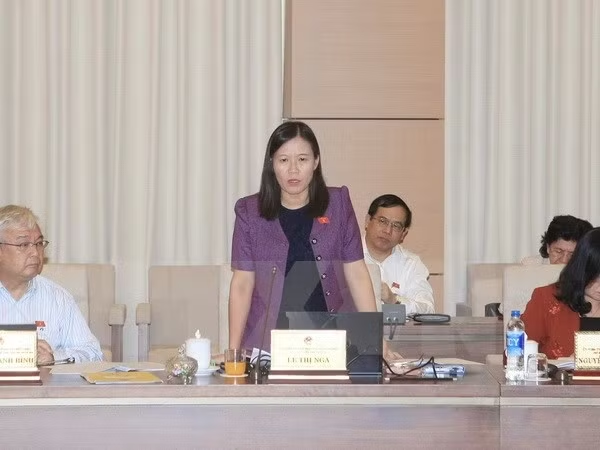
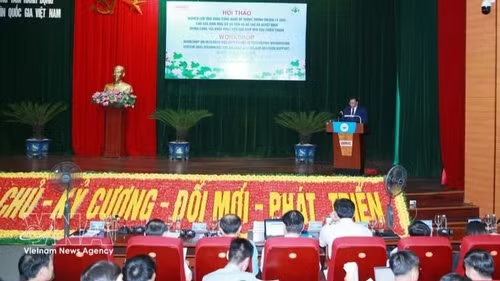
Chairwoman of the NA's Law Committee Le Thi Nga delivers speech at the yesterday meeting of the Standing Committee. — VNA/VNS. Photo: Pham Kien
Chairwoman of the NA's Law Committee Le Thi Nga delivers speech at the yesterday meeting of the Standing Committee. — VNA/VNS. Photo: Pham Kien

It was necessary to promote the tourism sector via culture, she said, adding that tourism development could not be separated from culture if it wants to succeed.

Some deputies said the draft law still failed to have specific and breakthrough policies to ensure that tourism could be developed into a spearhard economic sector. The compiling board should review related regulations and laws and study tourism development policies to mobilise all resources to support tourism development, and incorporate tourism development into socio-economic development plans, they said.

As for the establishment of a fund for tourism development regulated in the draft law, some deputies said it was necessary to set up the fund to support the promotion of tourism and staff training for the sector. However, some deputies questioned the feasibility of creating such a fund due to limited financial resources.

Draft law on belief, religion 

Regarding the draft Law on Belief and Religion, a regulation that allows religious organisations to join social, education and healthcare activities drew reactions from most participants.

Most of the deputies agreed with the regulation, under which religious organisations will be licensed to establish educational establishments as part of the national education system, operating in line with the current education regulations.

Phan Thanh Binh, Chairman of the National Assembly Committee for Culture, Education, Youth and Children, said that in reality, many religious organisations have opened and managed education establishments effectively for children in nursery schools, primary education and vocational training in line with the country’s laws.

Some 126,000 students attend about 270 schools currently operated by religious organisations.

National Assembly Chairwoman Ngan agreed with the regulation, saying that it matched the country’s policy to mobilise the participation of the whole society in education development.

However, some deputies raised concern that the current Law on Education does not have regulation on this issue, urging the draft law to make the regulation clearer.

National Assembly Vice Chairman Uong Chu Luu said more study was needed to ensure that education establishments set up by religious organisations refrain from teaching content relating to belief and religion in order to ensure the freedom of religions of each individual.

Concerning other social activities of religious organisations, such as charity, humanitarian relief, social protection and healthcare activities, most deputies agreed that religious organisations have done well, making great contributions to society.

However, some deputies said religious organisations should ask for permission from local authorities in localities where their social activities are held and not be allowed to conduct propaganda activities to expand and develop their religions so as to respect people’s  freedom of religion.

VNS

Other News

Vietnam steps up implementation of ethnic affairs strategy through 2030

Vietnam steps up implementation of ethnic affairs strategy through 2030

To accelerate the implementation of the the Ethnic Affairs Strategy by 2030, with a vision toward 2045, the Prime Minister requested ministries, agencies and local authorities to continue thoroughly carrying out the Party and State’s policies on ethnic affairs, enhancing the effectiveness of State management and strengthening oversight of policy implementation.

Security preparations reviewed for APEC 2027 in Phu Quoc

Security preparations reviewed for APEC 2027 in Phu Quoc

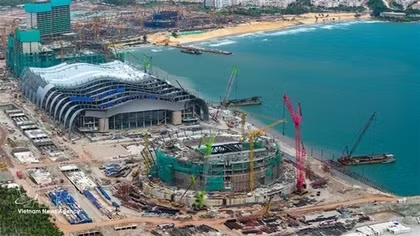
The team examined the APEC 2027 Convention Centre, where main conference activities are scheduled; Sun Serenia Hospital, designated to provide healthcare and emergency medical services for delegates; provincial road DT.975, which connects Phu Quoc International Airport to the convention centre; and the area surrounding Phu Quoc International Airport.

Hanoi accelerates seven Red River bridge projects, many exceed 70% completion

Hanoi accelerates seven Red River bridge projects, many exceed 70% completion

According to the municipal Transport Construction Investment Project Management Board, the city is simultaneously implementing seven projects, namely Tu Lien, Ngoc Hoi, Tran Hung Dao, Thuong Cat, Van Phuc, Hong Ha and Me So bridges. Construction is being carried out on multiple fronts, focusing on bored piles, pile caps, piers and superstructure works.

Dien Bien battlefield legacy powers tourism revival

Dien Bien battlefield legacy powers tourism revival

Seventy-two years after the Dien Bien Phu Victory, its legacy still reverberates. The unity, self-reliance, and resilience forged in that historic triumph remain a powerful internal engine, now propelling Dien Bien toward fast and sustainable development.

Hanoi accelerates shift to green buses, targets 100% by 2030

Hanoi accelerates shift to green buses, targets 100% by 2030

In the 2027–2030 period, the city will accelerate the transition towards the complete phase-out of fossil fuel-powered buses. The share of electric and green energy-fueled buses is projected to reach 79–89% by 2029 and 100% by 2030.

36 fishermen safely rescued after boat breaks down near Truong Sa

36 fishermen safely rescued after boat breaks down near Truong Sa

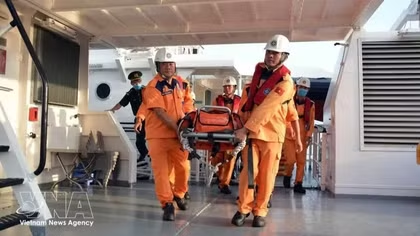
At 8:00 the same day, KN475 began towing the disabled fishing boat toward Da Tay A island. The towing operation was carried out safely, and by 18:30 both the vessel and its crew had arrived at the island without incident, where repairs and additional support procedures were arranged.

Vietnamese language contest in Laos strengthens youth ties, bilateral friendship

Vietnamese language contest in Laos strengthens youth ties, bilateral friendship

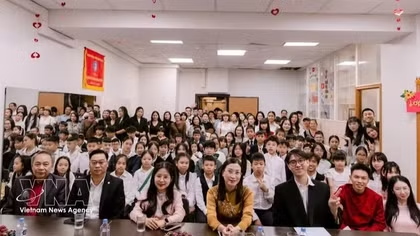
Held in response to the launch of the Vietnamese Language Day among overseas Vietnamese communities, the event aimed to enhance the quality of Vietnamese language teaching and learning in Laos while contributing to the great friendship, special solidarity, comprehensive cooperation and strategic cohesion between the two countries.

Vietnamese language contest in Laos strengthens youth ties, bilateral friendship

Vietnamese language contest in Laos strengthens youth ties, bilateral friendship

Held in response to the launch of the Vietnamese Language Day among overseas Vietnamese communities, the event aimed to enhance the quality of Vietnamese language teaching and learning in Laos while contributing to the great friendship, special solidarity, comprehensive cooperation and strategic cohesion between the two countries.

Hanoi launches 10 electric bus routes from April 1

Hanoi launches 10 electric bus routes from April 1

By the end of April, the number of buses using electricity and other green energy sources in the city is expected to reach 822, including 683 electric buses and 139 compressed natural gas (CNG) buses, representing 42.1% of the total number of vehicles.