Low income, high pressure blamed for public health workers quitting jobs

Low income, high pressure at work and unattractive remuneration policies are listed as the reason nearly 9,400 health workers quit their jobs in State facilities and moved to private health facilities between early 2021 and June 2022.

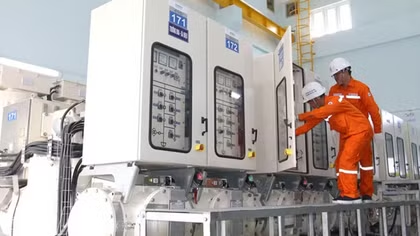
low income, high pressure blamed for public health workers quitting jobs picture 1

This was revealed in a report by the Vietnam Health Union which was recently sent to the Vietnam General Confederation of Labour.

The report said according to the current regulations on salary and allowance, a doctor after studying for six years and having 18 months of practice to be granted a practising certificate, will receive nearly VND4.9 million (US$209) per month. The amount consists of a salary of nearly VND3.5 million (US$149) and an allowance of VND1.4 million (US$60). The allowance is equal to 40% of the salary.

The amount of money that the health workers received each month has not deducted a payment of social and health insurance as regulations.

With the salary, it is very difficult to retain health workers working in public health facilities, the report said.

The income of health workers at private health facilities is often triple or quadruple, in some places the income is five or six times more than in public health facilities, the report said.

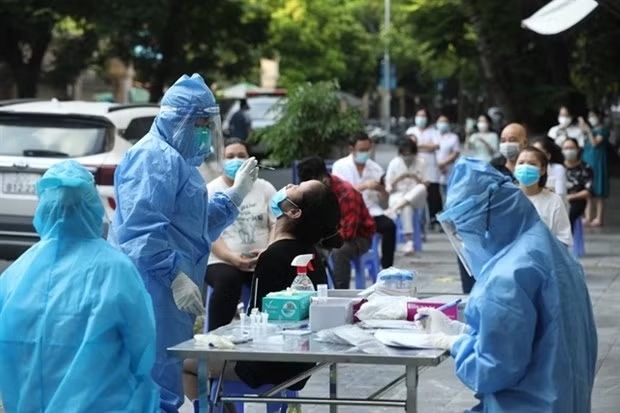
Since the outbreak of COVID-19, health officials and employees have become the frontline force in disease prevention and control. Working intensity was especially hard when the number of new cases increased, the report said.

“The health workers hardly have days off and they have to work with high intensity for a long time, especially, for health workers in localities with large populations such as HCM City and several southern provinces,” the report said.

Health workers often have to work in a dangerous environment, with high risk of contracting the disease, and in some cases it can be life-threatening. It has profoundly affected the psychology and working motivation of health workers, the report said.

The report also revealed another cause of people leaving was the recent cases of violations of the law in the procurement of drugs, supplies and medical equipment which affected the working environment of health staff.

It also caused a lack of modern equipment to deploy high-technology medical services, lack of medicine, even a lack of common medical tools and protective equipment for health workers.

Therefore, health workers tend to move to private health facilities with better conditions and working environment, the report said.

The report added that the strong development of private hospitals and health clinics with modern and friendly working environment is another reason public health workers are making the switch. Private medical facilities are willing to offer high salaries, while public health facilities do not have a mechanism to keep them.

The union has proposed to raise the level of allowances for public employees working in preventive medicine and grassroots health from 40% to 100% in order to attract more staff.

At the same time, the Party and Government should allow the Ministry of Health to adjust the price of medical services, including the price of medical examinations and treatment services for health insurance participants. It will help increase the revenue of public health facilities so that the public health facilities will have more funds to increase the income for health workers.

Additionally, relevant authorities propose the Government to provide funding to support health workers for their contributions in the fight against the COVID-19 pandemic. Each worker should receive an allowance, equivalent to their monthly salary or double.

It is advised to consider raising the starting salary for newly-graduated doctors to attract young doctors and provide more allowances for senior doctors, the union said.

The Government should have special support policies for health officials and employees working in extremely difficult areas, where natural disasters and epidemics often occur, the union said.

It is necessary to have preferential policies to attract doctors, nurses and technicians working in the fields of tuberculosis, psychiatry and emergency resuscitation.

VNA

Other News

Vietnam steps up implementation of ethnic affairs strategy through 2030

Vietnam steps up implementation of ethnic affairs strategy through 2030

To accelerate the implementation of the the Ethnic Affairs Strategy by 2030, with a vision toward 2045, the Prime Minister requested ministries, agencies and local authorities to continue thoroughly carrying out the Party and State’s policies on ethnic affairs, enhancing the effectiveness of State management and strengthening oversight of policy implementation.

Security preparations reviewed for APEC 2027 in Phu Quoc

Security preparations reviewed for APEC 2027 in Phu Quoc

The team examined the APEC 2027 Convention Centre, where main conference activities are scheduled; Sun Serenia Hospital, designated to provide healthcare and emergency medical services for delegates; provincial road DT.975, which connects Phu Quoc International Airport to the convention centre; and the area surrounding Phu Quoc International Airport.

Hanoi accelerates seven Red River bridge projects, many exceed 70% completion

Hanoi accelerates seven Red River bridge projects, many exceed 70% completion

According to the municipal Transport Construction Investment Project Management Board, the city is simultaneously implementing seven projects, namely Tu Lien, Ngoc Hoi, Tran Hung Dao, Thuong Cat, Van Phuc, Hong Ha and Me So bridges. Construction is being carried out on multiple fronts, focusing on bored piles, pile caps, piers and superstructure works.

Dien Bien battlefield legacy powers tourism revival

Dien Bien battlefield legacy powers tourism revival

Seventy-two years after the Dien Bien Phu Victory, its legacy still reverberates. The unity, self-reliance, and resilience forged in that historic triumph remain a powerful internal engine, now propelling Dien Bien toward fast and sustainable development.

Hanoi accelerates shift to green buses, targets 100% by 2030

Hanoi accelerates shift to green buses, targets 100% by 2030

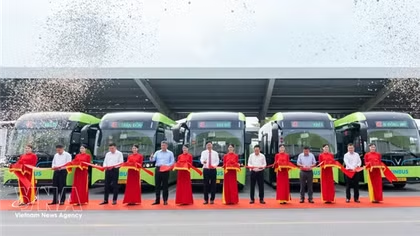
In the 2027–2030 period, the city will accelerate the transition towards the complete phase-out of fossil fuel-powered buses. The share of electric and green energy-fueled buses is projected to reach 79–89% by 2029 and 100% by 2030.

36 fishermen safely rescued after boat breaks down near Truong Sa

36 fishermen safely rescued after boat breaks down near Truong Sa

At 8:00 the same day, KN475 began towing the disabled fishing boat toward Da Tay A island. The towing operation was carried out safely, and by 18:30 both the vessel and its crew had arrived at the island without incident, where repairs and additional support procedures were arranged.

Vietnamese language contest in Laos strengthens youth ties, bilateral friendship

Vietnamese language contest in Laos strengthens youth ties, bilateral friendship

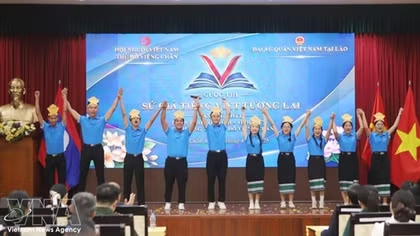
Held in response to the launch of the Vietnamese Language Day among overseas Vietnamese communities, the event aimed to enhance the quality of Vietnamese language teaching and learning in Laos while contributing to the great friendship, special solidarity, comprehensive cooperation and strategic cohesion between the two countries.

Vietnamese language contest in Laos strengthens youth ties, bilateral friendship

Vietnamese language contest in Laos strengthens youth ties, bilateral friendship

Held in response to the launch of the Vietnamese Language Day among overseas Vietnamese communities, the event aimed to enhance the quality of Vietnamese language teaching and learning in Laos while contributing to the great friendship, special solidarity, comprehensive cooperation and strategic cohesion between the two countries.

Hanoi launches 10 electric bus routes from April 1

Hanoi launches 10 electric bus routes from April 1

By the end of April, the number of buses using electricity and other green energy sources in the city is expected to reach 822, including 683 electric buses and 139 compressed natural gas (CNG) buses, representing 42.1% of the total number of vehicles.