Ministry inspects Mekong landslide aftermath

The Ministry of Agriculture and Natural Resources is seeking solutions to prevent landslides in the Mekong Delta, after a landslide occurred on the Vam Co Lau Canal on Monday afternoon in An Giang Province, causing six houses to collapse and forcing two other households to relocate. 
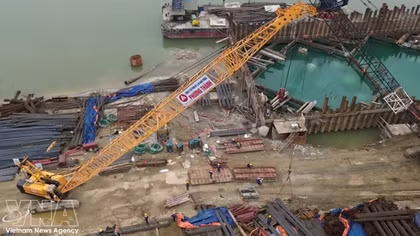
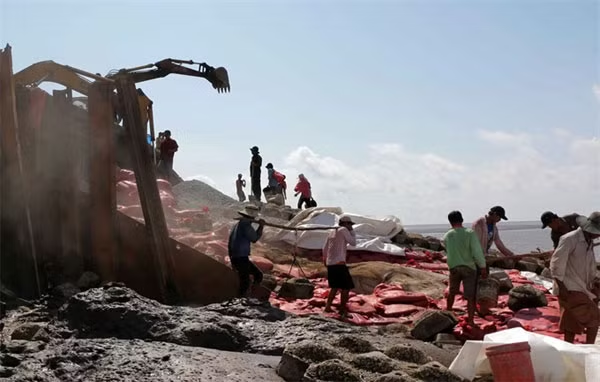
Workers fixing Ganh Hao sea dyke in Dong Hai District in the Cuu Long (Mekong) Delta province of Bac Lieu after it collapsed due to high tides and strong waves. Seawater flowed into residential areas. — Photo: VNA/VNS
Workers fixing Ganh Hao sea dyke in Dong Hai District in the Cuu Long (Mekong) Delta province of Bac Lieu after it collapsed due to high tides and strong waves. Seawater flowed into residential areas. — Photo: VNA/VNS 

Late last month, a serious landslide along the Vam Nao River occurred in Cho Moi District of the province, causing losses of VND90 billion ($3.96 million).

The most recent landslide, which occurred in the province’s An Phu District’s Phu Huu Commune, left a crater that was 100m long, 10m wide and 15m deep.

As soon as the crack on the canal was discovered on May 4, commune authorities urged local people to evacuate, thus avoiding loss of life.

Local police and the Army were asked to help residents relocate their properties to safe areas, and to put up warning signs and ban vehicles at the site of the landslide.

Of the eight households still living in the high-risk area, five houses could collapse at any moment.

Cao Xuan Dieu, chairman of the commune’s People’s Committee, said that each family whose house collapsed suffered a loss of VND30 million (US$1,320).

The commune gave each affected household VND1 million in cash and 10 kilos of rice per person.

Inspections

On May 9, a group of officials from the Ministry of Agriculture and Rural Development (MARD) began a four-day trip to review the causes of the landslides in the Delta and work with local authorities to set up plans to deal with disasters that have threatened people’s lives.

On the first day, the group visited several sea dykes in Bac Lieu Province.

Though the province has great potential to develop the sea economy thanks to its 56-km coastline, it has been affected by climate change, rising sea levels, saltwater intrusion and sea dyke breaching, threatening 100,000 people living by the sea, Duong Thanh Trung, chairman of the Bac Lieu Province People’s Committee, said at a meeting with MARD officials.

Since the beginning of the year, high tides, huge waves and strong winds have damaged the Ganh Hao dyke in Dong Hai District’s Ganh Hao Town and Nha Mat dyke in Bac Lieu City’s Nha Mat Ward.

Erosion has occurred on a 940 sq.m area of the Ganh Hao Sea Dyke, while erosion on the Nha Mat embankment stretches for 24 metres. Cracks and subsidence along the rest of the embankment have been reported.

The two sea dykes play an important role in protecting thousands of households and tens of thousands of hectares of coastal land.

Bac Lieu Province has asked for assistance from experts at research institutes and universities to solve the problem of dyke breaching.

One of the adopted measures would help reduce the height and strength of waves.

The province has asked for VNĐ340 billion ($14.95 million) of aid to implement measures to prevent further erosion and protect sea dykes.

Tran Quang Hoai, deputy head of MARD’s Water Resource Directorate, praised the province’s efforts to deal with erosion and instructed it to protect the dykes as the rainy season would come soon.

After the trip, MARD will work with other ministries and agencies to find a long-term and sustainable plan to combat landslides in the delta.

The delta has around 265 highly vulnerable spots where landslides have occurred, covering a total 450km in length.

Landslides have caused an annual average loss of 500ha of land in recent years.

The situation has worsened in recent years, especially in An Giang Province’s Cho Moi District and Dong Thap Province’s Thanh Binh District.

Dong Thap Province on April 28 declared a state of emergency after several landslides occurred in April along a 210m section of the Tien River in Thanh Binh District’s Binh Thanh Commune. 

VNS

Other News

Vietnam steps up implementation of ethnic affairs strategy through 2030

Vietnam steps up implementation of ethnic affairs strategy through 2030

To accelerate the implementation of the the Ethnic Affairs Strategy by 2030, with a vision toward 2045, the Prime Minister requested ministries, agencies and local authorities to continue thoroughly carrying out the Party and State’s policies on ethnic affairs, enhancing the effectiveness of State management and strengthening oversight of policy implementation.

Security preparations reviewed for APEC 2027 in Phu Quoc

Security preparations reviewed for APEC 2027 in Phu Quoc

The team examined the APEC 2027 Convention Centre, where main conference activities are scheduled; Sun Serenia Hospital, designated to provide healthcare and emergency medical services for delegates; provincial road DT.975, which connects Phu Quoc International Airport to the convention centre; and the area surrounding Phu Quoc International Airport.

Hanoi accelerates seven Red River bridge projects, many exceed 70% completion

Hanoi accelerates seven Red River bridge projects, many exceed 70% completion

According to the municipal Transport Construction Investment Project Management Board, the city is simultaneously implementing seven projects, namely Tu Lien, Ngoc Hoi, Tran Hung Dao, Thuong Cat, Van Phuc, Hong Ha and Me So bridges. Construction is being carried out on multiple fronts, focusing on bored piles, pile caps, piers and superstructure works.

Dien Bien battlefield legacy powers tourism revival

Dien Bien battlefield legacy powers tourism revival

Seventy-two years after the Dien Bien Phu Victory, its legacy still reverberates. The unity, self-reliance, and resilience forged in that historic triumph remain a powerful internal engine, now propelling Dien Bien toward fast and sustainable development.

Hanoi accelerates shift to green buses, targets 100% by 2030

Hanoi accelerates shift to green buses, targets 100% by 2030

In the 2027–2030 period, the city will accelerate the transition towards the complete phase-out of fossil fuel-powered buses. The share of electric and green energy-fueled buses is projected to reach 79–89% by 2029 and 100% by 2030.

36 fishermen safely rescued after boat breaks down near Truong Sa

36 fishermen safely rescued after boat breaks down near Truong Sa

At 8:00 the same day, KN475 began towing the disabled fishing boat toward Da Tay A island. The towing operation was carried out safely, and by 18:30 both the vessel and its crew had arrived at the island without incident, where repairs and additional support procedures were arranged.

Vietnamese language contest in Laos strengthens youth ties, bilateral friendship

Vietnamese language contest in Laos strengthens youth ties, bilateral friendship

Held in response to the launch of the Vietnamese Language Day among overseas Vietnamese communities, the event aimed to enhance the quality of Vietnamese language teaching and learning in Laos while contributing to the great friendship, special solidarity, comprehensive cooperation and strategic cohesion between the two countries.

Vietnamese language contest in Laos strengthens youth ties, bilateral friendship

Vietnamese language contest in Laos strengthens youth ties, bilateral friendship

Held in response to the launch of the Vietnamese Language Day among overseas Vietnamese communities, the event aimed to enhance the quality of Vietnamese language teaching and learning in Laos while contributing to the great friendship, special solidarity, comprehensive cooperation and strategic cohesion between the two countries.

Hanoi launches 10 electric bus routes from April 1

Hanoi launches 10 electric bus routes from April 1

By the end of April, the number of buses using electricity and other green energy sources in the city is expected to reach 822, including 683 electric buses and 139 compressed natural gas (CNG) buses, representing 42.1% of the total number of vehicles.