New MacBooks mark Apple's return to high-end laptops in age of the tablet

After a long period as a mid-market manufacturer, rapid shift signals a reaction to the changing shape of the PC market.

Apple released its latest laptops on Thursday, a new range of computers to replace the ageing range of Retina MacBook Pros. They are thinner and lighter than their predecessors, with a new touch bar at the top of the keyboard and a fingerprint sensor replacing the power button.

They are £750 more than the machines they replace were – though their price has also gone up. The larger of the two new MacBook Pros, the 15in with Touch Bar, is the first laptop the company has released with a starting price of more than £2,000 for more than a decade: it begins at an eye-watering £2,349, with build-to-order options taking it well north of £4,000.

Apple’s former cheapest laptop, the £749 MacBook, is also being retired. With the next cheapest going up in price due to post-Brexit currency swings, there is now only one Apple laptop available for less than £1,000: the £949 13in MacBook Pro, an almost two-year-old computer that is likely to never see another update.

After a long period as a mid-market manufacturer of some of the most popular laptops on the market, then, Apple is back to making premium computers for the very top end of the market.

“Apple has always had a firm strategy on the high-end of the market with adding a few models towards the mid-range to attract new user groups,” says the Gartner analyst Annette Zimmermann. 

The shift has been rapid, and reflects the changing shape of the PC market, Apple’s attempts to refashion its line-up of computers and mobile devices for that altered world, and some new competition from an old foe, says Ben Wood from the analysts CCS Insight.
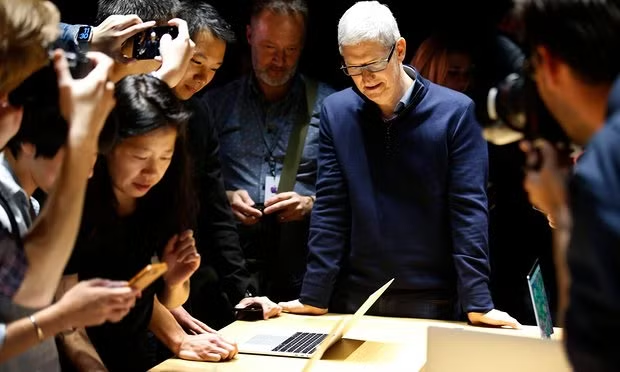
Tim Cook, CEO of Apple, looks on as guests inspect a new MacBook Pro. Photograph: Tony Avelar/EPA

“We shouldn’t forget that the last significant update to the MacBook Pro family was 2012,” he says. “I think it’s a real indication of the broader malaise in the notebook market that Apple was able to get away with selling a four-year-old product as successfully as it has. All they had to compete with was some nasty black plastic from Dell or HP.”

But over those four years, the PC market has shrunk consistently. In 2015, 164.4m units were sold, according to TrendForce, while that is expected to fall to 157.4m this year. The cause is obvious: the rise of mobile and table computers have allowed users to do more with less, be that replacing a laptop with an iPad, or simply never buying a full computer in the first place and going online with a smartphone.

Different companies have responded in different ways: first, by focusing less on their computer divisions as they chased the market to mobile, but later, by recognising that the smaller size of PC industry allows for greater segmentation of the market. One of the first to really push that to its limits was Apple’s old foe Microsoft.

Apple’s motivation to redefine its laptops may also have been driven by a desire to more fully distinguish between its iPads and its MacBook range. Until last week, the most expensive iPad, the 12.9-inch iPad Pro with Wi-Fi and mobile data, was more expensive than Apple’s cheapest laptop. That posed a problem for Apple, which struggled to explain what the two devices were for: if a laptop is best for work on the move, who would pay more for an iPad? 

Now, it can more consistently structure its messaging: iPads are cheaper, hardier portable devices with all-day battery life, but if your main computer is to be portable, a premium laptop is the way to go.

The Guardian

Other News

SK Group partners to build AI ecosystem in Vietnam

SK Group partners to build AI ecosystem in Vietnam

SK Innovation and SK Telecom signed MoUs with Nghe An province and the National Innovation Centre of Vietnam to advance AI ecosystem development and support the country’s long-term growth strategy.

Vietnam Research Excellence Fellowship for 2026-2030 approved

Vietnam Research Excellence Fellowship for 2026-2030 approved

Under the Vietnam Research Excellence Fellowship (VREF) for the 2026–2030 period, PhD students are identified as a core research force directly contributing to breakthroughs in sci-tech and innovation. Investing in top-tier doctoral candidates is more than workforce development, but a high-stakes strategic bet to forge a cohort of world-class scientists and technologists who can power Vietnam’s long-term economic ambitions.

Strategic tech must address practical challenges: PM

Strategic tech must address practical challenges: PM

Prime Minister Pham Minh Chinh on March 28 said strategic technologies must tackle Vietnam’s practical challenges, while chairing a meeting of the Government’s Steering Committee for science and technology, innovation, digital transformation, and Project 06.

Ho Chi Minh City sets sights on becoming semiconductor hub

Ho Chi Minh City sets sights on becoming semiconductor hub

Ho Chi Minh City is stepping up efforts to attract investment from global leading groups and companies in the fields of electronic components, semiconductors and chip manufacturing as it seeks to position itself as a leading semiconductor industry hub in both the region and the world. 

Ho Chi Minh City launches upgraded technology exchange platform

Ho Chi Minh City launches upgraded technology exchange platform

The upgraded platform represents a comprehensive shift from a simple information-sharing model to a managed online technology trading system, enabling monitoring and measurement of real transaction outcomes. It is built on three pillars, namely new tradable technology products, a modern digital platform, and an improved operational model.

AI – unmissable opportunity for Vietnam: Experts

AI – unmissable opportunity for Vietnam: Experts

AI also emerges as a key enabler for Vietnam's ambition to build financial and technology hubs. Applications can boost efficiency, automate workflows, cut costs, and sharpen data analytics, which are essential pillars of a modern financial system.

PM calls for accelerated space technology development in Vietnam

PM calls for accelerated space technology development in Vietnam

Vietnam aims by 2030 to achieve a mid-level position in space science and technology development within Southeast Asia, and after 2030 to build national capabilities to independently develop satellite technologies and apply space data to address global challenges and national security needs.

High-level forum advances Vietnam–US technological cooperation

High-level forum advances Vietnam–US technological cooperation

A high-level executive leadership forum focusing on strengthening Vietnam - US relations through technology cooperation was jointly held in Washington D.C. on March 11 by the Embassy of Vietnam in the US, the Weatherhead East Asian Institute of Columbia University, and the US -ASEAN Business Council (USABC). 

AI Law takes effect, anchors national governance framework

AI Law takes effect, anchors national governance framework

While many countries are still drafting policy blueprints or issuing non-binding guidance, Vietnam has moved ahead with a standalone Law on Artificial Intelligence (AI), effective from March 1, placing it among a select group of nations to adopt dedicated AI legislation at the parliamentary level. 

Vietnam International Defence Expo 2026 preparations move into high gear

Vietnam International Defence Expo 2026 preparations move into high gear

Vietnam International Defence Expo 2026, themed “Peace, Friendship, Cooperation and Development,” will be organised on a larger scale, featuring a wide array of weapons and technical equipment alongside product exhibitions, seminars and panel discussions, drills, live field demonstrations, and business networking activities.

Ministry requests urgent measures to counter UAVs threatening aviation safety

Ministry requests urgent measures to counter UAVs threatening aviation safety

Ministry of Construction requested the Ministry of National Defence, the Ministry of Public Security and provincial and municipal steering committees for counter-terrorism to strengthen the management, inspection and supervision of UAVs and other aerial devices, ensuring strict compliance with Decree No. 288/2025/ND-CP and relevant legal regulations.