No childhood for Vietnam’s child labourers

Social services need to improve to help curb child labour in Viet Nam and reduce its negative impacts on the country’s youth.

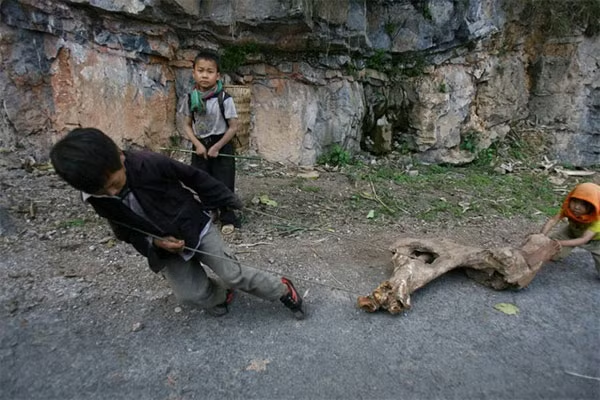
A child collects wood after finishing school in Mu Cang Chai District in the northern province of Yen Bai. – VNS Photo Viet Thanh

Statistics from Ministry of Labour, Invalids and Social Affiars (MoLISA) showed that nationwide there are more than 1.75 million children doing tough labour or working in an unhealthy environment.

Some 67 per cent of the children work in agriculture, 16.6 per cent work in services and 15.8 per cent work in the industry-construction sector.

Under current regulations, child labourers are defined as having specially disadvantaged circumstances but few of them have been received social support. They receive little support in education and healthcare, Nhan dan (People) newspaper reported.

The newspaper’s reporters went to U Market – one of the biggest cow/buffalo markets in the central region – in Dai Son Commune, Do Luong District, Nghe An Province.

The market is open six times a month, starting from sunrise and ending around mid-day.

Besides adults who come to buy or sell cattle, school-aged children can be seen at the crowded market. They come to seek jobs, with the most common towing bought cattle to their new home.

Most of them are in old torn clothes, bare feet, sunburnt and spattered with mud.

Some do a little work and leave the market early so they can go to school, while others work all day to make more money..

Nguyen Canh Hung, 12 years old from Nghi Van Commune of neighbouring Nghi Loc District said that he has worked as a buffalo tower for two years to earn money for his family.

Buffalo towers were usually paid VND 5,000 –VND 10,000 to take a cow/buffalo from the market to the buyers’ house in the same commune. If they have to go farther, they charge more, Hung said.

“On good days, I can earn up to VND 50,000 -60,000,” he said.

The boy said he went to work early, without breakfast and with just a bottle of water along to quench his thirst.

In Quynh Van and Quynh Thach - two other communes of Nghe An Province, children work at a brick making establishment.

They work with no safety equipment, carrying bricks and loading them on trucks.

An owner of a brick establishment told Nhan dan that he knew the work was too hard for children but they wanted a job and he wanted labourers.

In the central province of Ha Tinh’s salt fields, children and the elderly make up the majority of the workforce, as most healthy adults have moved to cities for work.

A man said that he reluctantly let his son work in the salt fields.

“What else can he do? I’m not often at home. He works there with his mother so that she can keep an eye on him,” he said.

Dang Hoa Nam, director of Child Care and Protection Department under Ministry of Labour, said that child labour was common among poor families in disadvantaged areas.

Parents, care givers and children do not have proper awareness of the problems of child labour and nor do they care about the long-term impacts, Nam claimed.

“Child labour is accompanied with dropping out of school, resulted in a low education level, few skills and fewer job opportunities, making it hard to escape from poverty,” he said.

Employers, especially in the informal sector, often hired children without knowing they are breaking the law.

Last year, the National Assembly approved the Child Law which takes effect next month, with child abuse defined clearly.

Forcing children to work in harmful, dangerous conditions that affect to their development is a form of child abuse, Nam said.

The law also identified the responsibilities of agencies in controlling child abuse, Nam said.

However, experts recommended that besides a legal framework, strong law enforcement is needed to ensure that offenders are punished.

They also called for an improved system of social services for child labourers and their families so that negative impacts are reduced.

Child labourers need care to re-integrate into normal life in terms of their physical and mental health.

According to the International Labour Organisation, the fight against child labour requires coherent policies to back child labour legislation – quality education, social protection and decent jobs for parents.


VNS

Other News

Vietnam steps up implementation of ethnic affairs strategy through 2030

Vietnam steps up implementation of ethnic affairs strategy through 2030

To accelerate the implementation of the the Ethnic Affairs Strategy by 2030, with a vision toward 2045, the Prime Minister requested ministries, agencies and local authorities to continue thoroughly carrying out the Party and State’s policies on ethnic affairs, enhancing the effectiveness of State management and strengthening oversight of policy implementation.

Security preparations reviewed for APEC 2027 in Phu Quoc

Security preparations reviewed for APEC 2027 in Phu Quoc

The team examined the APEC 2027 Convention Centre, where main conference activities are scheduled; Sun Serenia Hospital, designated to provide healthcare and emergency medical services for delegates; provincial road DT.975, which connects Phu Quoc International Airport to the convention centre; and the area surrounding Phu Quoc International Airport.

Hanoi accelerates seven Red River bridge projects, many exceed 70% completion

Hanoi accelerates seven Red River bridge projects, many exceed 70% completion

According to the municipal Transport Construction Investment Project Management Board, the city is simultaneously implementing seven projects, namely Tu Lien, Ngoc Hoi, Tran Hung Dao, Thuong Cat, Van Phuc, Hong Ha and Me So bridges. Construction is being carried out on multiple fronts, focusing on bored piles, pile caps, piers and superstructure works.

Dien Bien battlefield legacy powers tourism revival

Dien Bien battlefield legacy powers tourism revival

Seventy-two years after the Dien Bien Phu Victory, its legacy still reverberates. The unity, self-reliance, and resilience forged in that historic triumph remain a powerful internal engine, now propelling Dien Bien toward fast and sustainable development.

Hanoi accelerates shift to green buses, targets 100% by 2030

Hanoi accelerates shift to green buses, targets 100% by 2030

In the 2027–2030 period, the city will accelerate the transition towards the complete phase-out of fossil fuel-powered buses. The share of electric and green energy-fueled buses is projected to reach 79–89% by 2029 and 100% by 2030.

36 fishermen safely rescued after boat breaks down near Truong Sa

36 fishermen safely rescued after boat breaks down near Truong Sa

At 8:00 the same day, KN475 began towing the disabled fishing boat toward Da Tay A island. The towing operation was carried out safely, and by 18:30 both the vessel and its crew had arrived at the island without incident, where repairs and additional support procedures were arranged.

Vietnamese language contest in Laos strengthens youth ties, bilateral friendship

Vietnamese language contest in Laos strengthens youth ties, bilateral friendship

Held in response to the launch of the Vietnamese Language Day among overseas Vietnamese communities, the event aimed to enhance the quality of Vietnamese language teaching and learning in Laos while contributing to the great friendship, special solidarity, comprehensive cooperation and strategic cohesion between the two countries.

Vietnamese language contest in Laos strengthens youth ties, bilateral friendship

Vietnamese language contest in Laos strengthens youth ties, bilateral friendship

Held in response to the launch of the Vietnamese Language Day among overseas Vietnamese communities, the event aimed to enhance the quality of Vietnamese language teaching and learning in Laos while contributing to the great friendship, special solidarity, comprehensive cooperation and strategic cohesion between the two countries.

Hanoi launches 10 electric bus routes from April 1

Hanoi launches 10 electric bus routes from April 1

By the end of April, the number of buses using electricity and other green energy sources in the city is expected to reach 822, including 683 electric buses and 139 compressed natural gas (CNG) buses, representing 42.1% of the total number of vehicles.