Nutritionists launch portion size guide to tackle overeating

Recommendations focus on how much people should eat during the day to stay healthy.

Ministers and public health experts have long been telling us we eat too much sugar, saturated fat and salt but less attention has been paid to the size of the portions on the plate. Now a new guide to portion sizes warning that people are eating too much without realising has been launched by nutritionists, to suggest how much food people should eat during the day to stay healthy and help combat the obesity crisis.

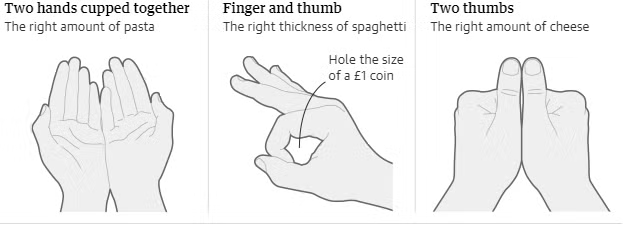
The British Nutrition Foundation’s (BNF) guide is designed, it says, to complement the government advice on the sorts of foods to eat, as laid out in the Eatwell Guide. It spells out how much of each sort of food – starchy carbohydrates, protein, dairy, fruit and vegetables and oils and spreads – constitute a healthy diet within the 2,000 calories a day that women need and 2,500 for men.
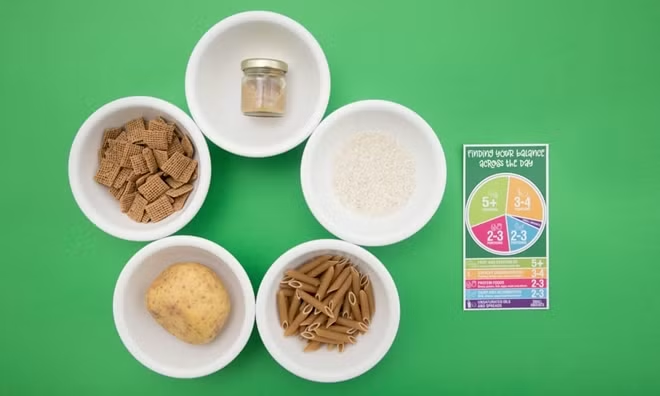
The British Nutrition Foundation’s recommended portion sizes. Photograph: Alicia Canter/Guardian

Super-sizing is clearly out but portion sizes are a puzzle to many. While an apple or a banana is a portion in itself, the right amount of pasta or rice to cook in the interests of staying a healthy weight is more difficult to assess. Recipes vary and many people take a guess and throw more into the saucepan if they feel particularly hungry. The BNF, in its new guide, says the answer is 65g to 75g dry weight (180g when cooked) – or about the amount that would fit in two cupped hands.

The guide offers spoon and hand measurements, which may be easier in daily life than continually getting out the scales. The suggested single portion of a grilled chicken breast, a cooked salmon fillet or a cooked steak is “about half the size of your hand”. This acknowledges that bigger adults, with bigger hands, will need larger portions. Cheddar cheese should be no more than “about the size of two thumbs together” and a baked potato “about the size of your fist”.

The government’s Eatwell Guide, says our diet should be made up of one-third fruit and vegetables, one-third starchy carbohydrates and the rest divided between dairy and protein. That means, says the BNF, we can eat five or more servings of fruit and vegetables, three to four of starchy carbohydrates such as potatoes, bread, rice and pasta (which in line with research this week should be wholegrain), and two to three portions each of protein foods and of dairy or alternatives and stay healthy without overdoing the calories.
We do not think much about portion sizes, says Bridget Benelam, a nutrition scientist with the BNF. “The amount we put on our plate typically depends on the portion size we are used to consuming, how hungry we feel and how much is offered as a helping at a restaurant table or in a packet or ready meal.”

She says the BNF looked at the data from the national diet and nutrition survey and found lots of variations in the sizes of people’s portions. “Our suggested portion size for cooked pasta is 180g (254 calories) but, for example, when we looked at portion sizes for spaghetti, the most commonly consumed size was 230g (324 calories), and about 10% of the sample we looked at were consuming 350g as a portion, which would provide nearly 500 calories from the pasta alone, before sauces and sides were added to the meal,” she said.

The guide says an easy way to measure spaghetti is to use your thumb and index finger to hold a bunch the size of a pound coin.
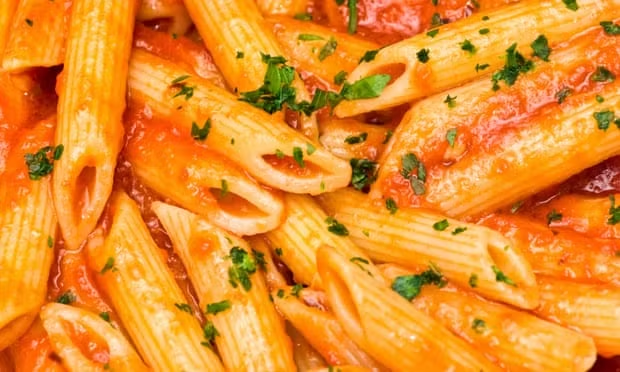
The BNF recommends 65g to 75g dry weight of pasta. Photograph: Luciano Mortula/Getty Images/Hemera
  The BNF recommends 65g to 75g dry weight of pasta. Photograph: Luciano Mortula/Getty Images/Hemera

It suggests smaller portion measures for snacks, such as 20g of unsalted nuts and seeds or the amount that fits into the palm of the hand, which will be between 113 and 137 calories. Also snack size is 55g of reduced-fat hummus – about two tablespoons, four cooked cocktail sausages or two falafel (40g and 113 calories).

A portion of fruit or vegetables – of which we should eat at least five a day – could be two plums, two satsumas, seven strawberries, three heaped serving spoons of peas or carrots, one medium tomato or three sticks of celery.

If you do include treats, says the guide, they should be small, at around 100 to 150 calories, and not too frequent. Their examples include a small chocolate biscuit bar, a small multipack bag of crisps, four small squares of chocolate (20g) or a mini muffin.

The guidance was produced with help from a panel of experts, says the BNF, and funding from major food companies and supermarkets including Waitrose, Tesco and Marks and Spencer.

The Guardian

Other News

SK Group partners to build AI ecosystem in Vietnam

SK Group partners to build AI ecosystem in Vietnam

SK Innovation and SK Telecom signed MoUs with Nghe An province and the National Innovation Centre of Vietnam to advance AI ecosystem development and support the country’s long-term growth strategy.

Vietnam Research Excellence Fellowship for 2026-2030 approved

Vietnam Research Excellence Fellowship for 2026-2030 approved

Under the Vietnam Research Excellence Fellowship (VREF) for the 2026–2030 period, PhD students are identified as a core research force directly contributing to breakthroughs in sci-tech and innovation. Investing in top-tier doctoral candidates is more than workforce development, but a high-stakes strategic bet to forge a cohort of world-class scientists and technologists who can power Vietnam’s long-term economic ambitions.

Strategic tech must address practical challenges: PM

Strategic tech must address practical challenges: PM

Prime Minister Pham Minh Chinh on March 28 said strategic technologies must tackle Vietnam’s practical challenges, while chairing a meeting of the Government’s Steering Committee for science and technology, innovation, digital transformation, and Project 06.

Ho Chi Minh City sets sights on becoming semiconductor hub

Ho Chi Minh City sets sights on becoming semiconductor hub

Ho Chi Minh City is stepping up efforts to attract investment from global leading groups and companies in the fields of electronic components, semiconductors and chip manufacturing as it seeks to position itself as a leading semiconductor industry hub in both the region and the world. 

Ho Chi Minh City launches upgraded technology exchange platform

Ho Chi Minh City launches upgraded technology exchange platform

The upgraded platform represents a comprehensive shift from a simple information-sharing model to a managed online technology trading system, enabling monitoring and measurement of real transaction outcomes. It is built on three pillars, namely new tradable technology products, a modern digital platform, and an improved operational model.

AI – unmissable opportunity for Vietnam: Experts

AI – unmissable opportunity for Vietnam: Experts

AI also emerges as a key enabler for Vietnam's ambition to build financial and technology hubs. Applications can boost efficiency, automate workflows, cut costs, and sharpen data analytics, which are essential pillars of a modern financial system.

PM calls for accelerated space technology development in Vietnam

PM calls for accelerated space technology development in Vietnam

Vietnam aims by 2030 to achieve a mid-level position in space science and technology development within Southeast Asia, and after 2030 to build national capabilities to independently develop satellite technologies and apply space data to address global challenges and national security needs.

High-level forum advances Vietnam–US technological cooperation

High-level forum advances Vietnam–US technological cooperation

A high-level executive leadership forum focusing on strengthening Vietnam - US relations through technology cooperation was jointly held in Washington D.C. on March 11 by the Embassy of Vietnam in the US, the Weatherhead East Asian Institute of Columbia University, and the US -ASEAN Business Council (USABC). 

AI Law takes effect, anchors national governance framework

AI Law takes effect, anchors national governance framework

While many countries are still drafting policy blueprints or issuing non-binding guidance, Vietnam has moved ahead with a standalone Law on Artificial Intelligence (AI), effective from March 1, placing it among a select group of nations to adopt dedicated AI legislation at the parliamentary level. 

Vietnam International Defence Expo 2026 preparations move into high gear

Vietnam International Defence Expo 2026 preparations move into high gear

Vietnam International Defence Expo 2026, themed “Peace, Friendship, Cooperation and Development,” will be organised on a larger scale, featuring a wide array of weapons and technical equipment alongside product exhibitions, seminars and panel discussions, drills, live field demonstrations, and business networking activities.

Ministry requests urgent measures to counter UAVs threatening aviation safety

Ministry requests urgent measures to counter UAVs threatening aviation safety

Ministry of Construction requested the Ministry of National Defence, the Ministry of Public Security and provincial and municipal steering committees for counter-terrorism to strengthen the management, inspection and supervision of UAVs and other aerial devices, ensuring strict compliance with Decree No. 288/2025/ND-CP and relevant legal regulations.