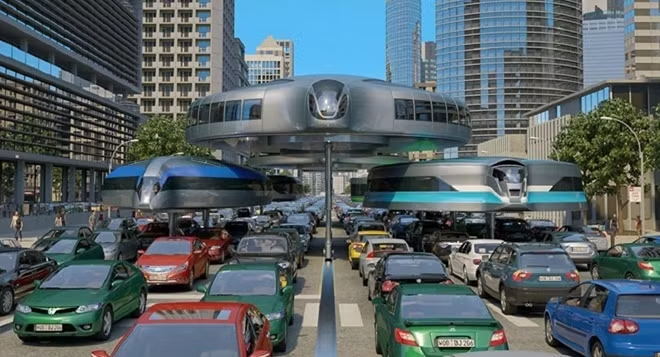
Featuring powerful gyroscopes and maintaining a balance thanks to their heavy flywheel, Semyonov's gyrotrain glides along dedicated rails several meters above ordinary vehicles and pedestrians. Most importantly, he says, his solution is affordable, safe, ecofriendly, and can be implemented along existing road networks.
 |
Semyonov, a native of Karachaevo-Cherkessia, lived in Moscow between 1982 to 2006, working in the construction industry. In 1993, he and a group of colleagues bought a stake at Moscow's Krasnaya Presnya plant, known in the Soviet period for its production of casting machines, molding machines and other industrial equipment, and produced vibro press equipment. In 2006, the engineer moved to Istanbul, Turkey, where he founded the prefabricated housing technology company Dahir Insaat, which has developed a series of unique, patented design and construction solutions.
In addition to housing, Semyonov has an eye for transport. The gyrotrain concept is his pride and joy.
Speaking to Russia's RIA Novosti about his thought process, and what drove him to come up with the gyrotrain idea, Semyonov explained that it all comes down to the physics of engineering.
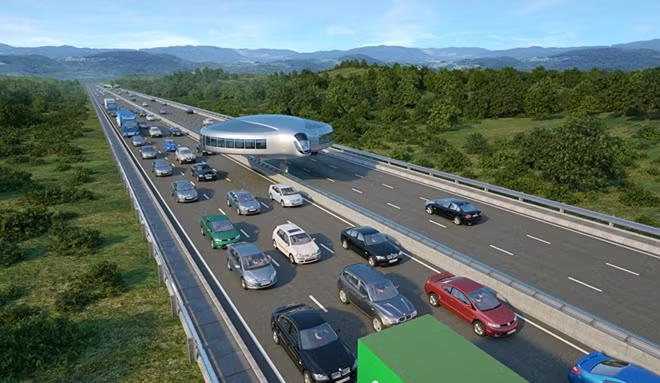 |
| A gyrotrain, envisioned by Russian engineer Dahir Semyonov, riding high above a busy highway. |
Focused on the here and now, the engineer stressed that what's needed is to take account of existing road networks, complete with their endless traffic jams. Between vehicles and the roads themselves, all that's left is the divider in the center of the road.
In addition to housing, Semyonov has an eye for transport. The gyrotrain concept is his pride and joy.
Speaking to Russia's RIA Novosti about his thought process, and what drove him to come up with the gyrotrain idea, Semyonov explained that it all comes down to the physics of engineering.
"Any problem has a limited number of possible solutions," he said. "The same is true as far as traffic jams are concerned. One can take off and to start flying over roads, build multi-level roads or a complex tunnel network, force motorists to switch to micro cars equipped with AI and navigation systems, build monorails or cable cars over existing cars, etc. But all of this is complicated, expensive, and most importantly, won't allow for the required speeds, or the volume of passenger transport."
Focused on the here and now, the engineer stressed that what's needed is to take account of existing road networks, complete with their endless traffic jams. Between vehicles and the roads themselves, all that's left is the divider in the center of the road.
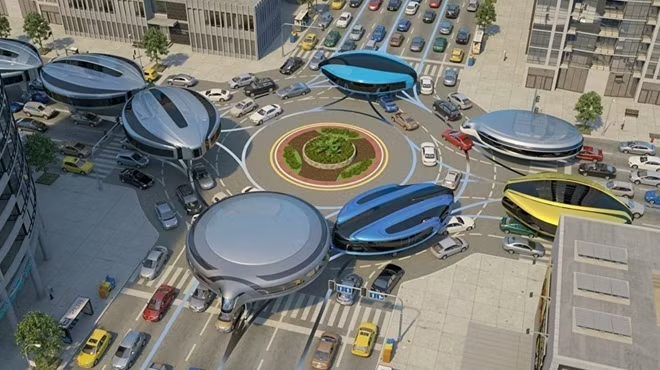 |
"This will allow us to solve the problem in an unconventional way," the engineer explained. "A rail just two centimeters above road level will not interfere with road traffic; it will be possible to drive across it in any direction. As a result, what we will have is a powerful vehicle able to move across existing roads, requiring only a narrow strip between the lanes."
Semyonov believes his invention will convince many commuters to forgo their private cars in favor of the new form of public transport.