Samsung must act fast to keep an exploding phone from blowing up its brand

Galaxy Note 7-maker faces questions over its response to defects with its devices that could tarnish the company in the long-term

The saga of the exploding Galaxy Note 7s has turned into a fully-fledged crisis for Samsung.

First released in August, the phone initially received rave reviews for the extent to which it pushed the envelope on what a phablet-sized smartphone could do. It shipped with wireless charging, a battery that lasted well over a day and charged to 70% in less than an hour, and a USB-C connector – Samsung’s first phone to use the next-generation port.

Then it started exploding.

Sporadic reports came in over early September suggesting that the phone’s battery became unstable when fully charged, and could overheat and explode. Samsung issued a global replacement programme, but steered clear of using the language of a “recall” – until the US consumer product safety commission stepped in and told it that it couldn’t bypass procedure.

Once the recall was announced, Samsung also issued a software update to earlier versions, capping the charge at 60% and displaying a warning as the devices were powered on. For the most part, the problems were limited to North America and South Korea, the two markets where the majority of the devices had been sold, and it looked like Samsung could begin to fix the problem.

Then, in early October, replacement Note 7s began to explode or catch fire as well. As of 10 October, eight have hit the press: five in the US, including one on a flight; one in Taiwan; and two in South Korea. Overnight, Samsung announced that it was “temporarily adjusting the Galaxy Note 7 production schedule”. The announcement apparently buried the news twice over: not only was it released immediately after the US presidential debate, it appears that the “adjustment” is down to zero. Korean news agency Yonhap reported that production was stopped entirely.
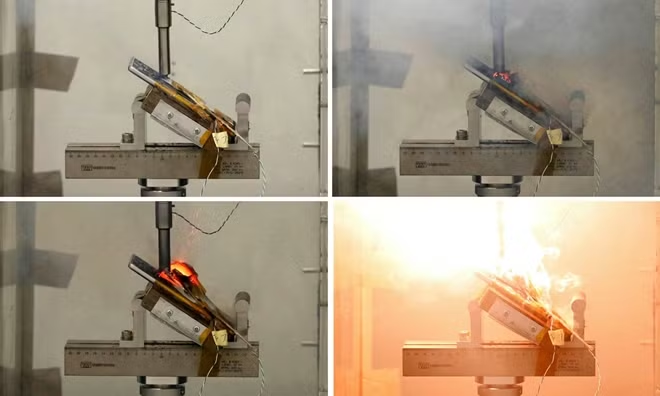
A combination photo shows a Samsung Galaxy Note 7 exploding as pressure is applied to its fully charged battery during a test at the Applied Energy Hub battery laboratory in Singapore. Photograph: Edgar Su/Reuters

The issue appears endemic to the Note 7, and could be a direct result of the same envelope-pushing that earned the phone praise at its launch. According to Bloomberg, Samsung expressly tried to rush a number of new features into the Note 7 all at once. The company had taken heed of rumours, proven correct, that the iPhone 7, released in September, would be an incremental update to the the earlier iPhone 6s, and wanted to capitalise on the “boring” release by dropping an exciting phone of its own a few days before.

The Note 7 was certainly exciting. If Samsung is lucky, the damage to the brand will be limited to one phone. But there’s a risk, as is so often the case, that the perception of a cover-up may prove to be worse than the issue.

That perception began almost the same time reports of exploding phones began trickling. Samsung’s decision to bypass official recall procedures was odd, and it took days for the company to work with the authorities and issue a strongly worded statement “asking users to power down their Galaxy Note 7s and exchange them now”.

When the replacement phones began exploding, it again took the company almost a week to take action. Worse, some customers reported what looked like attempts to keep them quiet. A Kentucky man whose phone caught fire on 4 October told his local news station that he’d felt like Samsung were helping him, until he received what he said was a misdirected text from a Samsung rep: “Just now got this. I can try and slow him down if we think it will matter, or we just let him do what he keeps threatening to do and see if he does it.” The company was so slow taking action that many US carriers decided to act unilaterally. Both AT&T and T-Mobile stopped selling the phone, based on the reports.

Worst of all, the crisis is threatening to engulf other areas of the Korean giant’s business. A lawsuit in the US alleges that washing machines sold in the US are also dodgy, prompting a CPSC intervention to “address safety issues”. Worse, the suit claims another cover-up: that Samsung “moved aggressively to collect and destroy all evidence of the defective machines” after they exploded.

It may be unfair, but Samsung is no longer fighting to defend the Note 7. The company says it “understands the concern our carriers and consumers must be feeling after recent reports have raised questions about our newly released replacement Note7 devices”.

“We want to reassure our customers that we take every report seriously and we appreciate their patience as we work diligently through this process.”

Its task now is to prevent the perception spreading that it’s a company that cares more for PR wins than customer safety.


The Guardian

Other News

SK Group partners to build AI ecosystem in Vietnam

SK Group partners to build AI ecosystem in Vietnam

SK Innovation and SK Telecom signed MoUs with Nghe An province and the National Innovation Centre of Vietnam to advance AI ecosystem development and support the country’s long-term growth strategy.

Vietnam Research Excellence Fellowship for 2026-2030 approved

Vietnam Research Excellence Fellowship for 2026-2030 approved

Under the Vietnam Research Excellence Fellowship (VREF) for the 2026–2030 period, PhD students are identified as a core research force directly contributing to breakthroughs in sci-tech and innovation. Investing in top-tier doctoral candidates is more than workforce development, but a high-stakes strategic bet to forge a cohort of world-class scientists and technologists who can power Vietnam’s long-term economic ambitions.

Strategic tech must address practical challenges: PM

Strategic tech must address practical challenges: PM

Prime Minister Pham Minh Chinh on March 28 said strategic technologies must tackle Vietnam’s practical challenges, while chairing a meeting of the Government’s Steering Committee for science and technology, innovation, digital transformation, and Project 06.

Ho Chi Minh City sets sights on becoming semiconductor hub

Ho Chi Minh City sets sights on becoming semiconductor hub

Ho Chi Minh City is stepping up efforts to attract investment from global leading groups and companies in the fields of electronic components, semiconductors and chip manufacturing as it seeks to position itself as a leading semiconductor industry hub in both the region and the world. 

Ho Chi Minh City launches upgraded technology exchange platform

Ho Chi Minh City launches upgraded technology exchange platform

The upgraded platform represents a comprehensive shift from a simple information-sharing model to a managed online technology trading system, enabling monitoring and measurement of real transaction outcomes. It is built on three pillars, namely new tradable technology products, a modern digital platform, and an improved operational model.

AI – unmissable opportunity for Vietnam: Experts

AI – unmissable opportunity for Vietnam: Experts

AI also emerges as a key enabler for Vietnam's ambition to build financial and technology hubs. Applications can boost efficiency, automate workflows, cut costs, and sharpen data analytics, which are essential pillars of a modern financial system.

PM calls for accelerated space technology development in Vietnam

PM calls for accelerated space technology development in Vietnam

Vietnam aims by 2030 to achieve a mid-level position in space science and technology development within Southeast Asia, and after 2030 to build national capabilities to independently develop satellite technologies and apply space data to address global challenges and national security needs.

High-level forum advances Vietnam–US technological cooperation

High-level forum advances Vietnam–US technological cooperation

A high-level executive leadership forum focusing on strengthening Vietnam - US relations through technology cooperation was jointly held in Washington D.C. on March 11 by the Embassy of Vietnam in the US, the Weatherhead East Asian Institute of Columbia University, and the US -ASEAN Business Council (USABC). 

AI Law takes effect, anchors national governance framework

AI Law takes effect, anchors national governance framework

While many countries are still drafting policy blueprints or issuing non-binding guidance, Vietnam has moved ahead with a standalone Law on Artificial Intelligence (AI), effective from March 1, placing it among a select group of nations to adopt dedicated AI legislation at the parliamentary level. 

Vietnam International Defence Expo 2026 preparations move into high gear

Vietnam International Defence Expo 2026 preparations move into high gear

Vietnam International Defence Expo 2026, themed “Peace, Friendship, Cooperation and Development,” will be organised on a larger scale, featuring a wide array of weapons and technical equipment alongside product exhibitions, seminars and panel discussions, drills, live field demonstrations, and business networking activities.

Ministry requests urgent measures to counter UAVs threatening aviation safety

Ministry requests urgent measures to counter UAVs threatening aviation safety

Ministry of Construction requested the Ministry of National Defence, the Ministry of Public Security and provincial and municipal steering committees for counter-terrorism to strengthen the management, inspection and supervision of UAVs and other aerial devices, ensuring strict compliance with Decree No. 288/2025/ND-CP and relevant legal regulations.