Scientists digitally reconstruct skulls of dinosaurs in fossilised eggs

The fossilised skulls of dinosaur embryos that died within their eggs about 200m years ago, have been digitally reconstructed by scientists, shedding new light on the animals’ development, and how close they were to hatching.

The rare clutch of seven eggs, some of which contain embryos, was discovered in South Africa in 1976, with the developing young found to be a species of dinosaur called Massospondylus carinatus.

The plant-eaters were ancestors of sauropod dinosaurs like diplodocus and, as fully-grown adults, would have walked on two legs, measured about five metres from nose to tail, and had long necks with small heads.

Now researchers say they have carried out high-resolution CT scans to digitally reconstruct the tiny skulls of the embryos, shedding fresh light on their development.

“One of the biggest problems when looking at embryos is that a lot of the tissues that you would normally use to define these developmental stages in embryos, they are not gong to fossilise,” said Dr Kimi Chapelle, co-author of the research from the University of Witwatersrand in South Africa.
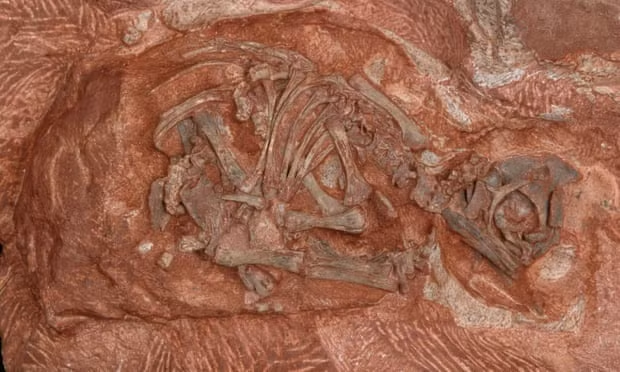
The embryonic skeleton of the dinosaur Massospondylus Photograph: D Scott/PA
 The embryonic skeleton of the dinosaur Massospondylus Photograph: D Scott/PA

Previous attempts at working out how mature dinosaur embryos are, such looking at the level of contact between different parts of the skull, have run into difficulties, not least because of challenges in assessing such features. However the scans, said Chapelle, offer a different approach, allowing researchers to look at the degree of bone formation and explore parts of the specimen otherwise hidden from view.

The new research, published in the journal Scientific Reports, reveals embryo remains in three of the eggs, the tiny, 2cm long, skulls showing two sets of teeth.

But while one set showed serrations and were similar to adult teeth, as has previously been seen in other dinosaur embryos, the other set was different, composed of simple, conical shaped teeth. “We have never seen that before,” said Chapelle, adding that, like many reptiles today, the dinosaurs would probably have either lost or reabsorbed these teeth before developing the teeth they would hatch with.

The team also drew on previously collected data from embryos of three animals alive today – the African spurred tortoise, the chicken and the nile crocodile – and tracked the location and extent of bone tissue formation within their embryos over their incubation. They then applied their findings to another living animal, the central bearded dragon.

The results reveal that while the animals have different incubation times, the sequence and relative timing of bone tissue formation with the skulls is similar.

Since all four animals, and dinosaurs, belong to the same group of land vertebrates – the saurians – Chapelle said the development of the dinosaur embryos probably followed a similar path.

“Having that same relative timing allows us to then apply the method to dinosaurs, no matter what [their] incubation period is – we can still tell how developed they are,” she said.

While previous work suggested the dinosaur embryos were on the verge of hatching at death the team say their comparison, together with the findings from the teeth, suggest the embryos were just 60% of the way through their incubation period – making them some of the least developed dinosaur embryos currently known.

Michael Benton, professor of vertebrate palaeontology at the University of Bristol, who was not involved in the research, said the study was a fantastic piece of work showing the ability of modern technology to reveal astonishing details, even of embryo dinosaurs.

He also praised the team’s method of comparing the growth of the skulls.

“This gives a reliable method of ageing an embryo of a dinosaur for the first time, and then particular events in development can be identified – such as the early appearance of teeth and then their re-absorption, long before the little creature hatches,” he said.

The Guardian

Other News

SK Group partners to build AI ecosystem in Vietnam

SK Group partners to build AI ecosystem in Vietnam

SK Innovation and SK Telecom signed MoUs with Nghe An province and the National Innovation Centre of Vietnam to advance AI ecosystem development and support the country’s long-term growth strategy.

Vietnam Research Excellence Fellowship for 2026-2030 approved

Vietnam Research Excellence Fellowship for 2026-2030 approved

Under the Vietnam Research Excellence Fellowship (VREF) for the 2026–2030 period, PhD students are identified as a core research force directly contributing to breakthroughs in sci-tech and innovation. Investing in top-tier doctoral candidates is more than workforce development, but a high-stakes strategic bet to forge a cohort of world-class scientists and technologists who can power Vietnam’s long-term economic ambitions.

Strategic tech must address practical challenges: PM

Strategic tech must address practical challenges: PM

Prime Minister Pham Minh Chinh on March 28 said strategic technologies must tackle Vietnam’s practical challenges, while chairing a meeting of the Government’s Steering Committee for science and technology, innovation, digital transformation, and Project 06.

Ho Chi Minh City sets sights on becoming semiconductor hub

Ho Chi Minh City sets sights on becoming semiconductor hub

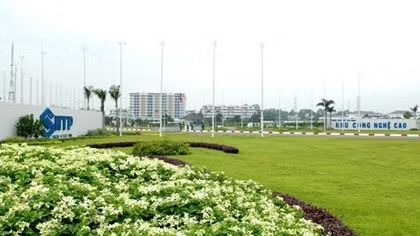
Ho Chi Minh City is stepping up efforts to attract investment from global leading groups and companies in the fields of electronic components, semiconductors and chip manufacturing as it seeks to position itself as a leading semiconductor industry hub in both the region and the world. 

Ho Chi Minh City launches upgraded technology exchange platform

Ho Chi Minh City launches upgraded technology exchange platform

The upgraded platform represents a comprehensive shift from a simple information-sharing model to a managed online technology trading system, enabling monitoring and measurement of real transaction outcomes. It is built on three pillars, namely new tradable technology products, a modern digital platform, and an improved operational model.

AI – unmissable opportunity for Vietnam: Experts

AI – unmissable opportunity for Vietnam: Experts

AI also emerges as a key enabler for Vietnam's ambition to build financial and technology hubs. Applications can boost efficiency, automate workflows, cut costs, and sharpen data analytics, which are essential pillars of a modern financial system.

PM calls for accelerated space technology development in Vietnam

PM calls for accelerated space technology development in Vietnam

Vietnam aims by 2030 to achieve a mid-level position in space science and technology development within Southeast Asia, and after 2030 to build national capabilities to independently develop satellite technologies and apply space data to address global challenges and national security needs.

High-level forum advances Vietnam–US technological cooperation

High-level forum advances Vietnam–US technological cooperation

A high-level executive leadership forum focusing on strengthening Vietnam - US relations through technology cooperation was jointly held in Washington D.C. on March 11 by the Embassy of Vietnam in the US, the Weatherhead East Asian Institute of Columbia University, and the US -ASEAN Business Council (USABC). 

AI Law takes effect, anchors national governance framework

AI Law takes effect, anchors national governance framework

While many countries are still drafting policy blueprints or issuing non-binding guidance, Vietnam has moved ahead with a standalone Law on Artificial Intelligence (AI), effective from March 1, placing it among a select group of nations to adopt dedicated AI legislation at the parliamentary level. 

Vietnam International Defence Expo 2026 preparations move into high gear

Vietnam International Defence Expo 2026 preparations move into high gear

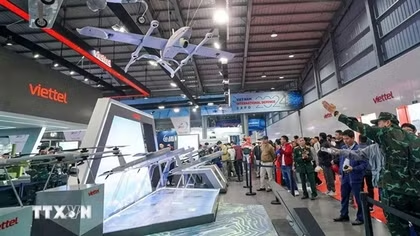
Vietnam International Defence Expo 2026, themed “Peace, Friendship, Cooperation and Development,” will be organised on a larger scale, featuring a wide array of weapons and technical equipment alongside product exhibitions, seminars and panel discussions, drills, live field demonstrations, and business networking activities.

Ministry requests urgent measures to counter UAVs threatening aviation safety

Ministry requests urgent measures to counter UAVs threatening aviation safety

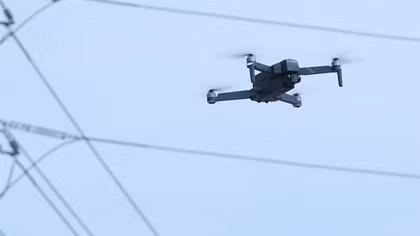
Ministry of Construction requested the Ministry of National Defence, the Ministry of Public Security and provincial and municipal steering committees for counter-terrorism to strengthen the management, inspection and supervision of UAVs and other aerial devices, ensuring strict compliance with Decree No. 288/2025/ND-CP and relevant legal regulations.