Scientists Find Cheap Way to Make Martian Soil into Super Strong Bricks

A new study has shown that Martian soil can be compressed into a building material similar to steel-reinforced concrete, but even stronger – meaning it could be used for the construction of a Martian settlement.

One of the central issues in building a Martian colony is the same one faced by creators of permanent settlements in any remote location: building materials. 

Perhaps shipping tons of concrete and steel to Antarctica is feasible, but moving matter into space is expensive and difficult. A cost-effective Martian colony would have to use materials already abundant on the Red Planet.
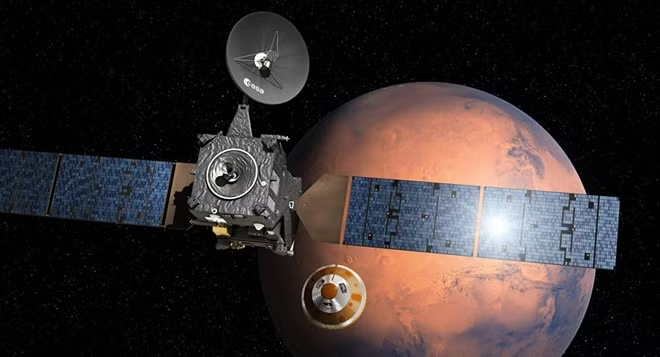
As Mars was virtually undisturbed for billions of years, the soil around the planet is highly uniform in chemical composition. If someone could find a way to make useful things out

"Near-future exploration to Mars connotes the technology of space construction," wrote the research team with the University of California at San Diego team that studied simulated Martian soil. "Permanent human settlement on Mars requires infrastructure to sustain habitats and life. A steady supply of structural materials is integral towards this effort."

The new study was funded by NASA and published in the journal Scientific Reports. During the study, the team used a Martian soil simulant called Mars-1a meant to mimic the dusts of Mars as closely as possible. Using compression alone, the researchers turned Mars-1a into a very strong, dense rocky material.

"Martian habitats are ideally constructed using only locally available soils; extant attempts to process structural materials on Mars, however, generally require additives or calcination," the study says. 

"In this work we demonstrate that Martian soil simulant Mars-1a can be directly compressed at ambient [temperature] into a strong solid without additives, highlighting a possible aspect of complete Martian in-situ resource utilization."

Previous teams have made bricks and other materials from Mars-1a, but they did so by changing the chemical composition in complex, frequently expensive procedures involving a polymer that bonds to the soil.

Study lead Yu Qiao and his team set out to find a cheaper polymer – but discovered that they didn't need one at all. Instead, they encased Mars-1a in a rubber tube and compacted it with a compressor. This caused the iron oxide present in Martian soil (the thing that gives it its red color) to act as a bonding agent, turning loose soil into dense rock.

The experimental brick was less than a millimeter thick, however. The researchers intend to test their method further on larger and larger bricks. If successful, they may have discovered the secret to building durable, cost-effective structures on Mars.

But don't book your stay in a Martian hotel just yet. Mars' soil is highly uniform compared to Earth, but that doesn't make it totally identical. Soil low in iron oxide would be less effective, or totally useless, with this technique.

In addition, while Mars-1a is very similar to Martian soil, it isn't identical. The technique may prove less effective on the real deal. "That is also our worry—everyone's worry," said Qiao in an interview with Popular Science.

As part of their new "Journey to Mars" initiative, NASA intends to put a human on the Martian surface sometime in the 2030s, possibly as part of a permanent scientific colony. "The people who will go to Mars will be incredibly brave," Qiao said in a statement. "They will be pioneers. And I would be honored to be their brick maker."

Sputnik News

Other News

SK Group partners to build AI ecosystem in Vietnam

SK Group partners to build AI ecosystem in Vietnam

SK Innovation and SK Telecom signed MoUs with Nghe An province and the National Innovation Centre of Vietnam to advance AI ecosystem development and support the country’s long-term growth strategy.

Vietnam Research Excellence Fellowship for 2026-2030 approved

Vietnam Research Excellence Fellowship for 2026-2030 approved

Under the Vietnam Research Excellence Fellowship (VREF) for the 2026–2030 period, PhD students are identified as a core research force directly contributing to breakthroughs in sci-tech and innovation. Investing in top-tier doctoral candidates is more than workforce development, but a high-stakes strategic bet to forge a cohort of world-class scientists and technologists who can power Vietnam’s long-term economic ambitions.

Strategic tech must address practical challenges: PM

Strategic tech must address practical challenges: PM

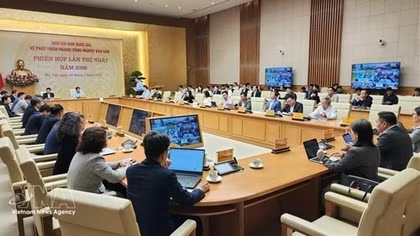
Prime Minister Pham Minh Chinh on March 28 said strategic technologies must tackle Vietnam’s practical challenges, while chairing a meeting of the Government’s Steering Committee for science and technology, innovation, digital transformation, and Project 06.

Ho Chi Minh City sets sights on becoming semiconductor hub

Ho Chi Minh City sets sights on becoming semiconductor hub

Ho Chi Minh City is stepping up efforts to attract investment from global leading groups and companies in the fields of electronic components, semiconductors and chip manufacturing as it seeks to position itself as a leading semiconductor industry hub in both the region and the world. 

Ho Chi Minh City launches upgraded technology exchange platform

Ho Chi Minh City launches upgraded technology exchange platform

The upgraded platform represents a comprehensive shift from a simple information-sharing model to a managed online technology trading system, enabling monitoring and measurement of real transaction outcomes. It is built on three pillars, namely new tradable technology products, a modern digital platform, and an improved operational model.

AI – unmissable opportunity for Vietnam: Experts

AI – unmissable opportunity for Vietnam: Experts

AI also emerges as a key enabler for Vietnam's ambition to build financial and technology hubs. Applications can boost efficiency, automate workflows, cut costs, and sharpen data analytics, which are essential pillars of a modern financial system.

PM calls for accelerated space technology development in Vietnam

PM calls for accelerated space technology development in Vietnam

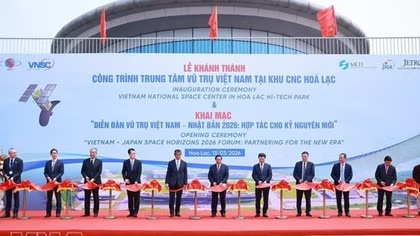
Vietnam aims by 2030 to achieve a mid-level position in space science and technology development within Southeast Asia, and after 2030 to build national capabilities to independently develop satellite technologies and apply space data to address global challenges and national security needs.

High-level forum advances Vietnam–US technological cooperation

High-level forum advances Vietnam–US technological cooperation

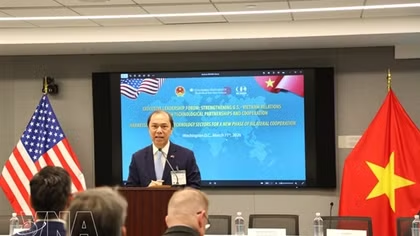
A high-level executive leadership forum focusing on strengthening Vietnam - US relations through technology cooperation was jointly held in Washington D.C. on March 11 by the Embassy of Vietnam in the US, the Weatherhead East Asian Institute of Columbia University, and the US -ASEAN Business Council (USABC). 

AI Law takes effect, anchors national governance framework

AI Law takes effect, anchors national governance framework

While many countries are still drafting policy blueprints or issuing non-binding guidance, Vietnam has moved ahead with a standalone Law on Artificial Intelligence (AI), effective from March 1, placing it among a select group of nations to adopt dedicated AI legislation at the parliamentary level. 

Vietnam International Defence Expo 2026 preparations move into high gear

Vietnam International Defence Expo 2026 preparations move into high gear

Vietnam International Defence Expo 2026, themed “Peace, Friendship, Cooperation and Development,” will be organised on a larger scale, featuring a wide array of weapons and technical equipment alongside product exhibitions, seminars and panel discussions, drills, live field demonstrations, and business networking activities.

Ministry requests urgent measures to counter UAVs threatening aviation safety

Ministry requests urgent measures to counter UAVs threatening aviation safety

Ministry of Construction requested the Ministry of National Defence, the Ministry of Public Security and provincial and municipal steering committees for counter-terrorism to strengthen the management, inspection and supervision of UAVs and other aerial devices, ensuring strict compliance with Decree No. 288/2025/ND-CP and relevant legal regulations.