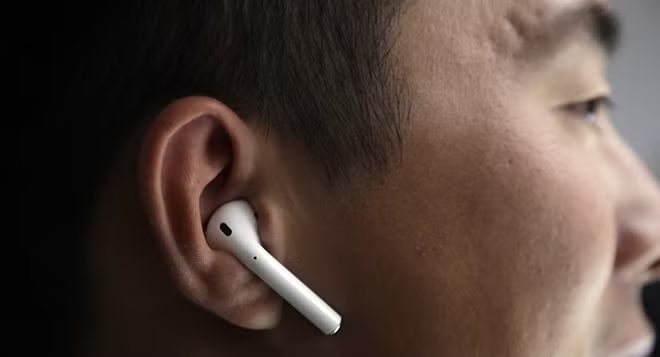
Scientists warn Apple AirPods may pose cancer risk

As many as 250 researchers have appealed to the WHO and UN member nations, drawing their attention to the harm even minimal electromagnetic waves were scientifically found to cause in humans, including an increase in free radicals and cellular damage, demanding that the international medical watchdog should come up with more protective guidelines.

Despite the enormous popularity wireless headphones, such as AirPods and the similar Samsung Galaxy Buds, have earned in recent years, researchers are increasingly voicing concerns about the harmful effects they may have on human health. 

The devices, which harness Bluetooth technology, a type of electromagnetic frequency (EMF) radio wave that can transmit data, are in dangerous proximity to the user’s inner skull, literally rubbing against it.

"My concern for AirPods is that their placement in the ear canal exposes tissues in the head to relatively high levels of radio-frequency radiation", said Jerry Phillips, a professor of biochemistry at the University of Colorado, who is among those who signed a petition calling for “protection” from the technology.

The petition, called International EMF Scientist Appeal, and signed by as many as 250 professionals in the field, reads as follows:
"Based upon peer-reviewed, published research, we have serious concerns regarding the ubiquitous and increasing exposure to EMF generated by electric and wireless devices".

The petition further mentions such diagnoses as cancer, neurological disorders, and even DNA damage, citing research that links these to EMF exposure, and hence, the use of wireless headphones. The document also brings up recent findings by The International Agency for Research on Cancer, suggesting that EMF “possibly” has “carcinogenic”  effects on humans, since high levels EMF can increase heat and thereby boost cell growth in human bodies.

The petition also mentions the fact that respective agencies that are supposed to introduce EMF exposure safety standards on permissible EMF exposure levels have so far failed to so, adding that “no sufficient guidelines”  have been imposed “to protect the general public, particularly children who are more vulnerable to the effects of EMF”. The petition has openly criticised the WHO in this regard:

"By not taking action, the WHO is failing to fulfil its role as the preeminent international public health agency".

In light of the technological and digital revolution of the past several years and launch of cutting-edge smartphones, EMF exposure has become a subject of scrupulous study. 

More specifically, Dr Andrew Goldsworthy, a retired lecturer from the Imperial College of London, one of the top three UK universities after Oxford and Cambridge, described “The Biological Effects of Weak Electromagnetic Fields” at length in a publication dated March 2012.

Short wavelengths, as well as the rapid rise and fall times of pulses emitted by Bluetooth and cell phones, can damage human cells by throwing off calcium ion signalling and causing ion channels to leak. This cellular disruption can cause irreparable DNA damage in the long run, which in turn increases cancer risk.

With this exposure close to the head, like in the case of headphones, the blood-brain barrier thins and weakens, leading to neuronal damage, DefenderShield cited Goldsworthy’s research. 

Meanwhile, some scientists, bioengineers in particular, have accused the afore-mentioned petition of cherry-picking varying data to prove the negative effects of EMF waves, suggesting the given arguments are not credible enough and citing the radio waves in headphones to be too miniscule to cause any harm.

"There are many thousands of papers of varying quality and relevance to health that point in all sorts of directions", Kenneth Foster, a professor of bioengineering at the University of Pennsylvania, insisted, adding that there is no objective evidence of harm that EMF may inflict.
Sputnik

Other News

SK Group partners to build AI ecosystem in Vietnam

SK Group partners to build AI ecosystem in Vietnam

SK Innovation and SK Telecom signed MoUs with Nghe An province and the National Innovation Centre of Vietnam to advance AI ecosystem development and support the country’s long-term growth strategy.

Vietnam Research Excellence Fellowship for 2026-2030 approved

Vietnam Research Excellence Fellowship for 2026-2030 approved

Under the Vietnam Research Excellence Fellowship (VREF) for the 2026–2030 period, PhD students are identified as a core research force directly contributing to breakthroughs in sci-tech and innovation. Investing in top-tier doctoral candidates is more than workforce development, but a high-stakes strategic bet to forge a cohort of world-class scientists and technologists who can power Vietnam’s long-term economic ambitions.

Strategic tech must address practical challenges: PM

Strategic tech must address practical challenges: PM

Prime Minister Pham Minh Chinh on March 28 said strategic technologies must tackle Vietnam’s practical challenges, while chairing a meeting of the Government’s Steering Committee for science and technology, innovation, digital transformation, and Project 06.

Ho Chi Minh City sets sights on becoming semiconductor hub

Ho Chi Minh City sets sights on becoming semiconductor hub

Ho Chi Minh City is stepping up efforts to attract investment from global leading groups and companies in the fields of electronic components, semiconductors and chip manufacturing as it seeks to position itself as a leading semiconductor industry hub in both the region and the world. 

Ho Chi Minh City launches upgraded technology exchange platform

Ho Chi Minh City launches upgraded technology exchange platform

The upgraded platform represents a comprehensive shift from a simple information-sharing model to a managed online technology trading system, enabling monitoring and measurement of real transaction outcomes. It is built on three pillars, namely new tradable technology products, a modern digital platform, and an improved operational model.

AI – unmissable opportunity for Vietnam: Experts

AI – unmissable opportunity for Vietnam: Experts

AI also emerges as a key enabler for Vietnam's ambition to build financial and technology hubs. Applications can boost efficiency, automate workflows, cut costs, and sharpen data analytics, which are essential pillars of a modern financial system.

PM calls for accelerated space technology development in Vietnam

PM calls for accelerated space technology development in Vietnam

Vietnam aims by 2030 to achieve a mid-level position in space science and technology development within Southeast Asia, and after 2030 to build national capabilities to independently develop satellite technologies and apply space data to address global challenges and national security needs.

High-level forum advances Vietnam–US technological cooperation

High-level forum advances Vietnam–US technological cooperation

A high-level executive leadership forum focusing on strengthening Vietnam - US relations through technology cooperation was jointly held in Washington D.C. on March 11 by the Embassy of Vietnam in the US, the Weatherhead East Asian Institute of Columbia University, and the US -ASEAN Business Council (USABC). 

AI Law takes effect, anchors national governance framework

AI Law takes effect, anchors national governance framework

While many countries are still drafting policy blueprints or issuing non-binding guidance, Vietnam has moved ahead with a standalone Law on Artificial Intelligence (AI), effective from March 1, placing it among a select group of nations to adopt dedicated AI legislation at the parliamentary level. 

Vietnam International Defence Expo 2026 preparations move into high gear

Vietnam International Defence Expo 2026 preparations move into high gear

Vietnam International Defence Expo 2026, themed “Peace, Friendship, Cooperation and Development,” will be organised on a larger scale, featuring a wide array of weapons and technical equipment alongside product exhibitions, seminars and panel discussions, drills, live field demonstrations, and business networking activities.

Ministry requests urgent measures to counter UAVs threatening aviation safety

Ministry requests urgent measures to counter UAVs threatening aviation safety

Ministry of Construction requested the Ministry of National Defence, the Ministry of Public Security and provincial and municipal steering committees for counter-terrorism to strengthen the management, inspection and supervision of UAVs and other aerial devices, ensuring strict compliance with Decree No. 288/2025/ND-CP and relevant legal regulations.