 |
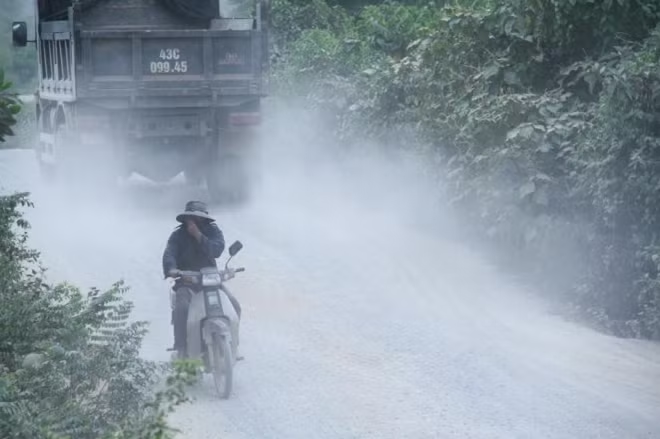
| Dusty roads in Phuoc Thuan Village - Photo tuoitre.vn |
The ever-closed doors
It’s the end of October, no rain in sight, yet roads and streets in Phuoc Thuan village (Hoa Nhon Commune) are covered in mud.
On a five-metre wide village road which was just water-sprayed to prevent dust, a line of dump trucks carrying stones and earth is a common sight.
Infamously named "road monsters", these trucks are the source of many residents’ grievances.
“Trucks carry stones and earth in and out of here all day, causing all kinds of noise and dust, even our homes shake,” Le Hung, a resident, told Tuoi Tre Cuoi Tuan (Youth, Weekend edition) newspaper.
Hung added that except for the annual Tet holiday, villagers are constantly disturbed by the many loud trucks, which have also laid waste to the village’s streets.
Da Nang City has granted permission to 12 quarries to operate in the two small villages of Phuoc Thuan and Phuoc Hau.
Following the truck route to the quarries is a journey through so much dust swirling up from the pitted dirt roads or rained down from quarries above that visibility is minimal, even in broad daylight.
Trees are coated with a white layer of dust that stifles their growth.
Virtually all doors and windows are tightly closed against the dust and noise.
Tran Trung from Phuoc Thuan Village said children are either kept indoors all day or sent to grandparents’ houses elsewhere to protect them from truck accidents, rock falls and pollution.
“Just me and my wife still live in this house. The older child has moved to another place since living here means being in constant fear,” he said.
Deafening familiarity
It’s past midnight but the quarries on the mountains are still bustling with activities, much to the annoyance of local residents.
The nearer one gets to the foot of the mountain, the trembles of rock blasting become more pronounced as does the deafening roar of drilling machines and excavators.
“After loudly drilling a hole in the rocks, miners put in explosives and detonate them without regard for the time of day or night. Every house shakes. Houses within a 400 metres radius of the mining sites suffer recurring damage , with cracks appearing along their walls,” Vo Thi Duyet, also from Phuoc Thuan Village, said.
“Many times, we were shaken awake in the middle of the night due to explosions from three quarries the same time. Sometimes the air reeks of the acrid smell of burnt explosives, and debris and dust rain down on us,” she added.
Ten years ago, residents used tree trunks and rocks to block the trucks, but to no avail.
Blighted livelihoods
The thick, verdant forests on the Trang Rang, Ho Khe, Ho Trau, Ho Bac, Ho Vi, Ho Rai mountains are scarred with gouged out patches of soil and rock or lined with empty paths where trees once grew.
“The previously forest-covered mountains and hills, which used to provide shelter for villagers, have now been stripped bare. When storms come, there’s no keeping the strong gusts from hitting our homes. In rainy seasons, floodwater level rises higher than before,” Le Hung said.
Le Van Tuan, head of Phuoc Thuan Village, said that out of 185 households in the village, only a few still cultivate rice and other crops in a total area of a mere 1 hectare.
Ever since the quarries started operating to provide building materials to Da Nang City, people cannot grow crops anymore.
“The water that used to flow down from the mountains has been obstructed by the mining companies to be used for their crushers. However, in case of a downpour, rainwater [unhampered by the damaged forests] carries all the sediments, dirt, and rocks from the mountain sides down to the fields, burying all the crops. When it is dry and sunny, the air is so dusty that rice plants cannot blossom, so the cultivated lands are just left abandoned.”
Tuan estimated that some 600 trucks of all types went in and out of his village every day, and as many as 1,000 on busy days.
“If not for the bond of generations with the land, most would not continue to stay here,” Tuan said.
Although just 10 km from the centre of Viet Nam’s third largest city, it’s hard to imagine anyone buying a house there.
A new road is scheduled to be completed next year so that trucks can bypass residential areas, but some routes to quarries will still pass through residential areas.
“If authorities continue to allow mining companies to operate here, then residents want a plan to relocate them from this area soon,” Tuan said.
In Box:
The Chairman of the People’s Committee of Da Nang City, Huynh Đuc Tho, has asked the Department of Construction to collaborate with relevant agencies to upgrade and reinforce roads leading to quarries. Quarry operators are required to carry out remediation, reclamation, restoration and rehabilitation activities once they finish exploiting the soil.