Switzerland will continue assistance to Việt Nam

HA NOI — Switzerland has pledged to continue its support to Việt Nam through overseas development assistance (ODA) projects, which focus on achieving sustainable economic growth.

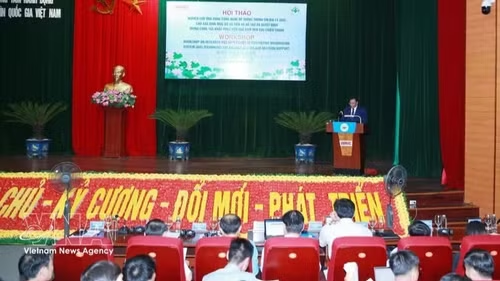
Speaking at a workshop to review the completion of 25 years of Swiss Agency for Development Co-operation (SDC) in Việt Nam last Friday, Swiss ambassador to Việt Nam Beatrice Maser Mallor said that as Việt Nam had become a lower-middle-income country, Switzerland’s assistance needed to be adjusted to reflect this new reality.

“Perhaps SDC’s most significant achievement has been to give people a voice in the local government and to promote people’s participation in decisions affecting their livelihoods at the grassroots level,” she said.

Between 1992 and 2016, SDC’s primary focus was to alleviate poverty and improve local governance. This paved the way for a new phase of bilateral development co-operation between the two countries, with SDC’s sister organisation – Switzerland’s State Secretariat for Economic Affairs (SECO) – to take over from 2017 onwards.

Việt Nam will continue to benefit from SDC’s various regional and global programmes that tackle climate change, water and food security, said Tim Enderlin, head of SDC in Việt Nam. Over the past 25 years, an estimated 4.6 to 6.8 million people nationwide have benefited directly and indirectly through 32 SDC programmes, with a total assistance of CHF216 million (approximately US$236 million).

“SDC’s programmes help people ‘climb’ out of poverty. I don’t like the phrase ‘lift people out of poverty.’ I think people do this themselves, with SDC’s assistance,” Jacob Gammelgaard, independent reviewer of SDC’s portfolio in Việt Nam, said. Other than promoting local governance, all of SDC’s programmes contribute to poverty reduction through self-empowerment.
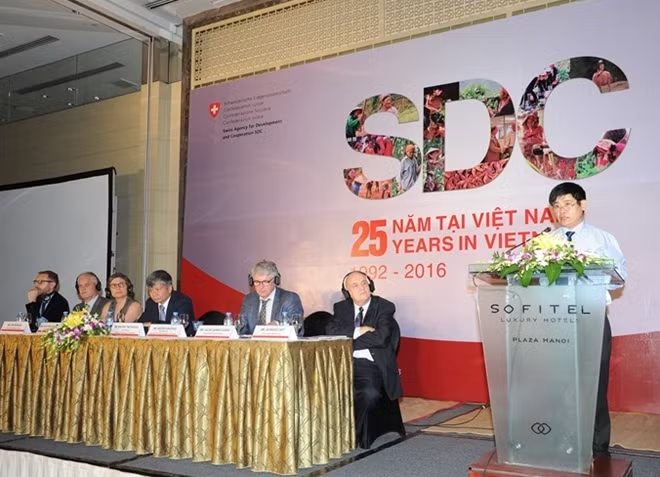
Nguyễn Văn Dũng – Deputy Chairman of the Hoà Bình Provincial People’s Committee delivers a speech at the workshop. – Photo SDC

Speaking at the workshop, deputy minister of the investment and planning ministry Nguyễn Thế Phương said the collaboration between the two countries made effective use of Switzerland’s expertise and experience in development, most notably, decentralisation and local-level planning, which is in line with the government’s policy of fostering grassroots democracy.

“Our co-operation spanned various areas, from education, vocational training, capacity building, management and public administration reforms to urban development planning and rural livelihoods,” he said.

Independent assessment based on documentation and interviews with stakeholders and beneficiaries rated 43.5 per cent of SDC’s portfolio disbursement as excellent and very good and 29.7 per cent as good, while 17.3 per cent and 4.1 were rated as below average and failed, respectively. Three OECD’s (Organisation for Economic Co-operation and Development) criteria to assess the programmes, namely sustainability, effectiveness and impact, and a fourth criterion of replicability was added.

Some of SDC’s flagship programmes include the one-stop shop model which aims to streamline public administrative services and is now implemented nationwide; the Strengthening Vocational Training Centres programme to build a base of Vietnamese researchers and educators; and the Market Access for the Rural Poor programme that helps rural products reach more customers locally and abroad.

The northern Hoà Bình province is a long-time beneficiary of SDC’s investment, seeing rural and forestry development, improved public services in agriculture and community participation programmes between 1998 and 2015.

Deputy Chairman of the provincial People’s Committee Nguyễn Văn Dũng said, “SDC projects approached people directly to mobilise their participation in planning, implementing and monitoring their community plans. The projects’ practices were institutionalised by the decisions of the provincial authorities. This substantively contributes to the implementation of grassroots democracy.”

Incidentally, 2016 also marked the 45th anniversary of Việt Nam-Switzerland diplomatic relations.


VNS

Other News

Vietnam steps up implementation of ethnic affairs strategy through 2030

Vietnam steps up implementation of ethnic affairs strategy through 2030

To accelerate the implementation of the the Ethnic Affairs Strategy by 2030, with a vision toward 2045, the Prime Minister requested ministries, agencies and local authorities to continue thoroughly carrying out the Party and State’s policies on ethnic affairs, enhancing the effectiveness of State management and strengthening oversight of policy implementation.

Security preparations reviewed for APEC 2027 in Phu Quoc

Security preparations reviewed for APEC 2027 in Phu Quoc

The team examined the APEC 2027 Convention Centre, where main conference activities are scheduled; Sun Serenia Hospital, designated to provide healthcare and emergency medical services for delegates; provincial road DT.975, which connects Phu Quoc International Airport to the convention centre; and the area surrounding Phu Quoc International Airport.

Hanoi accelerates seven Red River bridge projects, many exceed 70% completion

Hanoi accelerates seven Red River bridge projects, many exceed 70% completion

According to the municipal Transport Construction Investment Project Management Board, the city is simultaneously implementing seven projects, namely Tu Lien, Ngoc Hoi, Tran Hung Dao, Thuong Cat, Van Phuc, Hong Ha and Me So bridges. Construction is being carried out on multiple fronts, focusing on bored piles, pile caps, piers and superstructure works.

Dien Bien battlefield legacy powers tourism revival

Dien Bien battlefield legacy powers tourism revival

Seventy-two years after the Dien Bien Phu Victory, its legacy still reverberates. The unity, self-reliance, and resilience forged in that historic triumph remain a powerful internal engine, now propelling Dien Bien toward fast and sustainable development.

Hanoi accelerates shift to green buses, targets 100% by 2030

Hanoi accelerates shift to green buses, targets 100% by 2030

In the 2027–2030 period, the city will accelerate the transition towards the complete phase-out of fossil fuel-powered buses. The share of electric and green energy-fueled buses is projected to reach 79–89% by 2029 and 100% by 2030.

36 fishermen safely rescued after boat breaks down near Truong Sa

36 fishermen safely rescued after boat breaks down near Truong Sa

At 8:00 the same day, KN475 began towing the disabled fishing boat toward Da Tay A island. The towing operation was carried out safely, and by 18:30 both the vessel and its crew had arrived at the island without incident, where repairs and additional support procedures were arranged.

Vietnamese language contest in Laos strengthens youth ties, bilateral friendship

Vietnamese language contest in Laos strengthens youth ties, bilateral friendship

Held in response to the launch of the Vietnamese Language Day among overseas Vietnamese communities, the event aimed to enhance the quality of Vietnamese language teaching and learning in Laos while contributing to the great friendship, special solidarity, comprehensive cooperation and strategic cohesion between the two countries.

Vietnamese language contest in Laos strengthens youth ties, bilateral friendship

Vietnamese language contest in Laos strengthens youth ties, bilateral friendship

Held in response to the launch of the Vietnamese Language Day among overseas Vietnamese communities, the event aimed to enhance the quality of Vietnamese language teaching and learning in Laos while contributing to the great friendship, special solidarity, comprehensive cooperation and strategic cohesion between the two countries.

Hanoi launches 10 electric bus routes from April 1

Hanoi launches 10 electric bus routes from April 1

By the end of April, the number of buses using electricity and other green energy sources in the city is expected to reach 822, including 683 electric buses and 139 compressed natural gas (CNG) buses, representing 42.1% of the total number of vehicles.