Toll booths can’t be wished away: Transport Ministry

The Ministry of Transport says it is not feasible to remove toll booths on national roads because the Government would have to shell out significant sums of money to compensate private investors.

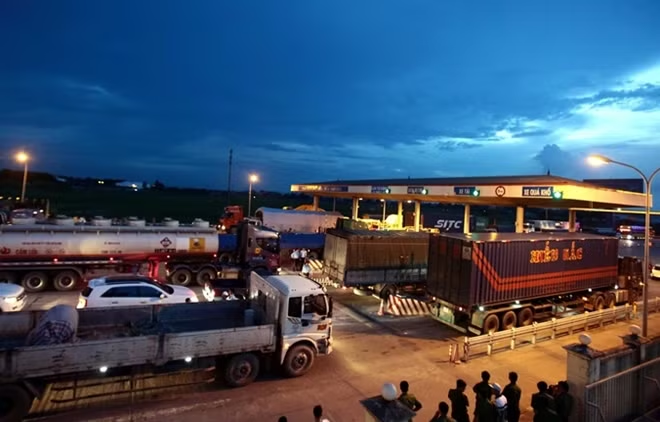
Trucks and cars line up at a toll booth on National Highway 5 in Hung Yen Province’s Van Lam District

This assessment has been made by the ministry’s Public-Private Partnership (PPP) department.

A report prepared by the department says that with Viet Nam still in a fast-growth mode, its infrastructure development demand is significant.

With limited State Budget resources, public infrastructure projects – especially traffic-related ones – that require large capital have been opened up to private investment, mostly under the Build-Operate-Transfer (BOT) model.

Under this model, the private developer responsible for construction and operation of a project is entitled to revenues generated by the project for a certain period. After this period, which is calculated to ensure the investor gets back the original investment, the project comes under public administration.

However, many BOT projects have generated controversy, disgruntlement and protests. Opponents have slammed high toll rates, inappropriate locations, lack of transparency and corruption.

According to the PPP department’s report, there are 88 toll booths on national roads across the country. Of these, 73 booths – 56 active and 17 yet to operate – are under the management of the ministry. The remaining 15 – 11 active and four slated to open under ongoing projects – are managed by provincial People’s Committees.

The majority of the toll booths, 58, lie more than 70km away from the nearest one, as per the minimum distance requirement set out in a circular by Ministry of Finance (MoF). Ten booths are only 60-70km from the nearest one on the same road, while 20 are less than 60km from their nearest neighbours.

To resolve issues related to these booths, there needs to be “consensus” between the MoT and the provincial people’s committee, with the MoF making the final decision, the report says.

It also says that after inspections by the National Assembly, the booths having issues have been divided into three types.

The first one comprises three toll booths to recoup capital for constructing bypasses.

The second type has six booths on main roads aiming to recoup investment in constructing and upgrading of the main road and its bypass.

The third type has six booths erected on national roads, the purpose of which is to recover capital spent on building expressways and upgrading parallel national roads (National Road 6, National Road 3, Bac Giang – Lang Son section of National Road 1, and National Road 5).

The installation of booths under the first category was in line with the law at that time, but they are no longer “appropriate,” the report says. These booths have attracted widespread public complaints.

“To solve this issue, the government can choose to buy these booths but, with the current budgetary constraints, it is not a feasible option,” it says.

For the second category of problematic toll booths, the two options are to end them completely or relocate them to the bypass roads.

“However, with the latter measure, the investors might not get back their capital investment in time and their debts might become bad debts, and then the government will have to step in to buy the whole project, which could total VNĐ8.5 trillion (US$374.26 million).

The same goes for the first measure,” a PPP department representative said, adding that removal of two toll booths on National Road 5 alone would cost the government VNĐ16 trillion ($704.5 million).

For the third type, the department has suggested that the Mot report to the Government on maintaining the locations of such tollbooths, citing feasible financial plans.

The department has suggested that higher authorities “raise awareness” on this issue so as to “create consensus among the public”, and avoid the controversies seen in recent times.

VNS

Other News

Hanoi ready to implement Capital Law 2026, unlocking new development momentum

Hanoi ready to implement Capital Law 2026, unlocking new development momentum

The effectiveness of the Capital Law 2026 will be measured not by the number of legal documents issued but by tangible improvements in governance and public administration, better services for people and businesses, faster administrative procedures, stronger investment attraction and higher economic growth.

Vietnamese students earn honours at ROBOG Asia Cup 2026

Vietnamese students earn honours at ROBOG Asia Cup 2026

Three teams from Chu Van An Secondary School in Vietnam’s Thai Nguyen province have earned First Prize honours and advanced to the quarterfinals at the ROBOG Asia Cup 2026, a regional robotics and artificial intelligence (AI) competition for students held in Hong Kong, China.

Hanoi sets out new investment blueprint with century-long development vision

Hanoi sets out new investment blueprint with century-long development vision

As of early June, Hanoi had attracted 74.6 billion USD in foreign direct investment (FDI) through more than 9,250 valid projects. FDI inflows in the first six months were projected at 3.2 billion USD, surpassing the annual target by 116%, while nearly 16,000 new businesses were established in the first five months, up 34.4% year-on-year.

Vietnam promotes legal cooperation and rule of law at global forum

Vietnam promotes legal cooperation and rule of law at global forum

Vietnam’s development and international integration have gone hand in hand with the improvement of its legal system, the incorporation of international commitments into domestic legislation, and legal reforms aimed at fostering development, openness and global integration. The country regards international law as an essential instrument for building fair, mutually beneficial relations among nations.

Hanoi to hold investment promotion event on June 29

Hanoi to hold investment promotion event on June 29

At the event, Hanoi authorities plan to grant investment policy decisions and investment registration certificates to 20 exemplary projects in the fields of transportation infrastructure, industrial parks, urban development, social housing, environment, science and technology, and foreign investment attraction.

Hanoi's Red River urban area development draws widespread attention

Hanoi's Red River urban area development draws widespread attention

Located south of the Red River and extending from the historic inner city to newly developing areas in the south and the west, the central urban area along Red River’s right bank covers approximately 45,317 hectares and is projected to accommodate around 6.365 million residents by 2045 and 6.455 million by 2065.

Hanoi's Red River urban area development draws widespread attention

Hanoi's Red River urban area development draws widespread attention

Located south of the Red River and extending from the historic inner city to newly developing areas in the south and the west, the central urban area along Red River’s right bank covers approximately 45,317 hectares and is projected to accommodate around 6.365 million residents by 2045 and 6.455 million by 2065.

Regional cooperation strengthened to combat cross-border drug crime

Regional cooperation strengthened to combat cross-border drug crime

Vietnam, China, Laos and Myanmar face common challenges as drug syndicates increasingly exploit the Mekong River, cross-border transport networks, e-commerce platforms, international logistics services, cyberspace and cryptocurrencies to organise drug transactions and smuggling operations.