Uber fires head of self-driving car unit amid lawsuit over stolen Google secrets

Uber has fired the head of its self-driving car unit, Anthony Levandowski, amid the continuing fallout from the engineer’s alleged theft of trade secrets from his former employer, Google.

The termination, which was first reported by the New York Times, comes three months after Levandowksi was accused of stealing 14,000 internal documents from Google’s self-driving car spinoff, Waymo, and taking them to Uber. Waymo sued Uber in February, alleging that the ride-hail company was using the stolen documents to advance its lidar technology, and the case between the two Silicon Valley firms is set to go to trial in October.

Uber has denied any wrongdoing, but Levandowski has invoked his fifth amendment right against self-incrimination. He has refused to turn over any documents or answer questions during a deposition.

On 12 May, a federal judge granted Waymo a preliminary injunction against Uber that required the company to remove Levandowski from any work on lidar, the technology that allows a self-driving car to “see” its surroundings, and to return any stolen documents to Waymo.

In Levandowski’s termination letter, which was included in a court filing and is dated 26 May, Uber general counsel Salle Yoo cited Levandowski’s failure to comply with the court order as the cause of his firing. Yoo also wrote that Levandowski’s actions had “impeded Uber’s internal investigation and defense of the lawsuit”.

The letter also revealed that Uber required Levandowski to have “returned or destroyed all property and confidential information belonging to any prior employer” as a condition of his employment. Yoo writes that Levandowski’s failure to comply with the court order constitutes a potential “breach” of the employment agreement.
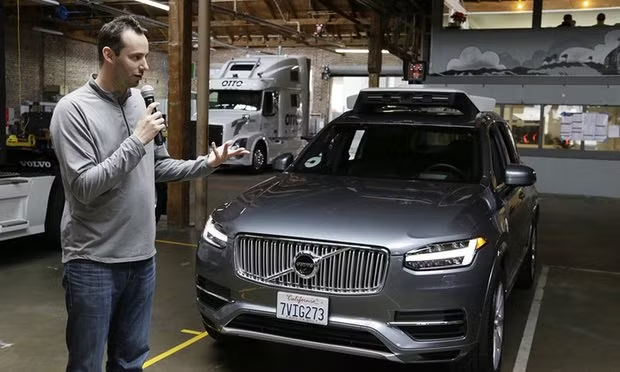
On 12 May, a federal judge granted Waymo a preliminary injunction against Uber that required the company to remove Levandowski from any work on lidar and to return any stolen documents to Waymo. Photograph: Eric Risberg/AP

Attorneys for Levandowski did not immediately respond to a request for comment, but they have argued in court filings that the preliminary injunction infringes on Levandowski’s constitutional rights by compelling Uber to fire him if he does not waive his fifth amendment right.

Levandowski was one of several alumni of Google’s self-driving car program who founded the self-driving truck startup Otto in 2016. Otto was acquired by Uber for $680m in August 2016, and Levandowski was installed as the head of Uber’s self-driving car program. Levandowski was awarded $250m in Uber stock as part of the deal, according to documents revealed in court.

In February, Google’s self-driving car spinoff Waymo sued Uber, alleging that Levandowski had downloaded 14,000 documents prior to leaving, and used the stolen technology to help Uber get a jump start with its own self-driving car program.

Levandowski could face criminal charges over the alleged theft. The judge overseeing the civil case recommended that federal prosecutors begin a criminal investigation on 12 May. Violations of the federal trade secrets law can carry up to a 10-year prison term.

Eric Meyhofer will take over Levandowski’s role in charge of Uber’s self-driving car program, an Uber spokesperson said.

The turmoil in Uber’s self-driving car program is just one of numerous scandals rocking the $68bn company. A report on Uber’s work environment is expected next week, following allegations of a widespread sexual harassment and gender discrimination by a former employee earlier this year. The company has seen an exodus of executives in recent months and a viral consumer boycott.

Last week, Uber admitted to underpaying New York City drivers tens of millions of dollars in fares. The company is under criminal investigation by the US justice department over its use of “Greyball”, a program that enabled it to evade enforcement officers in cities where it was operating illegally.
The Guardian

Other News

Vietnam targets at least 10 large strategic technology firms by 2030

Vietnam targets at least 10 large strategic technology firms by 2030

Deputy Prime Minister Ho Quoc Dung has signed a decision approving a plan to develop large domestic strategic technology enterprises in the 2026–2030 period, aimed at advancing digital infrastructure, digital human resources, digital data, strategic technologies and cybersecurity.

Protecting users crucial in building digital trust: Experts

Protecting users crucial in building digital trust: Experts

In Vietnam, digital transformation in the finance and banking sector is accelerating cashless payments, expanding access to financial services, improving market transparency and supporting economic growth and macroeconomic management.

Fostering skilled workforce for innovation era: experts

Fostering skilled workforce for innovation era: experts

Experts said close coordination among State management agencies, research institutes, universities, and businesses will improve training quality and serve the dual goals of quality education and practical research application.

Startup forum bridges Silicon Valley and local innovation ecosystem

Startup forum bridges Silicon Valley and local innovation ecosystem

The University of Economics Ho Chi Minh City (UEH), Saigon Asset Management (SAM), and Plug and Play Tech Centre co-hosted the “From Vietnam to Silicon Valley” forum, exploring AI innovation, venture capital, and pathways to integrate Vietnam’s startup ecosystem with Silicon Valley and global markets.

Experts call for stronger action against fake news online

Experts call for stronger action against fake news online

Experts have warned that fake news, misinformation and harmful online content are increasingly shaping public perceptions, particularly among young people, and stressed the need for stronger legal safeguards, technology tools and wider dissemination of credible information to tackle the problem effectively.

Protecting digital future in post-quantum, AI era

Protecting digital future in post-quantum, AI era

Participants highlighted the importance of building a proactive, synchronised and sustainable national cybersecurity ecosystem through closer cooperation among regulators, technology firms, research institutions and cybersecurity experts.

Vietnam attends SAHA 2026 defence, aerospace exhibition in Türkiye

Vietnam attends SAHA 2026 defence, aerospace exhibition in Türkiye

Vietnam’s participation in SAHA 2026 International Defence & Aerospace Exhibition in Istanbul reflects the country’s consistent policy of enhancing international defence integration and promoting defence industry cooperation towards self-reliance, self-strengthening, modernisation and dual-use development.

SK Group partners to build AI ecosystem in Vietnam

SK Group partners to build AI ecosystem in Vietnam

SK Innovation and SK Telecom signed MoUs with Nghe An province and the National Innovation Centre of Vietnam to advance AI ecosystem development and support the country’s long-term growth strategy.

Vietnam Research Excellence Fellowship for 2026-2030 approved

Vietnam Research Excellence Fellowship for 2026-2030 approved

Under the Vietnam Research Excellence Fellowship (VREF) for the 2026–2030 period, PhD students are identified as a core research force directly contributing to breakthroughs in sci-tech and innovation. Investing in top-tier doctoral candidates is more than workforce development, but a high-stakes strategic bet to forge a cohort of world-class scientists and technologists who can power Vietnam’s long-term economic ambitions.