UK to ban Huawei from providing 'core' parts of UK 5G network

Theresa May has ordered that Chinese telecoms supplier Huawei be banned from supplying core parts of the future 5G mobile phone network, following a meeting of ministers on the National Security Council (NSC).

Huawei will be allowed to supply some “non-core” technology to UK phone companies, insiders said, but several ministers in the meeting on Tuesday raised concerns even about that concession, arguing instead for a total ban on the supplier.

The ban risks agitating both China and the company – which is privately owned – and comes as concern grows in the UK, US and elsewhere about whether the company’s technology poses a long-term security risk.

Britain’s intelligence agencies have taken a cautious approach to Huawei, but not called for a blanket ban. Jeremy Fleming, the director of spy agency GCHQ, argued last month that the UK needs to understand “the opportunities and threats posed” by Chinese technology.
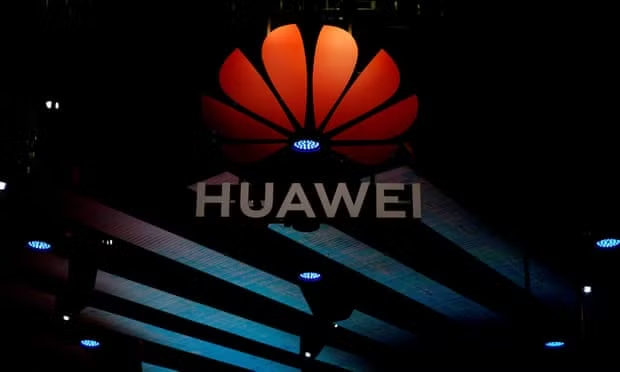
Several ministers have argued for a total ban on Huawei supplying technology for the UK’s 5G network. Photograph: Aly Song/Reuters

Other countries have taken a tougher stance. Chinese companies are banned from working on critical telecoms infrastructure in the United States. Mike Pence, the vice-president, called on “all our security partners to be vigilant” in February.

The leak of the Huawei decision came just days before Philip Hammond, the chancellor, is due in China this week to attend the country’s Belt and Road investment forum in Beijing and could cause problems for him.

In February, Hammond was forced to cancel a trade meeting with vice premier Hu Chunhua after the defence secretary, Gavin Williamson, had suggested the UK might deploy a new aircraft carrier into waters claimed by China on its maiden voyage in or around 2021.

Ministers said to have raised concerns about Huawei at the NSC meeting include Jeremy Hunt, the foreign secretary, Sajid Javid, the home secretary, Gavin Williamson, the defence secretary, and Penny Mordaunt, the international development secretary.

The decision came on the eve of a speech from Fleming in which he will pledge that indications that a cyber-attack is coming from China or Russia will be shared in a matter of seconds with corporations as he seeks to demonstrate how the spy agency can benefit British business and consumers.

The GCHQ director is expected to promise to increase the agency’s collaboration with the private and public sectors to create “a whole-of-nation, automated cyber-defence system” across the UK.

He will say at a security conference in Glasgow on Wednesday that its National Cyber Security Centre (NCSC) has already “made it simple for our analysts to share time-critical, secret information”.

Intelligence the NCSC picks up – “whether it’s indicators of a nation state cyber actor, details of malware used by cybercriminals or credit cards being sold on the dark web” – will be declassified and shared promptly in the future, Fleming will add.

He is not expected to name any countries as a specific threat, but hackers from Russia, China, North Korea and Iran are generally considered by the intelligence agencies the most likely sources of danger to British cybersecurity.

Extracts from Fleming’s speech provided only limited detail as to how cyber intelligence would be passed on, but the GCHQ boss said it would be done in a matter of seconds and “just one click” based on existing systems.

The NCSC acts as a window for the spy agency’s normally secretive activities, already sharing information with British business and the public sector in an attempt to improve cybersecurity.

But the organisation has already said that, despite its efforts, the UK can expect to face what it calls a category one, or C1 cyber-attack, by the end of the decade, such as interference in elections or an attack on energy, banking or other vital infrastructure.

Serious attacks elsewhere include the Russian hacking of the Democratic party in the run-up to the 2016 US presidential election. The most serious cyber-attack on the UK so far was the WannaCry ransomware attack in May 2017 that disrupted hospitals, which was ranked as a C2 attack because there was no threat to life.

Last October, Hunt, accused Russian military intelligence of being behind a spate of “reckless and indiscriminate” cyber-attacks ordered by the Kremlin, including on the World Anti-Doping Agency.

To demonstrate progress in national cybersecurity, Fleming will claim that fraudulent attempts to obtain sensitive information using phishing emails sent via British computers have fallen markedly in the past three years.

He will tell an audience of security professionals at the start of the CyberUK conference that the proportion of such emails has dropped from 5.4% globally in 2016 – when the NCSC was launched – to less than 2% today.

A particular example of success, Fleming will say, is HMRC. “In 2016, HMRC was the 16th most phished brand globally, accounting for 1.25% of all phishing emails sent. Today it is ranked 146th and accounts for less than 0.1% of all phishing emails.”

Phishing is the attempt to fool individuals into handing over passwords, bank details or other sensitive personal information via email, typically by sending a message that falsely claims to be from an organisation
The Guardian

Other News

Hanoi approves controlled pilot of two technology projects

Hanoi approves controlled pilot of two technology projects

The two projects involve an intelligent autonomous transportation system developed by Phenikaa-X JSC and a technology for producing mixed rare-earth oxides with a purity of over 95% on a semi-industrial scale developed by the Mining Technology and Construction Consultancy JSC.

Banking industry in AI era: When data becomes competitive advantage

Banking industry in AI era: When data becomes competitive advantage

In just a few years, AI has evolved from an experimental technology into an “assistant” for many banks, supporting everything from customer service, credit approval, and fraud detection to risk management. However, as the technological gap between institutions narrows, a new question is emerging: What will determine banks' competitive advantage in the AI era?

Bac Ninh considers establishing AI centre of excellence

Bac Ninh considers establishing AI centre of excellence

A meeting has been held in Bac Ninh to discuss potential cooperation with Plug and Play in developing the northern province’s innovation ecosystem and establishing an artificial intelligence (AI) centre of excellence, with Standing Vice Chairman of the provincial People’s Committee Mai Son receiving a delegation from the global innovation platform.

Hanoi allows 24-month trial of autonomous vehicles at Hoa Lac

Hanoi allows 24-month trial of autonomous vehicles at Hoa Lac

The project aims to assess the safety, reliability and readiness of autonomous vehicles under real traffic conditions, as well as the effectiveness of autonomous public transport and compatibility with existing systems. Its results will contribute to developing technical standards, operating procedures and management models suited to Hanoi’s traffic conditions.

Singapore's experience suggests solutions to Vietnam's human resources challenge in AI era

Singapore's experience suggests solutions to Vietnam's human resources challenge in AI era

As Vietnam accelerates digital transformation and high-tech development, Singapore’s experience and the engagement of global technology companies demonstrate that human resources preparation must stay ahead of the curve. The ability to filter knowledge, collaborate, innovate and effectively use AI will increasingly become essential to helping workers adapt to a changing labour market and strengthening the competitiveness of Vietnam’s economy in the new era.

Protecting national security amid digital transformation, cyberspace

Protecting national security amid digital transformation, cyberspace

Cybersecurity, information security and data security risks must be identified and addressed early and from afar, with appropriate defensive measures ready to neutralise threats and protect national interests in cyberspace, said Lieutenant General Le Xuan Minh, Director of the Ministry of Public Security’s Department of Cybersecurity and Hi-tech Crime Prevention (A05).

Mekong Delta launches first robotics, AI research institute

Mekong Delta launches first robotics, AI research institute

Dr. Nguyen Van Quang, Rector of Nam Can Tho University, said the university is developing a value chain covering training, research, technology development, testing, technology transfer and commercialisation. The model is designed to link research more closely with practical needs, ensuring that technologies generate products and products create value for society.

Vietnam positioned to harness AI wave, World Bank report says

Vietnam positioned to harness AI wave, World Bank report says

The WB report identifies Vietnam as one of the few economies outside the European Union (EU) to have adopted a comprehensive AI regulatory framework as early as 2025. Vietnam applies a risk-tiered approach similar to that of the EU AI Act, imposing different obligations depending on whether an AI system poses “unacceptable,” “high,” “low” or “minimal” risks. The approach is viewed as a strategic step towards ensuring safe and transparent AI governance.

AI offers both opportunities, challenges for Vietnam's growth

AI offers both opportunities, challenges for Vietnam's growth

Dr. Ho Duc Thang, a full-time member of the National Assembly’s Committee for Cultural and Educational, said productivity is the key to sustaining double-digit economic growth, and AI has greater potential to improve productivity than any previous technology.

Top leader unveils people-centred vision for new development model

Top leader unveils people-centred vision for new development model

Vietnam's growth model, long fueled by low-cost labour, resource extraction, contract manufacturing, expanded investment, and capital accumulation, has run out of road. The country now needs a sweeping reform agenda to shift from extensive growth to a model driven by productivity, knowledge, science and technology, innovation, and digital transformation.