Wiesen noted the results of last year’s election were “very encouraging” in terms of the increased number of women deputies to the National Assembly and provincial People’s Councils.
The percentage of women in the 15th National Assembly is now at 30.26%—an increase by 3.54% from the 14th tenure. For the 2021-2026 People’s Councils, women account for 29% at the provincial level, 29.08% at the district level, and 28.98% at commune level which are all higher than the previous term.
However, she said, within the Party and other government leadership structures, women remain underrepresented and there have been unfortunate regressions, citing UNDP’s research findings that have pointed out several obstacles hindering women’s political participation such as social norms.
Wiesen, therefore, stressed that more efforts are needed by the Vietnamese government to meet its own targets set by the Resolution 26-NQ/TW in 2018 of the Vietnamese Communist Party of having 35% of women’s representation in the National Assembly and People’s Councils at all levels by 2030.
Promoting gender equality and strengthening public institutions have been central to UNDP’s mandate and development approach, she said, adding that in 2022, through the new project “Gender Equality and Women’s empowerment”, UNDP Vietnam will continue to deepen its commitment and support to the country’s efforts in advancing women’s participation in political institutions at all levels.
Empowering women’s role in rural, ethnic minority-inhabited regions
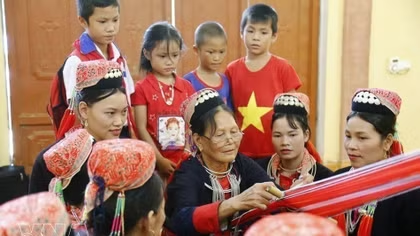
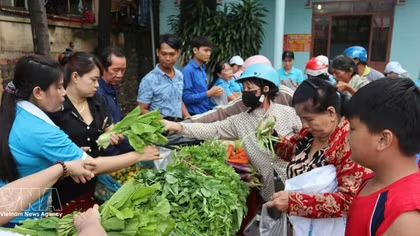
Wiesen praised the Vietnamese government’s efforts in empowering the role of women in rural and ethnic minority-inhabited regions.
UNDP Vietnam has worked closely with the Ministry of Labour, Invalids and Social Affairs (MoLISA) and the Committee for Ethnic Minority Affairs in building capacity and improving access to market for ethnic minority women owned businesses.
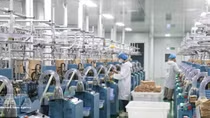
Such projects have helped ethnic minority women design new products, increase quality and productivity, thereby improving livelihoods and income for themselves and other women in their supply chains, she continued.
“Women’s economic empowerment and the promotion of their financial inclusion in the digital age will play a critical role in helping governments and people achieve a bold, sustainable, resilient and gender sensitive recovery. This, in turn, is foundational to achieving the SDGs and leaving no one behind in the context of the ‘new normal’ of co-existing with COVID-19,” Wiesen said.
The UNDP Representative also suggested ways to help Vietnam promote women’s engagement in innovation and economic activities, saying it is crucial to bridge the digital divide where women and girls are likely to fall further behind.
She highlighted the expansion of access to credit which is critical for women-led household businesses and micro and small enterprises working in the informal sector, along with innovative solutions, such as supporting financial service providers including banking agents that serve these enterprises to bring digital financial services to under-served groups, especially in rural and ethnic minority area, are needed.
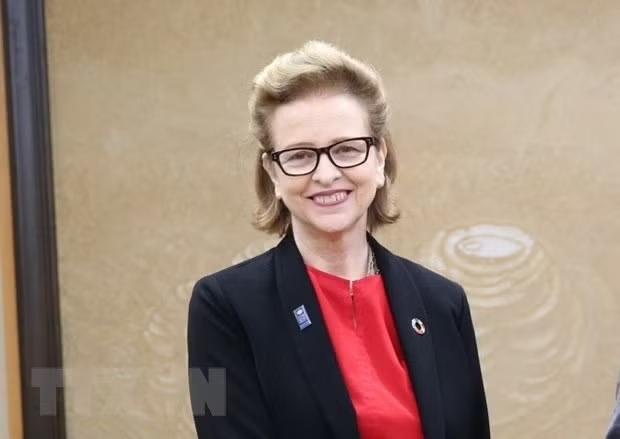
“These solutions should be designed and implemented in a gender-sensitive manner to address the chronic issues women-led enterprises face of having less access to credit than men and the risk of widening the “digital divide” between men and women.”
Other measures include: expanding women’s access to agricultural credit, supporting women-led micro, small and medium-sized enterprise (MSMEs) to have stronger linkages in domestic/ regional and global supply chains, and enhancing women’s labor mobility through reskilling and job matching services as well as overcoming other barriers to mobility that female workers face such as child/elderly care responsibilities and access to labor market information to smooth employment across unevenly recovering sectors, considering the more slowly recovering sectors that employ more female workers such as tourism and related services, garment, and footwear.
“Just like in politics, women’s participation in innovation and economic activities is crucial in Vietnam’s journey to sustainable gender equality,” she said. “Increasing women’s role as producers, traders, and consumers in the economy impacts positively on inclusive growth for the country.”
UNDP is working with Government to create an ecosystem that enables women business ventures to flourish, according to Wiesen.
With Vietnam taking urgent actions as part of the COVID-19 recovery, there is an unprecedented opportunity to put gender equality at the heart of caring for people and the planet, she emphasized.
Strong commitment to promoting women’s participation in UN peacekeeping operations
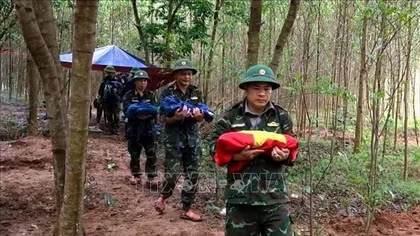
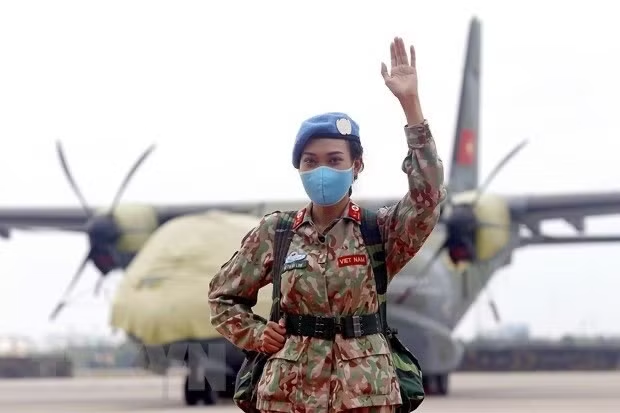
Wiesen also hailed Vietnam’s strong commitment to promoting women’s participation in UN peacekeeping operations.
Vietnam sent the first female staff officer to the UN Peacekeeping Mission in South Sudan in 2018 and since then the ratio of women in the Vietnamese peacekeeping forces has steadily increased and now has stabilised at ratios that are higher compared with other countries in the region, she said.
By March 2022, the number of Vietnamese women serving as UN Military Experts on Mission/Military observers is at 28.4%, or 3.4 higher than the target set in the “Uniformed gender parity strategy 2018-2028” of UN (25%). Similarly, the ratio of women serving in contingent Troops (Field Hospital 3rd rotation) is at 17.4% surpassing the UN’s 2028 target (15%).
“With the decision last year by the National Assembly, we look forward to women police soon joining Vietnam’s peacekeeping contingents,” she said.
As a non-permanent member of the UN Security Council in 2020-2021, Vietnam played an important leadership role in the region and globally in promoting women in peacekeeping operations and the broader Women, Peace, and Security Agenda.
Wiesen pledged that UNDP will further strengthen its partnership in supporting Vietnam’s leading role and efforts in advancing the meaningful participation of women in the UN Peacekeeping Operations in the region and globally.