U.S. charges China's Huawei for sanctions violations, technology theft

The United States on Monday announced criminal charges against China’s Huawei Technologies Co Ltd, escalating a fight with the world’s biggest telecommunications equipment maker which denies wrongdoing, and coming days before trade talks with Beijing.

The Justice Department charged Huawei and its chief financial officer with conspiring to violate U.S. sanctions on Iran by doing business through a subsidiary it tried to hide and that was reported on by Reuters.

In a separate case, the Justice Department said Huawei stole robotic technology from T-Mobile US Inc. Huawei has said the companies settled their dispute in 2017.

CFO Meng Wanzhou, the daughter of Huawei’s founder, was arrested in Vancouver on Dec. 1, in a move which was followed by China arresting two Canadians on national security grounds. She has denied wrongdoing and is scheduled to appear in court on Tuesday to discuss changes to her bail terms.
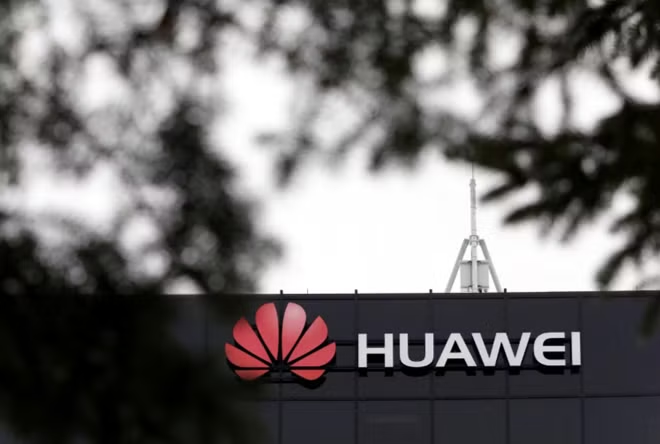
Late on Monday, public broadcaster CBC said the U.S. has formally requested her extradition, citing Canada’s Justice Department.

Huawei said it was “disappointed” to learn of the charges. It said it had sought to discuss them with U.S. authorities “but the request was rejected without explanation”.

“The Company denies that it or its subsidiary or affiliate have committed any of the asserted violations..., is not aware of any wrongdoing by Ms. Meng, and believes the U.S. courts will ultimately reach the same conclusion.”

China’s foreign ministry expressed “grave concern” and urged the United States drop the arrest warrant and end “unreasonable suppression” of Chinese companies.

The development is likely to upset talks between Beijing and Washington this week as part of negotiations intended to walk back trade tensions between the globe’s two largest economies.

U.S. President Donald Trump said in December he could intervene in Meng’s case if it would serve national security interests or help close a trade deal with China.

U.S. Commerce Secretary Wilbur Ross said the charges are “wholly separate” from the trade negotiations.

Canada’s Justice Minister will have 30 days from receipt of the extradition request to decide whether to grant authority to proceed. If granted, Meng’s case would be sent to the British Columbia Supreme Court for an extradition hearing, which could take weeks or months.
MARKET RESTRICTION

Huawei makes equipment including base stations, switches and routers, as well as consumer products such as smartphones, and derives nearly half of its total revenue outside China.

Its global reach has come under attack from the United States, which is trying to prevent U.S. companies from buying Huawei equipment and is pressing allies to do the same. U.S. security experts are concerned the gear could be used by China’s government for espionage - a concern Huawei calls unfounded.

Australia and New Zealand followed the U.S. lead in restricting market access over the past year. On Tuesday, TPG Telecom Ltd canceled the Huawei-based mobile phone network it was building, in the first commercial casualty of Australia’s move.

Huawei said it is the world’s leading provider of 5G technology, winning 30 contracts globally - more than any of its competitors - including 18 in Europe.

It is unclear how the U.S. charges would impact its business. Last year, Chinese peer ZTE Corp was prevented from buying essential components from U.S. firms after pleading guilty to similar charges, crippling its operations.

ZTE resumed normal business after paying up to $1.4 billion in fines and replacing its entire board, on top of a near $900 million penalty paid in 2017.

BANKING RELATIONS

U.S. Acting Attorney General Matthew Whitaker said the alleged criminal activity at Huawei “goes back at least 10 years and goes all the way to the top of the company.” The charges against Meng and Huawei cite the Reuters stories that said Huawei’s Skycom unit sought to sell goods to Iran.

The indictment noted that denials from Huawei in the stories were relied upon by financial institutions “in determining whether to continue their banking relationships with Huawei and its subsidiaries.”

The indictment featured a meeting in August 2013 between Meng and an executive from an unidentified bank. Sources told Reuters the bank is HSBC Holdings PLC, which paid $1.92 billion in 2012 for violating U.S. anti-money-laundering and sanctions laws.

During the meeting, Meng misrepresented Huawei operations in Iran and ownership and control of Skycom, the indictment showed.

The Justice Department has confirmed that HSBC is not under investigation in this case, HSBC said in a statement last month.

Also according to the indictment, in July 2007, the FBI interviewed Huawei founder Ren Zhengfei and U.S. authorities said he falsely told them Huawei did not violate U.S. export laws.

The indictment concerning trade secret theft alleged that Huawei had a formal policy instituting a bonus program to reward employees who stole confidential information from competitors.

FBI Director Christopher Wray said the Huawei cases, filed in New York and Washington state, “expose Huawei’s brazen and persistent actions to exploit American companies and financial institutions, and to threaten the free and fair global marketplace.”
Reuters

Other News

Hanoi approves controlled pilot of two technology projects

Hanoi approves controlled pilot of two technology projects

The two projects involve an intelligent autonomous transportation system developed by Phenikaa-X JSC and a technology for producing mixed rare-earth oxides with a purity of over 95% on a semi-industrial scale developed by the Mining Technology and Construction Consultancy JSC.

Banking industry in AI era: When data becomes competitive advantage

Banking industry in AI era: When data becomes competitive advantage

In just a few years, AI has evolved from an experimental technology into an “assistant” for many banks, supporting everything from customer service, credit approval, and fraud detection to risk management. However, as the technological gap between institutions narrows, a new question is emerging: What will determine banks' competitive advantage in the AI era?

Bac Ninh considers establishing AI centre of excellence

Bac Ninh considers establishing AI centre of excellence

A meeting has been held in Bac Ninh to discuss potential cooperation with Plug and Play in developing the northern province’s innovation ecosystem and establishing an artificial intelligence (AI) centre of excellence, with Standing Vice Chairman of the provincial People’s Committee Mai Son receiving a delegation from the global innovation platform.

Hanoi allows 24-month trial of autonomous vehicles at Hoa Lac

Hanoi allows 24-month trial of autonomous vehicles at Hoa Lac

The project aims to assess the safety, reliability and readiness of autonomous vehicles under real traffic conditions, as well as the effectiveness of autonomous public transport and compatibility with existing systems. Its results will contribute to developing technical standards, operating procedures and management models suited to Hanoi’s traffic conditions.

Singapore's experience suggests solutions to Vietnam's human resources challenge in AI era

Singapore's experience suggests solutions to Vietnam's human resources challenge in AI era

As Vietnam accelerates digital transformation and high-tech development, Singapore’s experience and the engagement of global technology companies demonstrate that human resources preparation must stay ahead of the curve. The ability to filter knowledge, collaborate, innovate and effectively use AI will increasingly become essential to helping workers adapt to a changing labour market and strengthening the competitiveness of Vietnam’s economy in the new era.

Protecting national security amid digital transformation, cyberspace

Protecting national security amid digital transformation, cyberspace

Cybersecurity, information security and data security risks must be identified and addressed early and from afar, with appropriate defensive measures ready to neutralise threats and protect national interests in cyberspace, said Lieutenant General Le Xuan Minh, Director of the Ministry of Public Security’s Department of Cybersecurity and Hi-tech Crime Prevention (A05).

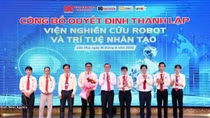
Mekong Delta launches first robotics, AI research institute

Mekong Delta launches first robotics, AI research institute

Dr. Nguyen Van Quang, Rector of Nam Can Tho University, said the university is developing a value chain covering training, research, technology development, testing, technology transfer and commercialisation. The model is designed to link research more closely with practical needs, ensuring that technologies generate products and products create value for society.

Vietnam positioned to harness AI wave, World Bank report says

Vietnam positioned to harness AI wave, World Bank report says

The WB report identifies Vietnam as one of the few economies outside the European Union (EU) to have adopted a comprehensive AI regulatory framework as early as 2025. Vietnam applies a risk-tiered approach similar to that of the EU AI Act, imposing different obligations depending on whether an AI system poses “unacceptable,” “high,” “low” or “minimal” risks. The approach is viewed as a strategic step towards ensuring safe and transparent AI governance.

AI offers both opportunities, challenges for Vietnam's growth

AI offers both opportunities, challenges for Vietnam's growth

Dr. Ho Duc Thang, a full-time member of the National Assembly’s Committee for Cultural and Educational, said productivity is the key to sustaining double-digit economic growth, and AI has greater potential to improve productivity than any previous technology.

Top leader unveils people-centred vision for new development model

Top leader unveils people-centred vision for new development model

Vietnam's growth model, long fueled by low-cost labour, resource extraction, contract manufacturing, expanded investment, and capital accumulation, has run out of road. The country now needs a sweeping reform agenda to shift from extensive growth to a model driven by productivity, knowledge, science and technology, innovation, and digital transformation.