Vietnam begins implementing Paris climate-change pact

Vietnam has officially joined the ranks of more than 83 countries around the globe that have formally ratified the Paris Climate Change Agreement (COP21) that comes into force this coming November 4.

Speaking with reporters at a conference on October 25 in Hanoi convened for the express purpose of laying out a roadmap to implement the accord, Deputy Prime Minister Trinh Dinh Dung, said it was a great day for Vietnam.

Mr Dung, who serves as the vice chair of National Committee on Climate Change, assured reporters that Vietnam is going to aggressively take practical actions to tackle climate change and grow the economy.
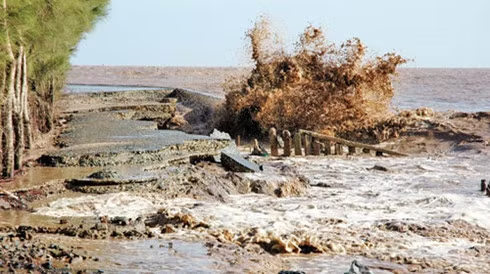
It’s all about the future for our children and grandchildren, Mr Dung proclaimed.

What we are putting in place at the conference in Hanoi is a framework for which we, specking collectively as a nation, can save ourselves from the negative impacts of a warming world.

We have committed ourselves to trying to avoid more than a one and one-half-degree Celsius increase in the global average temperature. It is essential that we stay well below two degrees, he noted.

This is a momentous occasion, exclaimed Minister Tran Hong Ha of the Ministry of Natural Resources and Environment.

What once seemed unimaginable, is now unstoppable, he quipped, noting that strong international support for the Paris Agreement entering force is a testament to the urgency for action.

It reflects the general consensus of governments around the globe that robust cooperation, grounded in systematic national action, is essential to meet the climate challenges.

But he warned that much work to giving the agreement effect still lays ahead. Now we must move beyond words and translate them into actionable deeds and breathe life into the Paris accord.

We need everyone pitching in to do their part – every part of Vietnamese society must be mobilized and actions coordinated in a concerted effort to reduce emissions and help communities adapt to inevitable climate impacts, he stressed.

Adopted in Paris by the 195 Parties to the UN Framework Convention on Climate Change (UNFCCC) at a conference known as COP21 this past December, the Agreement calls on countries to combat climate change and to accelerate and intensify the actions and investments needed for a sustainable low-carbon future, as well as to adapt to the increasing impacts of climate change.

Specifically, it seeks to limit global temperature rise to well below two degrees Celsius, and to strive for at least a one and one-half degrees Celsius cap. The pact – signed in New York earlier this year on April 22 by 175 countries at the largest, single-day signing ceremony in history – enters force 30 days after at least 55 countries, accounting for 55% of global greenhouse emissions, deposit their instruments of ratification, acceptance or accession with the Secretary-General.

That requirement was satisfied this past October 5 when Austria, Bolivia, Canada, France, Germany, Hungary, Malta, Nepal, Portugal and Slovakia, as well as the EU, deposited their instruments of ratification with the Secretary-General.

The Agreement now enters force in time for the Climate Conference (COP 22) in Morocco in November, where countries convene the first Meeting of the Parties to the Agreement.

Countries that have not yet completed all the formal steps to acceptance may participate as observers.
Specifically, the accord calls on countries to combat climate change and to accelerate and intensify the actions and investments needed for a sustainable low-carbon future, and to adapt to the increasing impacts of climate change.
In addition, it aims to strengthen the ability of countries to deal with the impacts of climate change. It calls for appropriate financial flows with higher income nations providing much needed support for those with lower finances.

It also targets a new technology and an enhanced capacity-building framework to support action by developing countries and the most vulnerable countries in line with their own national objectives.

Enhanced transparency of action and support through a more robust framework, are also among the key aims.
VOV

Other News

Vietnam steps up implementation of ethnic affairs strategy through 2030

Vietnam steps up implementation of ethnic affairs strategy through 2030

To accelerate the implementation of the the Ethnic Affairs Strategy by 2030, with a vision toward 2045, the Prime Minister requested ministries, agencies and local authorities to continue thoroughly carrying out the Party and State’s policies on ethnic affairs, enhancing the effectiveness of State management and strengthening oversight of policy implementation.

Security preparations reviewed for APEC 2027 in Phu Quoc

Security preparations reviewed for APEC 2027 in Phu Quoc

The team examined the APEC 2027 Convention Centre, where main conference activities are scheduled; Sun Serenia Hospital, designated to provide healthcare and emergency medical services for delegates; provincial road DT.975, which connects Phu Quoc International Airport to the convention centre; and the area surrounding Phu Quoc International Airport.

Hanoi accelerates seven Red River bridge projects, many exceed 70% completion

Hanoi accelerates seven Red River bridge projects, many exceed 70% completion

According to the municipal Transport Construction Investment Project Management Board, the city is simultaneously implementing seven projects, namely Tu Lien, Ngoc Hoi, Tran Hung Dao, Thuong Cat, Van Phuc, Hong Ha and Me So bridges. Construction is being carried out on multiple fronts, focusing on bored piles, pile caps, piers and superstructure works.

Dien Bien battlefield legacy powers tourism revival

Dien Bien battlefield legacy powers tourism revival

Seventy-two years after the Dien Bien Phu Victory, its legacy still reverberates. The unity, self-reliance, and resilience forged in that historic triumph remain a powerful internal engine, now propelling Dien Bien toward fast and sustainable development.

Hanoi accelerates shift to green buses, targets 100% by 2030

Hanoi accelerates shift to green buses, targets 100% by 2030

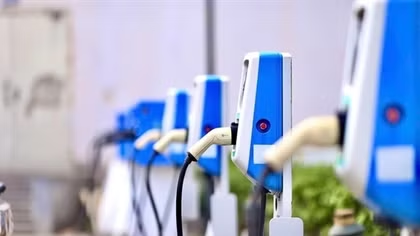
In the 2027–2030 period, the city will accelerate the transition towards the complete phase-out of fossil fuel-powered buses. The share of electric and green energy-fueled buses is projected to reach 79–89% by 2029 and 100% by 2030.

36 fishermen safely rescued after boat breaks down near Truong Sa

36 fishermen safely rescued after boat breaks down near Truong Sa

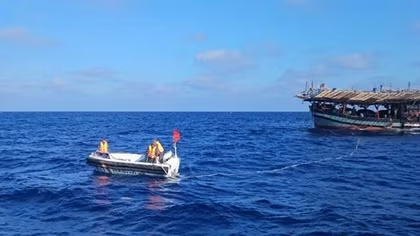
At 8:00 the same day, KN475 began towing the disabled fishing boat toward Da Tay A island. The towing operation was carried out safely, and by 18:30 both the vessel and its crew had arrived at the island without incident, where repairs and additional support procedures were arranged.

Vietnamese language contest in Laos strengthens youth ties, bilateral friendship

Vietnamese language contest in Laos strengthens youth ties, bilateral friendship

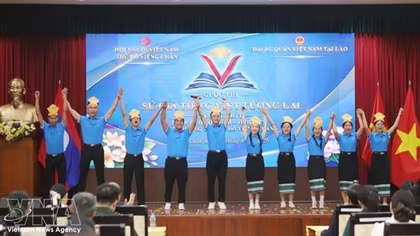
Held in response to the launch of the Vietnamese Language Day among overseas Vietnamese communities, the event aimed to enhance the quality of Vietnamese language teaching and learning in Laos while contributing to the great friendship, special solidarity, comprehensive cooperation and strategic cohesion between the two countries.

Vietnamese language contest in Laos strengthens youth ties, bilateral friendship

Vietnamese language contest in Laos strengthens youth ties, bilateral friendship

Held in response to the launch of the Vietnamese Language Day among overseas Vietnamese communities, the event aimed to enhance the quality of Vietnamese language teaching and learning in Laos while contributing to the great friendship, special solidarity, comprehensive cooperation and strategic cohesion between the two countries.

Hanoi launches 10 electric bus routes from April 1

Hanoi launches 10 electric bus routes from April 1

By the end of April, the number of buses using electricity and other green energy sources in the city is expected to reach 822, including 683 electric buses and 139 compressed natural gas (CNG) buses, representing 42.1% of the total number of vehicles.