Vietnam ranks 6th in Climate Risk Index ranking

Vietnam ranks 6th globally in the most up-to-date Climate Risk Index ranking released by Germanwatch, the highest of any ASEAN country.
vietnam ranks 6th in climate risk index ranking hinh 0
Pham Van Tan, deputy head of the Climate Change Department, Vietnam’s Ministry of Natural Resources and Environment (MoNRE), presents the ministry’s response to climate change threats to the country 

Germanwatch released the ranking, which analyses the extent to which each country has been affected by weather-related loss events, at the 24th Conference of the Parties to the United Nations Framework Convention on Climate Change (COP24) on December 4 in Katowice, Poland.

Germanwatch is an NGO based in Bonn, Germany, also the home of the UN Framework Convention on Climate Change (UNFCCC). For 27 years, it has been engaged in environment and development issues, seeking to influence national policy and North-South relations.

In the ranking, Vietnam was followed by Thailand at number 10. This is the result of storms, typhoons and droughts in 2017, which killed 298 people.

The deadliest one, Typhoon Damrey, hit Vietnam in November and killed at least 106.

2017 was an exceptionally intense year for tropical cyclones, according to Germanwatch Policy Adviser for Climate Risk Management Lena Hutfils. “Many countries are hit very frequently, so they don’t have an opportunity to recover in time,” Hutfils said. 

She also drew attention to how eight out of the top ten countries are from low- or middle-income groups.

David Eckstein, the organisation’s Policy Adviser for Climate Finance and Investment, explained that the index consists of two components: one which looks at data from the previous year, and one which incorporates a 20-year development. Data includes direct short-term and long-term linkages between climate change and meteorological events.

“[The index] should be understood as a warning signal,” Eckstein said. Furthermore, it provides crucial evidence to support the story that climate change and annual increases in storms, typhoons, floods, are linked.

Eckstein hopes that this would translate into action from national governments, not only to deal with the impact once it happens but also do more planning in advance.

Responding to these recent developments at COP24, Pham Van Tan, deputy head of the Climate Change Department, Ministry of Natural Resources and Environment (MoNRE), declared that climate change adaptation would be “the number one priority.”

Tan noted how Vietnam’s Government was one of the first to pass an implementation framework for the Paris Agreement on climate change, nearly a month before the agreement itself went into effect in 2016. A key part of this plan is the constant review, submission and implementation of Nationally Determined Contribution (NDC), each country’s objectives for mitigation measures.

At COP24’s Session on ASEAN NDC Partnership, Tan stated that 47 of Vietnam’s 63 provinces had already submitted concrete implementation plans for the Paris Agreement. Vietnam is “among the most advanced in ASEAN” in terms of NDC implementation, according to the Vietnamese official. His claim is supported by many in the international community, who raised questions during the session to learn from Vietnam’s policies.

The NDC Partnership’s Country Engagement Director Jahan Chowdhury commended Vietnam on its effective coordination between the government’s supreme leadership, Ministries and civil-society actors for better climate change adaptation. According to Tan, MoNRE meets with NGOs once every three months to discuss the implementation of policies at the grassroots level.

He has high expectations for the outcome of COP24, the most important gathering of international negotiators on the issue of climate change.

He wants to see how much support Vietnam will be able to obtain from the international community following MoNRE’s proposal for Greenhouse Gases Reduction plan.

“Support” is hereby defined as a combination of three things: finance, technology transfer and capacity building. So far, Vietnam has not received any pledges from developed countries with regards to financial support, a major concern.

VIR

Other News

Vietnam steps up implementation of ethnic affairs strategy through 2030

Vietnam steps up implementation of ethnic affairs strategy through 2030

To accelerate the implementation of the the Ethnic Affairs Strategy by 2030, with a vision toward 2045, the Prime Minister requested ministries, agencies and local authorities to continue thoroughly carrying out the Party and State’s policies on ethnic affairs, enhancing the effectiveness of State management and strengthening oversight of policy implementation.

Security preparations reviewed for APEC 2027 in Phu Quoc

Security preparations reviewed for APEC 2027 in Phu Quoc

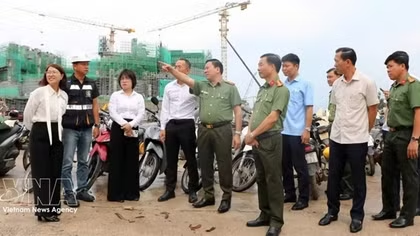
The team examined the APEC 2027 Convention Centre, where main conference activities are scheduled; Sun Serenia Hospital, designated to provide healthcare and emergency medical services for delegates; provincial road DT.975, which connects Phu Quoc International Airport to the convention centre; and the area surrounding Phu Quoc International Airport.

Hanoi accelerates seven Red River bridge projects, many exceed 70% completion

Hanoi accelerates seven Red River bridge projects, many exceed 70% completion

According to the municipal Transport Construction Investment Project Management Board, the city is simultaneously implementing seven projects, namely Tu Lien, Ngoc Hoi, Tran Hung Dao, Thuong Cat, Van Phuc, Hong Ha and Me So bridges. Construction is being carried out on multiple fronts, focusing on bored piles, pile caps, piers and superstructure works.

Dien Bien battlefield legacy powers tourism revival

Dien Bien battlefield legacy powers tourism revival

Seventy-two years after the Dien Bien Phu Victory, its legacy still reverberates. The unity, self-reliance, and resilience forged in that historic triumph remain a powerful internal engine, now propelling Dien Bien toward fast and sustainable development.

Hanoi accelerates shift to green buses, targets 100% by 2030

Hanoi accelerates shift to green buses, targets 100% by 2030

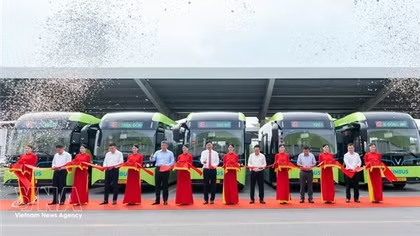
In the 2027–2030 period, the city will accelerate the transition towards the complete phase-out of fossil fuel-powered buses. The share of electric and green energy-fueled buses is projected to reach 79–89% by 2029 and 100% by 2030.

36 fishermen safely rescued after boat breaks down near Truong Sa

36 fishermen safely rescued after boat breaks down near Truong Sa

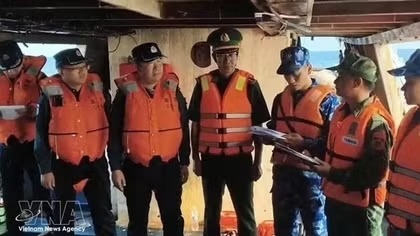
At 8:00 the same day, KN475 began towing the disabled fishing boat toward Da Tay A island. The towing operation was carried out safely, and by 18:30 both the vessel and its crew had arrived at the island without incident, where repairs and additional support procedures were arranged.

Vietnamese language contest in Laos strengthens youth ties, bilateral friendship

Vietnamese language contest in Laos strengthens youth ties, bilateral friendship

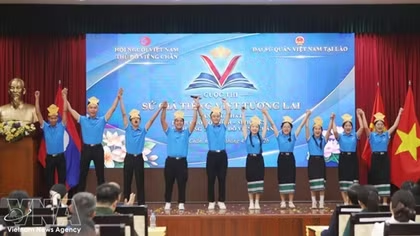
Held in response to the launch of the Vietnamese Language Day among overseas Vietnamese communities, the event aimed to enhance the quality of Vietnamese language teaching and learning in Laos while contributing to the great friendship, special solidarity, comprehensive cooperation and strategic cohesion between the two countries.

Vietnamese language contest in Laos strengthens youth ties, bilateral friendship

Vietnamese language contest in Laos strengthens youth ties, bilateral friendship

Held in response to the launch of the Vietnamese Language Day among overseas Vietnamese communities, the event aimed to enhance the quality of Vietnamese language teaching and learning in Laos while contributing to the great friendship, special solidarity, comprehensive cooperation and strategic cohesion between the two countries.

Hanoi launches 10 electric bus routes from April 1

Hanoi launches 10 electric bus routes from April 1

By the end of April, the number of buses using electricity and other green energy sources in the city is expected to reach 822, including 683 electric buses and 139 compressed natural gas (CNG) buses, representing 42.1% of the total number of vehicles.