Vietnam ready to make labour market effective

The share of job seekers who are using formal channels (employment services) is growing in Vietnam, but still accounts for a minority of the job search channels used. Most jobs in the country today are filled through personal contacts, according to the General Statistics Office (GSO).
vietnam ready to make labour market effective hinh 0

A study by the International Labour Organisation (ILO) with GSO data found that around 40 percent of employed young people had found their jobs by asking friends and family.

Valentina Barcucci, ILO Vietnam’s Labour Economist, said that the higher the education and training attainment of a job seeker, the more likely they are to rely on employment services.

The strengthening of employment services is also important in the context of Vietnam’s role within ASEAN, which the country will chair in 2020.

According to ILO, Vietnam has made an important step in labour market development by ratifying ILO Convention 88, known as the Employment Service Convention. Employment services promote an efficient development, integration and use of the labour force.

To achieve this objective, they serve two groups of direct clients – workers (which they assist to find suitable employment) and employers (which they assist to find suitable workers). Employment services are therefore at the intersection of two networks of information – the one on job applicants and the one on job vacancies.

They are at the core between supply and demand for labour.

“As Vietnam is experiencing its economic transformation, the ratification of this convention which will promote the development of employment services is a significant step,” said Barcucci.

“Industrialisation, integration into regional and global markets, and increased foreign direct investment have all been changing the labour market into one where employment opportunities, qualifications and skills requirements become more formal. Accordingly, the methods for matching job offers with takers need to become more effective, accessible, and used,” she said.

In a country in transformation like Vietnam, labour market information is a vital source of data on how the labour market is evolving.

Employment services can produce a large set of labour market information through administrative data coming from the profiles of job seekers, occupations in demand by employers and therefore skills needs, duration of job search by profile of job seeker, hard-to-fill vacancies, and others.

These data all help answer questions such as What skills do employers look for? Do job seekers find jobs that match their qualifications? Who needs to look for jobs for relatively longer periods? What skills are missing – and yet needed - on the labour market?

“The answers to these questions represent an important input for policy-makers,” said Barcucci.

“These data can be used to periodically revise employment policy and skills development policy, to help workers adapt to labour market changes, and employers find the skills that they need, for a more inclusive society and a stronger economy.”

Convention 88 states that one of the objectives of employment services is to facilitate occupational and geographical mobility. In the context of the ASEAN Community Vision 2025, the chart towards economic and cultural integration, ASEAN envisages increased openness in a number of areas, including the ‘seamless movement’ of skilled labour.

“The ratification of the Convention is a critical step towards strengthening employment services in the country. However, it remains one step of the way,” Barcucci said while reaffirming ILO’s commitment to support the Government, workers’ and employers’ organisations in ensuring that policies and programmes will follow to implement the Convention.

The ILO will also provide continuous assistance on institutional commitments such as formal reporting on the implementation of Convention 88. The Convention on Employment Service became the 22nd ILO Convention Vietnam has ratified. 

By the end of 2019, Vietnam also plans to ratify Convention 98 on the Right to Organise and Collective Bargaining – one of the remaining fundamental conventions – and Convention 159 on Vocational Rehabilitation and Employment (Disabled Persons).

VNA/VOV

Other News

Vietnam steps up implementation of ethnic affairs strategy through 2030

Vietnam steps up implementation of ethnic affairs strategy through 2030

To accelerate the implementation of the the Ethnic Affairs Strategy by 2030, with a vision toward 2045, the Prime Minister requested ministries, agencies and local authorities to continue thoroughly carrying out the Party and State’s policies on ethnic affairs, enhancing the effectiveness of State management and strengthening oversight of policy implementation.

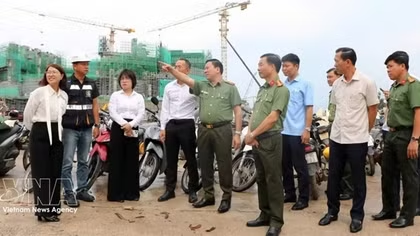
Security preparations reviewed for APEC 2027 in Phu Quoc

Security preparations reviewed for APEC 2027 in Phu Quoc

The team examined the APEC 2027 Convention Centre, where main conference activities are scheduled; Sun Serenia Hospital, designated to provide healthcare and emergency medical services for delegates; provincial road DT.975, which connects Phu Quoc International Airport to the convention centre; and the area surrounding Phu Quoc International Airport.

Hanoi accelerates seven Red River bridge projects, many exceed 70% completion

Hanoi accelerates seven Red River bridge projects, many exceed 70% completion

According to the municipal Transport Construction Investment Project Management Board, the city is simultaneously implementing seven projects, namely Tu Lien, Ngoc Hoi, Tran Hung Dao, Thuong Cat, Van Phuc, Hong Ha and Me So bridges. Construction is being carried out on multiple fronts, focusing on bored piles, pile caps, piers and superstructure works.

Dien Bien battlefield legacy powers tourism revival

Dien Bien battlefield legacy powers tourism revival

Seventy-two years after the Dien Bien Phu Victory, its legacy still reverberates. The unity, self-reliance, and resilience forged in that historic triumph remain a powerful internal engine, now propelling Dien Bien toward fast and sustainable development.

Hanoi accelerates shift to green buses, targets 100% by 2030

Hanoi accelerates shift to green buses, targets 100% by 2030

In the 2027–2030 period, the city will accelerate the transition towards the complete phase-out of fossil fuel-powered buses. The share of electric and green energy-fueled buses is projected to reach 79–89% by 2029 and 100% by 2030.

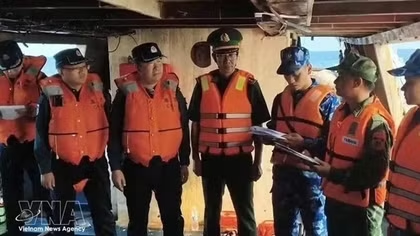
36 fishermen safely rescued after boat breaks down near Truong Sa

36 fishermen safely rescued after boat breaks down near Truong Sa

At 8:00 the same day, KN475 began towing the disabled fishing boat toward Da Tay A island. The towing operation was carried out safely, and by 18:30 both the vessel and its crew had arrived at the island without incident, where repairs and additional support procedures were arranged.

Vietnamese language contest in Laos strengthens youth ties, bilateral friendship

Vietnamese language contest in Laos strengthens youth ties, bilateral friendship

Held in response to the launch of the Vietnamese Language Day among overseas Vietnamese communities, the event aimed to enhance the quality of Vietnamese language teaching and learning in Laos while contributing to the great friendship, special solidarity, comprehensive cooperation and strategic cohesion between the two countries.

Vietnamese language contest in Laos strengthens youth ties, bilateral friendship

Vietnamese language contest in Laos strengthens youth ties, bilateral friendship

Held in response to the launch of the Vietnamese Language Day among overseas Vietnamese communities, the event aimed to enhance the quality of Vietnamese language teaching and learning in Laos while contributing to the great friendship, special solidarity, comprehensive cooperation and strategic cohesion between the two countries.

Hanoi launches 10 electric bus routes from April 1

Hanoi launches 10 electric bus routes from April 1

By the end of April, the number of buses using electricity and other green energy sources in the city is expected to reach 822, including 683 electric buses and 139 compressed natural gas (CNG) buses, representing 42.1% of the total number of vehicles.