Vietnam seeks EU smart city know-how

Ho Chi Minh City requires Europe’s experience and solutions to create smart cities, a conference heard on June 30.

Speaking at the “Cyber security, Internet of Things and Connected Services towards a smart city” conference, organised by the European Chamber of Commerce in Vietnam (EuroCham), Vo Quang Hue, vice chairman of EuroCham, said: “The Smart Cities subject is one of great importance for EuroCham Vietnam. EuroCham believes its members have a lot to offer for Vietnam’s sustainable development.”

“The relevant know-how developed and tested in Europe, and all over the world, needs no introduction and we are very keen to promote contacts between the relevant companies and the Vietnamese Government for business opportunities that can produce concrete results in terms of a smart future for Vietnam’s cities.”
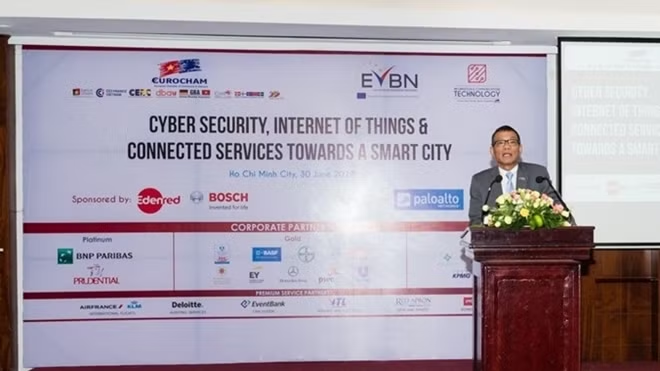
Philip Hung Cao, security solution consultant at Palo Alto Networks, fears that cyber security could be a nightmare for a smart city.

“All parts of a connected city, including field components, data transmission network, data processing, data aggregation connectivity and smart processing of a smart city face the threat of attack.”

He listed all the possible threats to smart cities, such as eavesdropping/wiretapping, unauthorised use/access, tampering/alteration, theft, distributed denial of services (DDos) and loss of reputation due to hacking, besides hardware failure/multifunction, software error, operator/user error, electrical and frequency disturbance/interference, end of support obsolescence, acts of nature and environmental incidents.

To avoid these security threats, he suggested seven solutions: building a risk-based approach to cyber security; setting clear priorities; defining minimum ICT security baselines; sharing and co-ordinating threats and vulnerability information; building incident response capabilities; boosting public awareness, education and workforce training; and enabling public, private and academic co-operation.

Guru Mallikarjuna, vice chairman of EuroCham’s information communication technology sector committee, and managing director of Robert Bosch Engineering and Business Solutions Vietnam Co.ltd, said: “Internet of Things is the basis for a broad smart city competency and by 2020 four billion people will be connected with 25 million applications, 50 trillion gigabytes of data and 25 billion intelligent systems.”

He also listed the challenges and solutions for mobility, energy and security, the three pillars of a smart city.

The challenges facing mobility are the need to reorganise/revitalise existing infrastructure and having a connected and efficient public transportation system, he said.

The solutions are intelligent parking, fleet monitoring and management and intelligent traffic management, he said.

The challenges facing energy supply include the management of peak demand, environmental impacts and the improvement of existing infrastructure, while their solutions are energy management, a smart grid (metering, software) and smart water meters, he said.

The security challenges are public security (mass events, crime) and the impacts of natural disasters and video surveillance, emergency services and disaster response units are the solutions, he added.

To grasp the opportunities in the context of the “fourth industrial revolution” and address various socio-economic issues, the Government has recently begun adopting measures to encourage cities to become smart cities.

Actions and initiatives have been taken with respect to several information and communication technology breakthroughs which are central to this shift, such as the Internet of Things, Data Flow, Connected Services, e-governance, autonomous vehicles, artificial intelligence, robotics, and others.


NDO/VNA

Other News

SK Group partners to build AI ecosystem in Vietnam

SK Group partners to build AI ecosystem in Vietnam

SK Innovation and SK Telecom signed MoUs with Nghe An province and the National Innovation Centre of Vietnam to advance AI ecosystem development and support the country’s long-term growth strategy.

Vietnam Research Excellence Fellowship for 2026-2030 approved

Vietnam Research Excellence Fellowship for 2026-2030 approved

Under the Vietnam Research Excellence Fellowship (VREF) for the 2026–2030 period, PhD students are identified as a core research force directly contributing to breakthroughs in sci-tech and innovation. Investing in top-tier doctoral candidates is more than workforce development, but a high-stakes strategic bet to forge a cohort of world-class scientists and technologists who can power Vietnam’s long-term economic ambitions.

Strategic tech must address practical challenges: PM

Strategic tech must address practical challenges: PM

Prime Minister Pham Minh Chinh on March 28 said strategic technologies must tackle Vietnam’s practical challenges, while chairing a meeting of the Government’s Steering Committee for science and technology, innovation, digital transformation, and Project 06.

Ho Chi Minh City sets sights on becoming semiconductor hub

Ho Chi Minh City sets sights on becoming semiconductor hub

Ho Chi Minh City is stepping up efforts to attract investment from global leading groups and companies in the fields of electronic components, semiconductors and chip manufacturing as it seeks to position itself as a leading semiconductor industry hub in both the region and the world. 

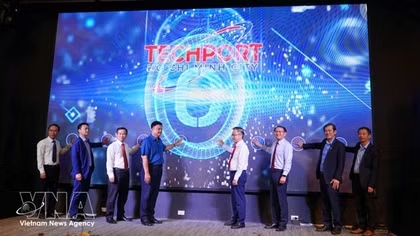
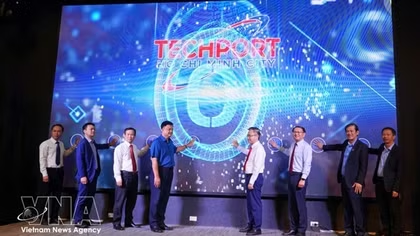
Ho Chi Minh City launches upgraded technology exchange platform

Ho Chi Minh City launches upgraded technology exchange platform

The upgraded platform represents a comprehensive shift from a simple information-sharing model to a managed online technology trading system, enabling monitoring and measurement of real transaction outcomes. It is built on three pillars, namely new tradable technology products, a modern digital platform, and an improved operational model.

AI – unmissable opportunity for Vietnam: Experts

AI – unmissable opportunity for Vietnam: Experts

AI also emerges as a key enabler for Vietnam's ambition to build financial and technology hubs. Applications can boost efficiency, automate workflows, cut costs, and sharpen data analytics, which are essential pillars of a modern financial system.

PM calls for accelerated space technology development in Vietnam

PM calls for accelerated space technology development in Vietnam

Vietnam aims by 2030 to achieve a mid-level position in space science and technology development within Southeast Asia, and after 2030 to build national capabilities to independently develop satellite technologies and apply space data to address global challenges and national security needs.

High-level forum advances Vietnam–US technological cooperation

High-level forum advances Vietnam–US technological cooperation

A high-level executive leadership forum focusing on strengthening Vietnam - US relations through technology cooperation was jointly held in Washington D.C. on March 11 by the Embassy of Vietnam in the US, the Weatherhead East Asian Institute of Columbia University, and the US -ASEAN Business Council (USABC). 

AI Law takes effect, anchors national governance framework

AI Law takes effect, anchors national governance framework

While many countries are still drafting policy blueprints or issuing non-binding guidance, Vietnam has moved ahead with a standalone Law on Artificial Intelligence (AI), effective from March 1, placing it among a select group of nations to adopt dedicated AI legislation at the parliamentary level. 

Vietnam International Defence Expo 2026 preparations move into high gear

Vietnam International Defence Expo 2026 preparations move into high gear

Vietnam International Defence Expo 2026, themed “Peace, Friendship, Cooperation and Development,” will be organised on a larger scale, featuring a wide array of weapons and technical equipment alongside product exhibitions, seminars and panel discussions, drills, live field demonstrations, and business networking activities.

Ministry requests urgent measures to counter UAVs threatening aviation safety

Ministry requests urgent measures to counter UAVs threatening aviation safety

Ministry of Construction requested the Ministry of National Defence, the Ministry of Public Security and provincial and municipal steering committees for counter-terrorism to strengthen the management, inspection and supervision of UAVs and other aerial devices, ensuring strict compliance with Decree No. 288/2025/ND-CP and relevant legal regulations.