Vietnam still lacks legal framework to protect child labor

Vietnam needed to improve its legal framework on child labor, especially regulations on minors working in informal sectors, experts recommended.
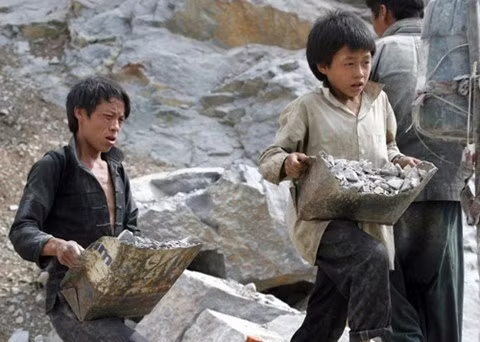
Children help their parents at a stone mine in Dong Van district in the northern mountainous province of Ha Giang.(Photo: thanhnien.vn)

Children help their parents at a stone mine in Dong Van district in the northern mountainous province of Ha Giang.(Photo: thanhnien.vn)

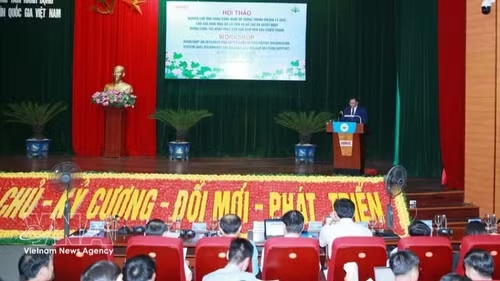
Minoru Ogasawara, chief advisor of the project ‘Technical Support for Enhancing the National Capacity to Prevent and Reduce Child Labor in Vietnam’ (ENHANCE), said at a workshop early this week in the northern province of Quang Ninh that Vietnam was integrating into the world economy through new generation free trade agreements like the Comprehensive and Progressive Agreement for Trans-Pacific Partnership (CPTPP) and the EU-Vietnam Free Trade Agreement.

“It’s very important to eliminate or reduce child labor in the supply chain of products that Vietnam makes for export,” he said.

Ogasawara said the majority of Vietnam’s child workers were in informal sectors but the country’s Labor Code did not have regulations addressing these areas.

“The legal framework is not strict enough to protect child workers in informal sectors,” he said.

In Vietnam, the national survey of child labor in 2012 – the first one of its kind in the country - showed that there were about 1.75 million child laborers nationwide, making up 9.6 percent of children aged between five and 17.

The number of child laborers is estimated at 1.7 million, with 34 percent working over 42 hours per week.

In chapter XI of Vietnam’s Labor Code dated 2012, there are separate provisions for minor employees- who are defined as employees under 18 years of age.

Employment of minors is prohibited in heavy, toxic and dangerous jobs or in workplaces or jobs which may adversely affect their personalities, as determined in a list issued by the Ministry of Labor, Invalids and Social Affairs in coordination with the Ministry of Health.

The working time for minors aged from full 15 to 18 years must not exceed 8 hours per day or 40 hours per week. The working time for employees aged under 15 years must not exceed 4 hours per day or 20 hours per week and employers may not employ minors to work overtime or at night.

According to the International Labor Organisation (ILO), Vietnam had laid the foundation for effective and sustainable action against child labor.

Vietnam was the first country in Asia and second in the world to ratify the United Nations’ International Convention on the Rights of the Child.

In November 2000, the Government of Vietnam ratified the Worst Forms of Child Labor Convention, 1999 (No.182), and in 2003 the Government ratified the Minimum Age Convention, 1973 (No.138).

Ratifications signalled to the international community Vietnam’s commitment and determination to urgently undertake time-bound measures for the elimination of the worst forms of child labor in the country.

In 2016, the Government launched a program on the prevention and control of child labor from 2016 to 2020.

However, Hanoi-based Leadco Legal Counsel, after reviewing and analyzing the legal framework of child labor in Vietnam, found shortcomings.

The shortcomings were represented at a workshop in Quang Ninh together with recommendations such as the inconsistency of ages mentioned in definitions of child, juvenile and minor employees, the need to develop legal mechanisms to protect youngsters as well as regulations on child labor in informal sectors.

Ha Dinh Bon, head of the Legal Affairs Department under Ministry of Labor, Invalids and Social Affairs, the ministry planned to submit to the Government a draft of the revised Labor Code next month and submit it to the National Assembly in May for discussion.

The International Labor Organisation estimates there are about 152 million child laborers in the world at present. Working at an early age causes serious consequences, including affecting children’s physical and mental development and preventing their access to suitable education. It also harms socio-economic development, especially the quality of future human resources.

VNS/VNA

Other News

Vietnam steps up implementation of ethnic affairs strategy through 2030

Vietnam steps up implementation of ethnic affairs strategy through 2030

To accelerate the implementation of the the Ethnic Affairs Strategy by 2030, with a vision toward 2045, the Prime Minister requested ministries, agencies and local authorities to continue thoroughly carrying out the Party and State’s policies on ethnic affairs, enhancing the effectiveness of State management and strengthening oversight of policy implementation.

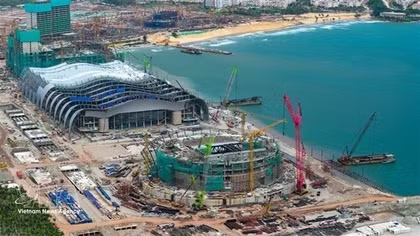
Security preparations reviewed for APEC 2027 in Phu Quoc

Security preparations reviewed for APEC 2027 in Phu Quoc

The team examined the APEC 2027 Convention Centre, where main conference activities are scheduled; Sun Serenia Hospital, designated to provide healthcare and emergency medical services for delegates; provincial road DT.975, which connects Phu Quoc International Airport to the convention centre; and the area surrounding Phu Quoc International Airport.

Hanoi accelerates seven Red River bridge projects, many exceed 70% completion

Hanoi accelerates seven Red River bridge projects, many exceed 70% completion

According to the municipal Transport Construction Investment Project Management Board, the city is simultaneously implementing seven projects, namely Tu Lien, Ngoc Hoi, Tran Hung Dao, Thuong Cat, Van Phuc, Hong Ha and Me So bridges. Construction is being carried out on multiple fronts, focusing on bored piles, pile caps, piers and superstructure works.

Dien Bien battlefield legacy powers tourism revival

Dien Bien battlefield legacy powers tourism revival

Seventy-two years after the Dien Bien Phu Victory, its legacy still reverberates. The unity, self-reliance, and resilience forged in that historic triumph remain a powerful internal engine, now propelling Dien Bien toward fast and sustainable development.

Hanoi accelerates shift to green buses, targets 100% by 2030

Hanoi accelerates shift to green buses, targets 100% by 2030

In the 2027–2030 period, the city will accelerate the transition towards the complete phase-out of fossil fuel-powered buses. The share of electric and green energy-fueled buses is projected to reach 79–89% by 2029 and 100% by 2030.

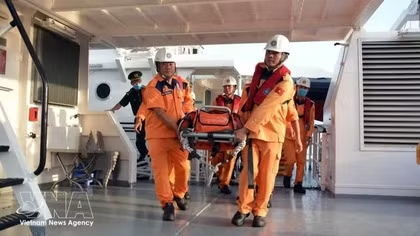
36 fishermen safely rescued after boat breaks down near Truong Sa

36 fishermen safely rescued after boat breaks down near Truong Sa

At 8:00 the same day, KN475 began towing the disabled fishing boat toward Da Tay A island. The towing operation was carried out safely, and by 18:30 both the vessel and its crew had arrived at the island without incident, where repairs and additional support procedures were arranged.

Vietnamese language contest in Laos strengthens youth ties, bilateral friendship

Vietnamese language contest in Laos strengthens youth ties, bilateral friendship

Held in response to the launch of the Vietnamese Language Day among overseas Vietnamese communities, the event aimed to enhance the quality of Vietnamese language teaching and learning in Laos while contributing to the great friendship, special solidarity, comprehensive cooperation and strategic cohesion between the two countries.

Vietnamese language contest in Laos strengthens youth ties, bilateral friendship

Vietnamese language contest in Laos strengthens youth ties, bilateral friendship

Held in response to the launch of the Vietnamese Language Day among overseas Vietnamese communities, the event aimed to enhance the quality of Vietnamese language teaching and learning in Laos while contributing to the great friendship, special solidarity, comprehensive cooperation and strategic cohesion between the two countries.

Hanoi launches 10 electric bus routes from April 1

Hanoi launches 10 electric bus routes from April 1

By the end of April, the number of buses using electricity and other green energy sources in the city is expected to reach 822, including 683 electric buses and 139 compressed natural gas (CNG) buses, representing 42.1% of the total number of vehicles.