Vietnam to train more IC engineers

Vietnam needs stronger human resources to serve the growing integrated circuit (IC) industry to create greater investment opportunities.

Mai Anh Tuan from the National Centre for Technological Progress under the Ministry of Science and Technology, said: "IC is at the heart of all electronic devices. The industry offers core support to other industries such as information technology, telecoms, and mechanical and automated engineering.”

Tuan said that “The US-China trade war will rearrange global industrial production. Vietnam is one of best equipped countries in the region to attract a hi-tech production investment wave.”

Big IC companies such as Samsung, LG, Sharp and Foxconn are reported to be planning to expand in the country.  

With 20 years of experience in the industry, Terry Teh, director at Advinno Technologies Pte Ltd, Singapore could also see the opportunities for Vietnam.
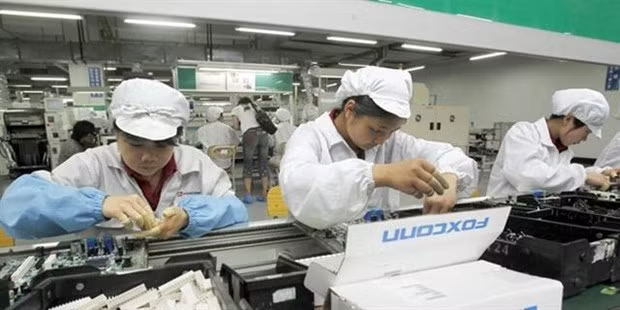
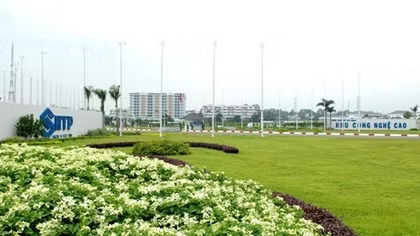
Apple assembler Foxconn is planning to build a 40 million USD factory in Dong Mai Industrial Park in Quang Ninh prvince. (Photo: 9tomac)

“Vietnam is strong in IC design so a lot of multi-national companies are coming to the country,” he said.

Teh also said Vietnam could build an ecosystem with the Government, universities and companies involved to boost development in the country.

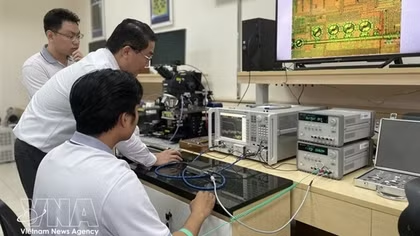
However, Tuan, who runs the IC Microfabrication Laboratory and Pilot Plant Center at Hoa Lac High-tech Park, said: “Vietnam is lacking well trained IC engineers.”

There are about 100,000 fresh under-graduate engineers each year, but they are still far behind the middle- and high-level IC engineers needed in the country over the next five years as the industry rapidly grows.

There are now more than 300,000 enterprises in HCM City and the number is forecast to reach 500,000 in 2020, raising the demand for high-quality labour.

The demand for highly skilled workers has grown at least 20 percent per year in the last three years, but labour supply cannot meet demand.

Tuan said to fill the gap Vietnam should also introduce IC training at local vocational and short-term training centres, as well as colleges and universities.

According to Tran Phu Duy, a research associate at Future Industries Institute, University of South Australia, Vietnam and Australia are cooperating in technology and innovation, and Australia will help Vietnam to grow its technology workforce to serve the 4.0 era. Thus, Vietnam has a good opportunity to develop its IC engineers.”

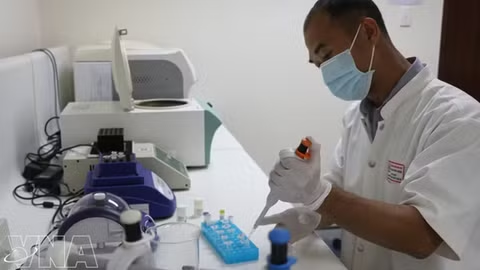
Duy, who is an expert in sensor and microchip research, is co-operating with the Vietnam Institute of Technology Application to research and manufacture biochemical sensors with ultra-high sensitivity that can quickly detect the risk of pre-eclampsia.

He said that human resources were both an advantage and challenge for Vietnam.

“It is a challenge to train IC staff but it is more difficult to keep them once they are skilled,” said Duy, adding that the country needed a mechanism to attract knowledgeable experts and researchers who could train adjacent engineers to develop the IC industry.

Agreeing with Duy, Tuan said few people worked in the industry and those that did keep switching jobs for higher salaries, causing instability in the local industry.

He said: “Vietnam should create better conditions to train more IC engineers as well as to attract Vietnamese IC experts who are working in Japan, South Korea, Taiwan and the US to serve their country.”

As a first step to solving the problem, Phenikaa Group has decided to spend 500 billion VND (21.5 million USD) on a fund for research and training human resources in IC design. President of the group Ho Xuan Nang made the announcement at a workshop which gathered 100 international and domestic experts in Hanoi this month.

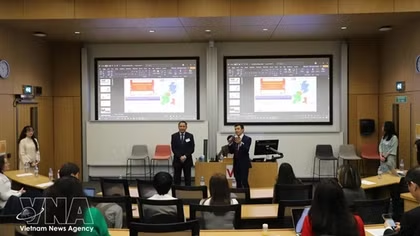
The workshop on IC Design and Fabrication (We Fab) was held for the second time in Hanoi to discuss IC simulation and modelling; specialised IC design and manufacturing; sensor technology; and Industry 4.0 and its impacts on Vietnam’s future industry./.

VNA

Other News

SK Group partners to build AI ecosystem in Vietnam

SK Group partners to build AI ecosystem in Vietnam

SK Innovation and SK Telecom signed MoUs with Nghe An province and the National Innovation Centre of Vietnam to advance AI ecosystem development and support the country’s long-term growth strategy.

Vietnam Research Excellence Fellowship for 2026-2030 approved

Vietnam Research Excellence Fellowship for 2026-2030 approved

Under the Vietnam Research Excellence Fellowship (VREF) for the 2026–2030 period, PhD students are identified as a core research force directly contributing to breakthroughs in sci-tech and innovation. Investing in top-tier doctoral candidates is more than workforce development, but a high-stakes strategic bet to forge a cohort of world-class scientists and technologists who can power Vietnam’s long-term economic ambitions.

Strategic tech must address practical challenges: PM

Strategic tech must address practical challenges: PM

Prime Minister Pham Minh Chinh on March 28 said strategic technologies must tackle Vietnam’s practical challenges, while chairing a meeting of the Government’s Steering Committee for science and technology, innovation, digital transformation, and Project 06.

Ho Chi Minh City sets sights on becoming semiconductor hub

Ho Chi Minh City sets sights on becoming semiconductor hub

Ho Chi Minh City is stepping up efforts to attract investment from global leading groups and companies in the fields of electronic components, semiconductors and chip manufacturing as it seeks to position itself as a leading semiconductor industry hub in both the region and the world. 

Ho Chi Minh City launches upgraded technology exchange platform

Ho Chi Minh City launches upgraded technology exchange platform

The upgraded platform represents a comprehensive shift from a simple information-sharing model to a managed online technology trading system, enabling monitoring and measurement of real transaction outcomes. It is built on three pillars, namely new tradable technology products, a modern digital platform, and an improved operational model.

AI – unmissable opportunity for Vietnam: Experts

AI – unmissable opportunity for Vietnam: Experts

AI also emerges as a key enabler for Vietnam's ambition to build financial and technology hubs. Applications can boost efficiency, automate workflows, cut costs, and sharpen data analytics, which are essential pillars of a modern financial system.

PM calls for accelerated space technology development in Vietnam

PM calls for accelerated space technology development in Vietnam

Vietnam aims by 2030 to achieve a mid-level position in space science and technology development within Southeast Asia, and after 2030 to build national capabilities to independently develop satellite technologies and apply space data to address global challenges and national security needs.

High-level forum advances Vietnam–US technological cooperation

High-level forum advances Vietnam–US technological cooperation

A high-level executive leadership forum focusing on strengthening Vietnam - US relations through technology cooperation was jointly held in Washington D.C. on March 11 by the Embassy of Vietnam in the US, the Weatherhead East Asian Institute of Columbia University, and the US -ASEAN Business Council (USABC). 

AI Law takes effect, anchors national governance framework

AI Law takes effect, anchors national governance framework

While many countries are still drafting policy blueprints or issuing non-binding guidance, Vietnam has moved ahead with a standalone Law on Artificial Intelligence (AI), effective from March 1, placing it among a select group of nations to adopt dedicated AI legislation at the parliamentary level. 

Vietnam International Defence Expo 2026 preparations move into high gear

Vietnam International Defence Expo 2026 preparations move into high gear

Vietnam International Defence Expo 2026, themed “Peace, Friendship, Cooperation and Development,” will be organised on a larger scale, featuring a wide array of weapons and technical equipment alongside product exhibitions, seminars and panel discussions, drills, live field demonstrations, and business networking activities.

Ministry requests urgent measures to counter UAVs threatening aviation safety

Ministry requests urgent measures to counter UAVs threatening aviation safety

Ministry of Construction requested the Ministry of National Defence, the Ministry of Public Security and provincial and municipal steering committees for counter-terrorism to strengthen the management, inspection and supervision of UAVs and other aerial devices, ensuring strict compliance with Decree No. 288/2025/ND-CP and relevant legal regulations.