VN laws need fine tuning for TPP: report

Hanoi — Vietnam’s legal framework is compatible with most of the commitments on investment it has undertaken under the Trans-Pacific Partnership agreement (TPP) but not compatible with commitments on transfer and investor-State dispute resettlement, Vietnam Chamber of Commerce and Industry (VCCI) announced yesterday.

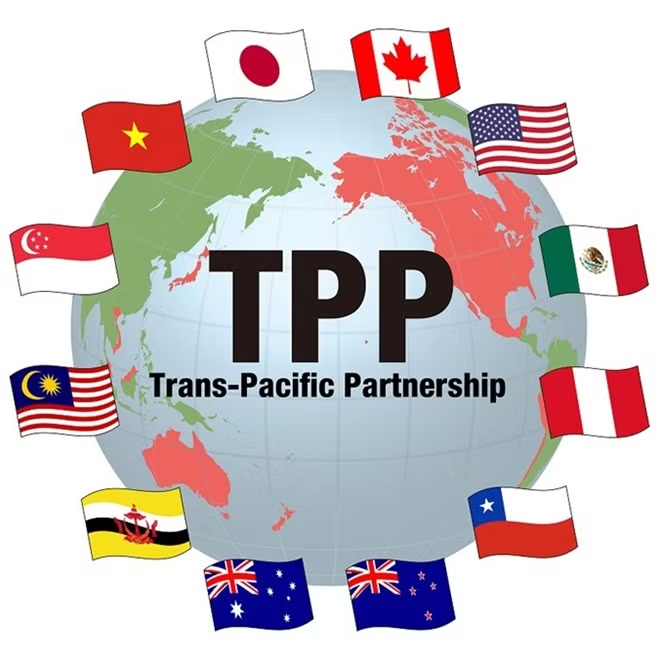
Among the new-generation free trade agreements of Vietnam, the TPP and the Việt Nam-EU FTA (EVFTA) are considered the two with the most significant impact for trade and investment policies. VNS File Photo

Among the new-generation free trade agreements (FTA) of Vietnam, the TPP and the Việt Nam-EU FTA (EVFTA) are considered the two with the most significant impact for trade and investment policies.

The VCCI, with support from the British Embassy in Vietnam, completed a draft review of the EVFTA and TPP commitments on investment.

When the pacts take effect, investment commitments are expected to change Vietnam’s investment environment given that investors from 38 partner states account for a huge proportion of Vietnam’s Foreign Development Investment (FDI).

Nguyen Thi Thu Trang, Director of VCCI’s World Trade Organisation Centre and a member of the review group, said the team reviewed TPP’s Investment Chapter and Vietnam’s Investment Law, its guiding documents, relevant laws such as the Civil Law, laws on enterprise, State compensation liability and specialised laws related to market access of foreign investment.

They found that Vietnam legal framework is compatible with most of TPP commitments on investment, especially basic principles on market access and removing investment barriers.

For example, Vietnam’s laws on investment and enterprises make no distinction between domestic and foreign investors, a fact compatible with the Nation Treatment principle.

Vietnam’s legal provisions also do not distinguish among investors from different countries, which is compatible with Most-favored Nation Treatment principle.

However, she said, Vietnam’s legal framework does not address the overseas transfer of goods and money. Vietnam regulates cases allowed for transfer while TPP regulates cases which could be limited for transfer.

When it comes to foreign investor-State dispute settlement, Vietnam’s legal framework does not provide for consultation and mediation, unlike the TPP. Moreover, its legal framework is completely different than the TPP with regard to arbitration procedures, Trang said.

The incompatibility could result in situations in which some actions following domestic laws but violating TPP commitments, she said, noting that foreign investors could sue Vietnam’s Government.

“Vietnam has made efforts to fine-tune its legal framework since joining ... in the global integration ... but it should pay more attention to law enforcement to ensure the benefits for the parties involved,” she said.

Trang also suggested that local businesses learn about Vietnam’s commitments to foreign investors.

Learning the TPP commitments would also be useful to Vietnamese businesses that want to invest in TPP member countries, she said.

Pham Manh Dzung of the LCT Lawyer Company and former director of the Legal Department under the Ministry of Planning and Investment, said that commitments on investment are not only included in TPP’s Investment Chapter but also other chapters on finance, logistic or communication services, chapter on State-owned enterprises, small and medium enterprises, labour and labour dispute settlement.

“The VCCI’s review could have been comprehensive if its scale was larger and if it could review legal documents issued by local governments and  provincial/municipal People’s Committees,” he said.

He added that a similar review of Vietnam’s TPP commitments on intellectual property was needed because investors from developed countries care much about intellectual property protection.

Twelve Pacific Rim countries, including Vietnam and the US, signed the TPP in New Zealand in February, 2016. The TPP is now undergoing a two-year ratification period in which at least six countries – which account for 85 percent of the 12 nations’ combined gross domestic production - must approve the final text for the deal to be implemented.


VNS

Other News

Vietnam steps up implementation of ethnic affairs strategy through 2030

Vietnam steps up implementation of ethnic affairs strategy through 2030

To accelerate the implementation of the the Ethnic Affairs Strategy by 2030, with a vision toward 2045, the Prime Minister requested ministries, agencies and local authorities to continue thoroughly carrying out the Party and State’s policies on ethnic affairs, enhancing the effectiveness of State management and strengthening oversight of policy implementation.

Security preparations reviewed for APEC 2027 in Phu Quoc

Security preparations reviewed for APEC 2027 in Phu Quoc

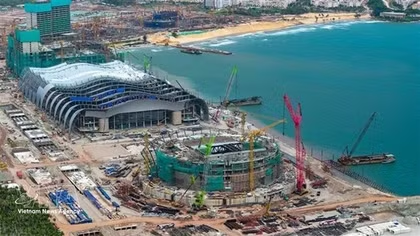
The team examined the APEC 2027 Convention Centre, where main conference activities are scheduled; Sun Serenia Hospital, designated to provide healthcare and emergency medical services for delegates; provincial road DT.975, which connects Phu Quoc International Airport to the convention centre; and the area surrounding Phu Quoc International Airport.

Hanoi accelerates seven Red River bridge projects, many exceed 70% completion

Hanoi accelerates seven Red River bridge projects, many exceed 70% completion

According to the municipal Transport Construction Investment Project Management Board, the city is simultaneously implementing seven projects, namely Tu Lien, Ngoc Hoi, Tran Hung Dao, Thuong Cat, Van Phuc, Hong Ha and Me So bridges. Construction is being carried out on multiple fronts, focusing on bored piles, pile caps, piers and superstructure works.

Dien Bien battlefield legacy powers tourism revival

Dien Bien battlefield legacy powers tourism revival

Seventy-two years after the Dien Bien Phu Victory, its legacy still reverberates. The unity, self-reliance, and resilience forged in that historic triumph remain a powerful internal engine, now propelling Dien Bien toward fast and sustainable development.

Hanoi accelerates shift to green buses, targets 100% by 2030

Hanoi accelerates shift to green buses, targets 100% by 2030

In the 2027–2030 period, the city will accelerate the transition towards the complete phase-out of fossil fuel-powered buses. The share of electric and green energy-fueled buses is projected to reach 79–89% by 2029 and 100% by 2030.

36 fishermen safely rescued after boat breaks down near Truong Sa

36 fishermen safely rescued after boat breaks down near Truong Sa

At 8:00 the same day, KN475 began towing the disabled fishing boat toward Da Tay A island. The towing operation was carried out safely, and by 18:30 both the vessel and its crew had arrived at the island without incident, where repairs and additional support procedures were arranged.

Vietnamese language contest in Laos strengthens youth ties, bilateral friendship

Vietnamese language contest in Laos strengthens youth ties, bilateral friendship

Held in response to the launch of the Vietnamese Language Day among overseas Vietnamese communities, the event aimed to enhance the quality of Vietnamese language teaching and learning in Laos while contributing to the great friendship, special solidarity, comprehensive cooperation and strategic cohesion between the two countries.

Vietnamese language contest in Laos strengthens youth ties, bilateral friendship

Vietnamese language contest in Laos strengthens youth ties, bilateral friendship

Held in response to the launch of the Vietnamese Language Day among overseas Vietnamese communities, the event aimed to enhance the quality of Vietnamese language teaching and learning in Laos while contributing to the great friendship, special solidarity, comprehensive cooperation and strategic cohesion between the two countries.

Hanoi launches 10 electric bus routes from April 1

Hanoi launches 10 electric bus routes from April 1

By the end of April, the number of buses using electricity and other green energy sources in the city is expected to reach 822, including 683 electric buses and 139 compressed natural gas (CNG) buses, representing 42.1% of the total number of vehicles.