Why Hanoians need a ’Code of Conduct’

Is there a “code of conduct” for Hanoians? The question seems strange to many.

“I’ve never heard of such a thing,” said Pham Van Thang, who has lived in Ha Noi for almost 80 years.

But Thang thinks a code of conduct is a good idea for Hanoians.

"We often witness bad behaviour - like students fighting, smoking or drinking alcohol and young people elbowing others out when standing in a queue, refusing to give up their seats to senior citizens, children and people with disabilities - so creating a code of conduct (CoC) for Hanoians is necessary to adjust their manners," Thang said.
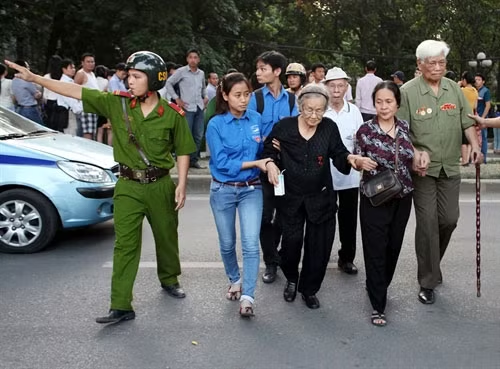
Volunteers help the elderly cross the streets of Ha Noi. -- Photos: VNA/VNS

Nguyen Khac Loi, deputy head of Ha Noi’s Department of Culture and Sports, said the Code is a basis for advocacy, guiding and educating people to live and behave in accordance with the norms of society.

The department used crowded places - such as residential areas, hospitals, offices, recreation centres and festivals - as arenas to fine-tune the code of conduct.

The CoC was scheduled to be promulgated last year but it was delayed due to a change in the targeted group.

Instead of the Code focusing on the whole city as planned, the Culture and Sports Department emphasized a focus on public areas, recreation centres, bus stations, museums, libraries, supermarkets and restaurants to make the Code easy to understand.

Once completed, the CoC will be formalised into concise rules which will be implemented at trial locations first.

Then administrative agencies, schools, hospitals and residential communities will create their own rules of behaviours, based on the CoC published by the department.

The CoC for public places is finished and will be issued by the Ha Noi People’s Committee soon.

Do Xuan Thuy, director general of Dong Xuan joint stock company, said modern society should have a code of conduct as a standard for everyone to strive for.

"It was imperative for Dong Xuan Market, where there were a large number of traders. We look forward to the issuance of the code of conduct, and we will disseminate it to businesses."

"The creation of a CoC had never been a more pressing and necessary requirement," Le Thi Bich Hong, deputy director of the Culture and Arts Department under the Central Committee for Propaganda Education, said.

To create positive changes in society, individuals and organisations should create appropriate CoCs for administrative agencies, schools, enterprises and residential areas, Hong told Ha Noi Moi (New Ha Noi) newspaper. Village regulations for Ha Noi must be included while creating these COCs, she said.

While many people welcomed the creation of the code of conduct, others opposed it.

“Creating a code of conduct was not really necessary for Hanoians whose ancestors have been here for generations, like me,” said Nguyen Thuy Linh, a 40-year-old Hanoian, whose family has lived in the capital city for three generations.

Linh’s view was common among people who possess what is thought of as the elegance and courteous nature of Hanoians.

"Good behaviour should be taught by schools and families," said Le Thu Trang, 38, another Hanoian.

"Hanoians whose ancestors orginated in Ha Noi behave differently than newcomers. They are more sensitive, polite and better behaved than others," she said.

"Hanoians inheritted good character from their ancestors and they preserve it, even now," Trang said. "The code of conduct for Hanoinans should take advantage of this."

"Whether the code of conduct by the Ha Noi’s Department of Culture and Sports will achieve desirable results or not depends on how agencies implement it and how the community will react," said Thang.

He attributed the rampant use of foul language and other inappropriate behaviours of individuals to rapid urbanisation and expansion of the city.

"It isn’t an easy task that can be fulfilled in a short time," he said. 

VNS

Other News

Vietnam steps up implementation of ethnic affairs strategy through 2030

Vietnam steps up implementation of ethnic affairs strategy through 2030

To accelerate the implementation of the the Ethnic Affairs Strategy by 2030, with a vision toward 2045, the Prime Minister requested ministries, agencies and local authorities to continue thoroughly carrying out the Party and State’s policies on ethnic affairs, enhancing the effectiveness of State management and strengthening oversight of policy implementation.

Security preparations reviewed for APEC 2027 in Phu Quoc

Security preparations reviewed for APEC 2027 in Phu Quoc

The team examined the APEC 2027 Convention Centre, where main conference activities are scheduled; Sun Serenia Hospital, designated to provide healthcare and emergency medical services for delegates; provincial road DT.975, which connects Phu Quoc International Airport to the convention centre; and the area surrounding Phu Quoc International Airport.

Hanoi accelerates seven Red River bridge projects, many exceed 70% completion

Hanoi accelerates seven Red River bridge projects, many exceed 70% completion

According to the municipal Transport Construction Investment Project Management Board, the city is simultaneously implementing seven projects, namely Tu Lien, Ngoc Hoi, Tran Hung Dao, Thuong Cat, Van Phuc, Hong Ha and Me So bridges. Construction is being carried out on multiple fronts, focusing on bored piles, pile caps, piers and superstructure works.

Dien Bien battlefield legacy powers tourism revival

Dien Bien battlefield legacy powers tourism revival

Seventy-two years after the Dien Bien Phu Victory, its legacy still reverberates. The unity, self-reliance, and resilience forged in that historic triumph remain a powerful internal engine, now propelling Dien Bien toward fast and sustainable development.

Hanoi accelerates shift to green buses, targets 100% by 2030

Hanoi accelerates shift to green buses, targets 100% by 2030

In the 2027–2030 period, the city will accelerate the transition towards the complete phase-out of fossil fuel-powered buses. The share of electric and green energy-fueled buses is projected to reach 79–89% by 2029 and 100% by 2030.

36 fishermen safely rescued after boat breaks down near Truong Sa

36 fishermen safely rescued after boat breaks down near Truong Sa

At 8:00 the same day, KN475 began towing the disabled fishing boat toward Da Tay A island. The towing operation was carried out safely, and by 18:30 both the vessel and its crew had arrived at the island without incident, where repairs and additional support procedures were arranged.

Vietnamese language contest in Laos strengthens youth ties, bilateral friendship

Vietnamese language contest in Laos strengthens youth ties, bilateral friendship

Held in response to the launch of the Vietnamese Language Day among overseas Vietnamese communities, the event aimed to enhance the quality of Vietnamese language teaching and learning in Laos while contributing to the great friendship, special solidarity, comprehensive cooperation and strategic cohesion between the two countries.

Vietnamese language contest in Laos strengthens youth ties, bilateral friendship

Vietnamese language contest in Laos strengthens youth ties, bilateral friendship

Held in response to the launch of the Vietnamese Language Day among overseas Vietnamese communities, the event aimed to enhance the quality of Vietnamese language teaching and learning in Laos while contributing to the great friendship, special solidarity, comprehensive cooperation and strategic cohesion between the two countries.

Hanoi launches 10 electric bus routes from April 1

Hanoi launches 10 electric bus routes from April 1

By the end of April, the number of buses using electricity and other green energy sources in the city is expected to reach 822, including 683 electric buses and 139 compressed natural gas (CNG) buses, representing 42.1% of the total number of vehicles.