After Huawei, U.S. could blacklist Chinese surveillance tech firm: media

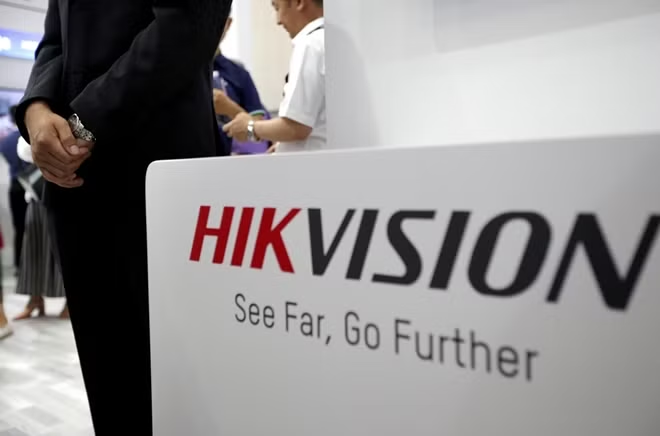
The U.S. administration is considering Huawei-like sanctions on Chinese video surveillance firm Hikvision, media reports show, deepening worries that trade friction between the world’s top two economies could be further inflamed.

The restrictions would limit Hikvision's ability to buy U.S. technology and American companies may have to obtain government approval to supply components to the Chinese firm, the New York Times reported on Tuesday.

The United States stuck Huawei Technologies on a trade blacklist last week, effectively banning U.S. firms from doing business with the world’s largest telecom network gear maker, in a major escalation in the trade war.

The United States has accused Huawei of activities contrary to national security, a charge Huawei denies. However, this week the Trump administration granted the firm a license to buy U.S. goods until Aug. 19 to minimize disruption for customers.

Huawei says it can ensure a steady components supply chain without U.S. help. A Hikvision executive echoed the sentiment.

“Even if the U.S. stops selling them to us we can remedy this through other suppliers,” a Hikvision executive said on condition of anonymity given the sensitivity of the matter.

“The chips Hikvision uses are very commercial and most of the suppliers are actually in China,” she said, but added the company had not been informed of any possible U.S. blacklisting.

The White House did not respond to a request for comment.

Bloomberg, citing people familiar with the matter, reported the U.S. government was deliberating whether to add Hikvision, security equipment maker Zhejiang Dahua Technology and several other unidentified firms to a blacklist.

A Dahua investment department employee declined to comment.

Hikvision, with a market value of more than $37 billion, calls itself the world’s largest video surveillance gear maker.

Its products are used in public places in China, from Beijing to Xinjiang. Headquartered in high-tech Hangzhou, one of China’s richest cities, it sells close-circuit TV products, traffic and thermal cameras, and unmanned aerial vehicles.

China’s foreign ministry on Wednesday urged the United States to provide a fair environment for Chinese firms, in the wake of reports Hikvision could be blacklisted.

“Recently we have repeatedly expressed China’s position of opposing the United States’ abuse of national power to wilfully smear and suppress other countries’ companies, including Chinese companies,” ministry spokesman Lu Kang said at a briefing.

China requires its companies to abide by international norms when investing abroad, but “at the same time we always demand that other countries give Chinese enterprises fair and non-discriminatory treatment”, he added.

UIGHUR CONNECTION

Shares in Hikvision, 42% held by state-owned firms, opened 10% lower on Wednesday. It later pared some losses to trade down 6%. Dahua shares slumped as much as 9.2%.

Jefferies analyst Rex Wu downplayed the impact of a possible ban on Hikvision, saying the United States accounted for roughly 5% of the company’s sales.

“Most AI solutions are sold to the government, public and enterprise sectors in China. Hikvision may be able to acquire GPU (graphics processing unit) via local distributors,” Wu said.

Hikvision and Dahua were specifically cited in a letter to U.S. President Donald Trump’s top advisers last month, signed by more than 40 lawmakers, which called for tighter U.S. export controls over China’s treatment of Muslim minority.

China has faced growing global condemnation for setting up facilities in its western region of Xinjiang that U.N. experts describe as mass detention centers holding more than 1 million ethnic Uighurs and other Muslims.

Beijing has said its measures in Xinjiang, which reportedly also include widespread surveillance, are aimed at stemming the threat of Islamist militancy. The camps that have opened are vocational training centers, it has said.

In a separate email on Wednesday, a Hikvision spokeswoman said the firm took these concerns seriously and had since last October been engaging with the U.S. government on the subject.
Reuters

Other News

Hanoi approves controlled pilot of two technology projects

Hanoi approves controlled pilot of two technology projects

The two projects involve an intelligent autonomous transportation system developed by Phenikaa-X JSC and a technology for producing mixed rare-earth oxides with a purity of over 95% on a semi-industrial scale developed by the Mining Technology and Construction Consultancy JSC.

Banking industry in AI era: When data becomes competitive advantage

Banking industry in AI era: When data becomes competitive advantage

In just a few years, AI has evolved from an experimental technology into an “assistant” for many banks, supporting everything from customer service, credit approval, and fraud detection to risk management. However, as the technological gap between institutions narrows, a new question is emerging: What will determine banks' competitive advantage in the AI era?

Bac Ninh considers establishing AI centre of excellence

Bac Ninh considers establishing AI centre of excellence

A meeting has been held in Bac Ninh to discuss potential cooperation with Plug and Play in developing the northern province’s innovation ecosystem and establishing an artificial intelligence (AI) centre of excellence, with Standing Vice Chairman of the provincial People’s Committee Mai Son receiving a delegation from the global innovation platform.

Hanoi allows 24-month trial of autonomous vehicles at Hoa Lac

Hanoi allows 24-month trial of autonomous vehicles at Hoa Lac

The project aims to assess the safety, reliability and readiness of autonomous vehicles under real traffic conditions, as well as the effectiveness of autonomous public transport and compatibility with existing systems. Its results will contribute to developing technical standards, operating procedures and management models suited to Hanoi’s traffic conditions.

Singapore's experience suggests solutions to Vietnam's human resources challenge in AI era

Singapore's experience suggests solutions to Vietnam's human resources challenge in AI era

As Vietnam accelerates digital transformation and high-tech development, Singapore’s experience and the engagement of global technology companies demonstrate that human resources preparation must stay ahead of the curve. The ability to filter knowledge, collaborate, innovate and effectively use AI will increasingly become essential to helping workers adapt to a changing labour market and strengthening the competitiveness of Vietnam’s economy in the new era.

Protecting national security amid digital transformation, cyberspace

Protecting national security amid digital transformation, cyberspace

Cybersecurity, information security and data security risks must be identified and addressed early and from afar, with appropriate defensive measures ready to neutralise threats and protect national interests in cyberspace, said Lieutenant General Le Xuan Minh, Director of the Ministry of Public Security’s Department of Cybersecurity and Hi-tech Crime Prevention (A05).

Mekong Delta launches first robotics, AI research institute

Mekong Delta launches first robotics, AI research institute

Dr. Nguyen Van Quang, Rector of Nam Can Tho University, said the university is developing a value chain covering training, research, technology development, testing, technology transfer and commercialisation. The model is designed to link research more closely with practical needs, ensuring that technologies generate products and products create value for society.

Vietnam positioned to harness AI wave, World Bank report says

Vietnam positioned to harness AI wave, World Bank report says

The WB report identifies Vietnam as one of the few economies outside the European Union (EU) to have adopted a comprehensive AI regulatory framework as early as 2025. Vietnam applies a risk-tiered approach similar to that of the EU AI Act, imposing different obligations depending on whether an AI system poses “unacceptable,” “high,” “low” or “minimal” risks. The approach is viewed as a strategic step towards ensuring safe and transparent AI governance.

AI offers both opportunities, challenges for Vietnam's growth

AI offers both opportunities, challenges for Vietnam's growth

Dr. Ho Duc Thang, a full-time member of the National Assembly’s Committee for Cultural and Educational, said productivity is the key to sustaining double-digit economic growth, and AI has greater potential to improve productivity than any previous technology.

Top leader unveils people-centred vision for new development model

Top leader unveils people-centred vision for new development model

Vietnam's growth model, long fueled by low-cost labour, resource extraction, contract manufacturing, expanded investment, and capital accumulation, has run out of road. The country now needs a sweeping reform agenda to shift from extensive growth to a model driven by productivity, knowledge, science and technology, innovation, and digital transformation.