Amazon's moves beyond retail get Wall Street thumbs up, for now

Amazon.com Inc's ventures far beyond online retail, from cloud computing to movie making, are raising questions among corporate strategy experts about its focus.

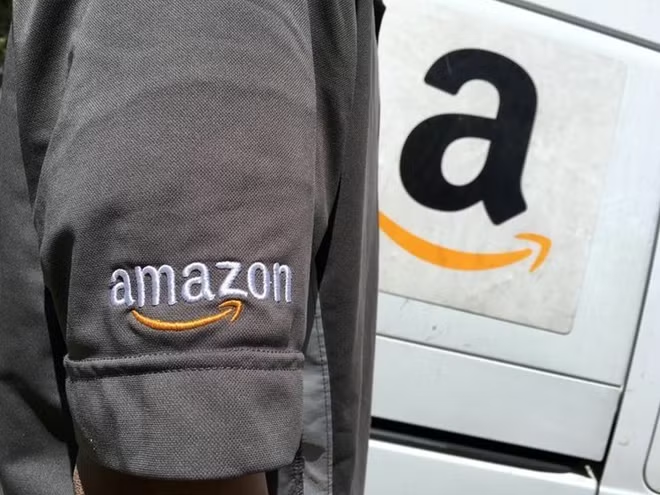
FILE PHOTO: An Amazon.com Inc driver stands next to an Amazon delivery truck in Los Angeles, California, U.S., May 21, 2016. REUTERS/Lucy Nicholson/File Photo

FILE PHOTO: An Amazon.com Inc driver stands next to an Amazon delivery truck in Los Angeles, California, U.S., May 21, 2016. REUTERS/Lucy Nicholson/File Photo

The Seattle-based company wowed Wall Street again this week with a 23 percent jump in sales, pushing its shares to an all-time high. But there are concerns that if blockbuster growth stops, investors may come to regard the company more like a conglomerate stock - worth less than the sum of its pieces.

"High growth covers a lot of sins," said Harry Kraemer, a partner at private equity firm Madison Dearborn Partners and a professor at Northwestern University's Kellogg School of Management.

"Picture yourself running the company where one minute we're talking about how we're going to operate air cargo, and the next minute we're going to talk about artificial intelligence," he said. "I don’t think it's sustainable."

So far, analysts have balked at the idea of calling Amazon a conglomerate because its businesses, although varied, all relate in some way to retail. Warehouses, trucks and planes bring packages to shoppers' doorsteps. Amazon Web Services sells the very cloud-computing services to enterprises that were built to meet the technology needs of Amazon.com.

"It's not like General Electric Co having financial services and making aircraft engines," Baird Equity Research analyst Colin Sebastian said.

Some initiatives, though, such as a television studio in Hollywood, seem further afield. Amazon says the video foray has allowed it to stream unique programming to members of its Prime shopping club, thereby increasing sign-ups for a program that encourages people to buy more goods, more often.

The financial success of the investment is difficult to assess. Revenue from Prime membership fees and other media subscriptions rose 49 percent in the first quarter to $1.9 billion, the company reported on Thursday. It does not disclose the costs of content for its Prime Video service, but they were estimated by an analyst to be more than $3 billion in 2016.

Amazon did not respond to a request for comment.

OUT OF FASHION

These days, conglomerates like GE are out of fashion in the corporate world. By a standard method of valuation - comparing a company's share price to its earnings per share - Amazon is worth about 10 times more than storied conglomerates Berkshire Hathaway Inc and United Technologies Corp.

Investors discount conglomerate stocks partly because diverse businesses are tough to manage, and partly because they believe the market allots money across industries better than a company can.

Indeed, a 2012 report by McKinsey & Co consultants found that conglomerates' revenue on average grew by 6.3 percent per year from 2002 to 2010, while "focused" companies grew by 9.2 percent.

Amazon has acknowledged its pursuits point in many directions, but stresses they are for the long-term, not for quick gains.

Chief Financial Officer Brian Olsavsky rattled off a lengthy list of investments from retail in India to drones and artificial intelligence on the company's earnings conference call on Thursday, in an attempt to explain why its operating profit margin had thinned in North America.

"I know I'm drifting a bit from North America, but it's all part of the same theme," he told analysts.

For now at least, Amazon is being treated as a special case in part from the halo effect around its billionaire founder Jeff Bezos, the second-richest person alive. Many view Bezos as an entrepreneurial genius; he's already extended his reach beyond Amazon to start a space exploration company and purchase the Washington Post.

"Bezos gets a longer leash to wander around than the typical CEO," said Erik Gordon, a professor at the University of Michigan's Ross School of Business. But he was not convinced it was entirely justified.

"You hesitate to bet on this being the singular team that can do something that history has shown - over and over again - is really hard to do," said Gordon. Referring to Walt Disney Co's CEO, he said: "Leave the movie making to Bob Iger."


Reuters

Other News

Hanoi approves controlled pilot of two technology projects

Hanoi approves controlled pilot of two technology projects

The two projects involve an intelligent autonomous transportation system developed by Phenikaa-X JSC and a technology for producing mixed rare-earth oxides with a purity of over 95% on a semi-industrial scale developed by the Mining Technology and Construction Consultancy JSC.

Banking industry in AI era: When data becomes competitive advantage

Banking industry in AI era: When data becomes competitive advantage

In just a few years, AI has evolved from an experimental technology into an “assistant” for many banks, supporting everything from customer service, credit approval, and fraud detection to risk management. However, as the technological gap between institutions narrows, a new question is emerging: What will determine banks' competitive advantage in the AI era?

Bac Ninh considers establishing AI centre of excellence

Bac Ninh considers establishing AI centre of excellence

A meeting has been held in Bac Ninh to discuss potential cooperation with Plug and Play in developing the northern province’s innovation ecosystem and establishing an artificial intelligence (AI) centre of excellence, with Standing Vice Chairman of the provincial People’s Committee Mai Son receiving a delegation from the global innovation platform.

Hanoi allows 24-month trial of autonomous vehicles at Hoa Lac

Hanoi allows 24-month trial of autonomous vehicles at Hoa Lac

The project aims to assess the safety, reliability and readiness of autonomous vehicles under real traffic conditions, as well as the effectiveness of autonomous public transport and compatibility with existing systems. Its results will contribute to developing technical standards, operating procedures and management models suited to Hanoi’s traffic conditions.

Singapore's experience suggests solutions to Vietnam's human resources challenge in AI era

Singapore's experience suggests solutions to Vietnam's human resources challenge in AI era

As Vietnam accelerates digital transformation and high-tech development, Singapore’s experience and the engagement of global technology companies demonstrate that human resources preparation must stay ahead of the curve. The ability to filter knowledge, collaborate, innovate and effectively use AI will increasingly become essential to helping workers adapt to a changing labour market and strengthening the competitiveness of Vietnam’s economy in the new era.

Protecting national security amid digital transformation, cyberspace

Protecting national security amid digital transformation, cyberspace

Cybersecurity, information security and data security risks must be identified and addressed early and from afar, with appropriate defensive measures ready to neutralise threats and protect national interests in cyberspace, said Lieutenant General Le Xuan Minh, Director of the Ministry of Public Security’s Department of Cybersecurity and Hi-tech Crime Prevention (A05).

Mekong Delta launches first robotics, AI research institute

Mekong Delta launches first robotics, AI research institute

Dr. Nguyen Van Quang, Rector of Nam Can Tho University, said the university is developing a value chain covering training, research, technology development, testing, technology transfer and commercialisation. The model is designed to link research more closely with practical needs, ensuring that technologies generate products and products create value for society.

Vietnam positioned to harness AI wave, World Bank report says

Vietnam positioned to harness AI wave, World Bank report says

The WB report identifies Vietnam as one of the few economies outside the European Union (EU) to have adopted a comprehensive AI regulatory framework as early as 2025. Vietnam applies a risk-tiered approach similar to that of the EU AI Act, imposing different obligations depending on whether an AI system poses “unacceptable,” “high,” “low” or “minimal” risks. The approach is viewed as a strategic step towards ensuring safe and transparent AI governance.

AI offers both opportunities, challenges for Vietnam's growth

AI offers both opportunities, challenges for Vietnam's growth

Dr. Ho Duc Thang, a full-time member of the National Assembly’s Committee for Cultural and Educational, said productivity is the key to sustaining double-digit economic growth, and AI has greater potential to improve productivity than any previous technology.

Top leader unveils people-centred vision for new development model

Top leader unveils people-centred vision for new development model

Vietnam's growth model, long fueled by low-cost labour, resource extraction, contract manufacturing, expanded investment, and capital accumulation, has run out of road. The country now needs a sweeping reform agenda to shift from extensive growth to a model driven by productivity, knowledge, science and technology, innovation, and digital transformation.