ASEAN Summit: UN, WB applaud regional responses to COVID-19

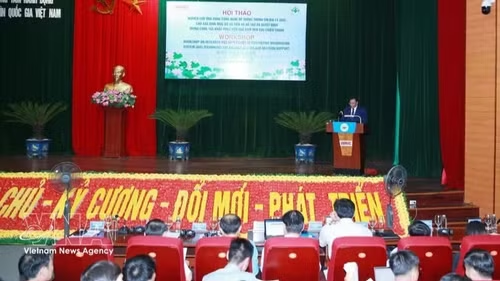
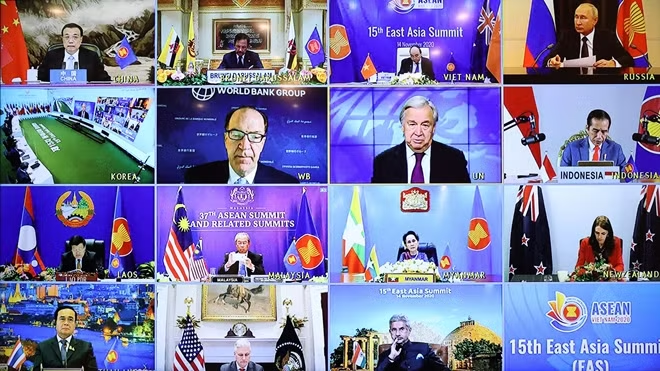
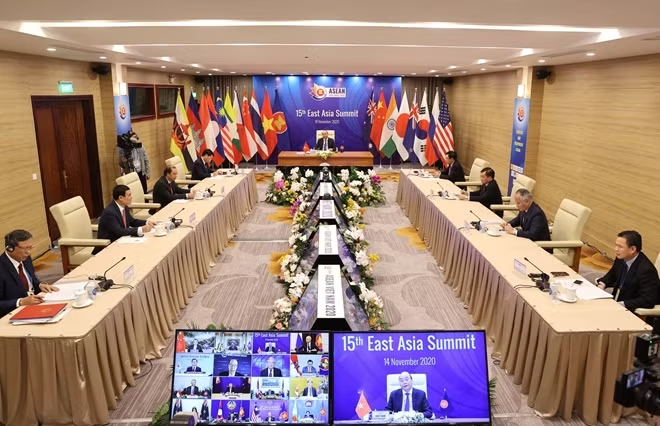
Within the framework of the the 37th ASEAN Summit, Prime Minister Nguyen Xuan Phuc on November 14 chaired the 15th East Asia Summit (EAS) in virtual format. Secretary-General of the United Nations António Guterres and World Bank Group President David Malpass delivered important remarks at the event.  

Strong example in dealing with COVID-19

Speaking at the event, Secretary-General of the United Nations António Guterres said that, the pandemic has caused profound disruption around the world. The countries of East and Southeast Asia have set a strong example in dealing with the pandemic. 

However, the economic and social crises triggered by COVID-19 have added to the challenges of the immediate health crisis. In East Asia alone, as many as 39 million people could revert to extreme poverty.

Therefore, the global community needs to tackle this challenge with compassion and solidarity to recover stronger and stay on track to achieve the Sustainable Development Goals. The United Nations, led by the World Health Organization, has been working to coordinate global efforts to develop and scale up the production of effective vaccines and therapeutics.
"These must be available and affordable for everyone, everywhere. No one is safe until we are all safe. The United Nations has also coordinated a Global Humanitarian Response Plan for those most in need", said UN Secretary-General António Guterres.

Accordingly, UN has called for countries to mobilize a stimulus package amounting to at least 10 per cent of global Gross Domestic Product. But, tt is essential that we invest in people, including through social protection, universal healthcare and quality education. 

"Together, we can use the response to COVID-19 to build a world with less inequality, that is more inclusive and more sustainable", he said.

First region to recover from COVID-19 crisis 

Agree to UN Secretary-General's remarks, World Bank Group President David Malpass pointed out that, in its first year, COVID-19 may push up to 150 million people into extreme poverty, ending two decades of steady progress on poverty reduction.

"The impact is harshest on the poorest countries and the poorest people within each country, adding to inequality. The pandemic is likely to leave a lasting scar on the next generation. Sickness, food insecurity, job losses, and school closures are leading to the erosion of human capital", he stressed.
In order to reduce the COVID-19's consequence, the World Bank Group has moved rapidly to deploy its full financial capacity. "We are on track to commit a record $160 billion over 15 months, including grants and concessional financing. 40% of this amount was committed in the first six months", said President David Malpass.

World Bank also established a fast-track COVID response that has delivered emergency support to 112 countries so far. World Bank made available up to $12 billion of fast-track financing to client countries for them to choose, purchase and deploy COVID-19 vaccines. 

He then stressed that, in the current crisis, East Asia was the first to enter crisis and is well positioned to be the first region to recover from it. Countries will need to prepare for a different economy post-COVID, by allowing capital, labor, skills and innovation to move into new businesses and sectors.

The disruption of trade and global value chains presents both a challenge and an opportunity. The World Bank strongly supports trade facilitation measures to encourage greater flows across borders. We’ve expanded trade finance to banks in the East Asia and Pacific region and beyond. 

"The challenges are daunting, but I’m optimistic that solutions are possible and indeed likely. I know that the World Bank Group is working hard to do as much as we can to help respond to the crisis and strengthen the recovery.  Thank you for your attention and I wish all of you good health, safety and success", World Bank Group President affirmed. 
By An Nhien

Other News

Vietnam steps up implementation of ethnic affairs strategy through 2030

Vietnam steps up implementation of ethnic affairs strategy through 2030

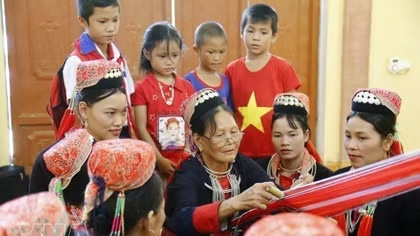
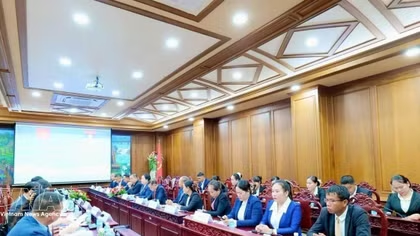
To accelerate the implementation of the the Ethnic Affairs Strategy by 2030, with a vision toward 2045, the Prime Minister requested ministries, agencies and local authorities to continue thoroughly carrying out the Party and State’s policies on ethnic affairs, enhancing the effectiveness of State management and strengthening oversight of policy implementation.

Security preparations reviewed for APEC 2027 in Phu Quoc

Security preparations reviewed for APEC 2027 in Phu Quoc

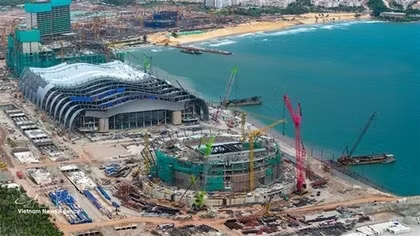
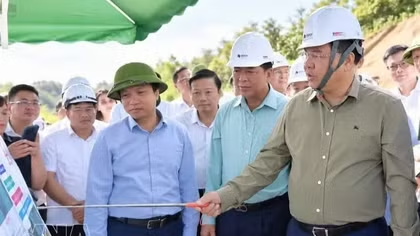
The team examined the APEC 2027 Convention Centre, where main conference activities are scheduled; Sun Serenia Hospital, designated to provide healthcare and emergency medical services for delegates; provincial road DT.975, which connects Phu Quoc International Airport to the convention centre; and the area surrounding Phu Quoc International Airport.

Hanoi accelerates seven Red River bridge projects, many exceed 70% completion

Hanoi accelerates seven Red River bridge projects, many exceed 70% completion

According to the municipal Transport Construction Investment Project Management Board, the city is simultaneously implementing seven projects, namely Tu Lien, Ngoc Hoi, Tran Hung Dao, Thuong Cat, Van Phuc, Hong Ha and Me So bridges. Construction is being carried out on multiple fronts, focusing on bored piles, pile caps, piers and superstructure works.

Dien Bien battlefield legacy powers tourism revival

Dien Bien battlefield legacy powers tourism revival

Seventy-two years after the Dien Bien Phu Victory, its legacy still reverberates. The unity, self-reliance, and resilience forged in that historic triumph remain a powerful internal engine, now propelling Dien Bien toward fast and sustainable development.

Hanoi accelerates shift to green buses, targets 100% by 2030

Hanoi accelerates shift to green buses, targets 100% by 2030

In the 2027–2030 period, the city will accelerate the transition towards the complete phase-out of fossil fuel-powered buses. The share of electric and green energy-fueled buses is projected to reach 79–89% by 2029 and 100% by 2030.

36 fishermen safely rescued after boat breaks down near Truong Sa

36 fishermen safely rescued after boat breaks down near Truong Sa

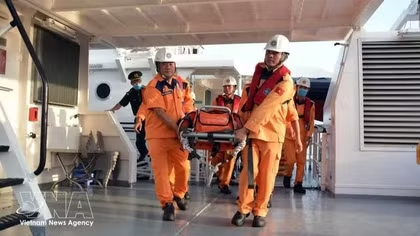
At 8:00 the same day, KN475 began towing the disabled fishing boat toward Da Tay A island. The towing operation was carried out safely, and by 18:30 both the vessel and its crew had arrived at the island without incident, where repairs and additional support procedures were arranged.

Vietnamese language contest in Laos strengthens youth ties, bilateral friendship

Vietnamese language contest in Laos strengthens youth ties, bilateral friendship

Held in response to the launch of the Vietnamese Language Day among overseas Vietnamese communities, the event aimed to enhance the quality of Vietnamese language teaching and learning in Laos while contributing to the great friendship, special solidarity, comprehensive cooperation and strategic cohesion between the two countries.

Vietnamese language contest in Laos strengthens youth ties, bilateral friendship

Vietnamese language contest in Laos strengthens youth ties, bilateral friendship

Held in response to the launch of the Vietnamese Language Day among overseas Vietnamese communities, the event aimed to enhance the quality of Vietnamese language teaching and learning in Laos while contributing to the great friendship, special solidarity, comprehensive cooperation and strategic cohesion between the two countries.

Hanoi launches 10 electric bus routes from April 1

Hanoi launches 10 electric bus routes from April 1

By the end of April, the number of buses using electricity and other green energy sources in the city is expected to reach 822, including 683 electric buses and 139 compressed natural gas (CNG) buses, representing 42.1% of the total number of vehicles.