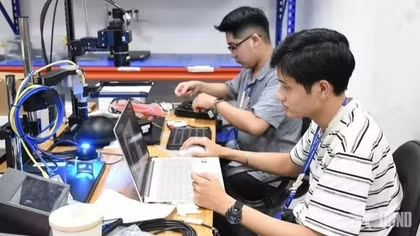
Two new technologies, 3D printing and ceramic matrix composites, have revolutionized the aviation industry in the past year.
Starting in 2015, the fist-sized piece of silver metal – which houses the compressor inlet temperature sensor inside a jet engine – became a symbol of one of the biggest changes in modern jet engine design.
The housing for the sensor, known as T25, became the first 3D-printed part certified by the US Federal Aviation Administration (FAA) to fly inside GE commercial jet engines.
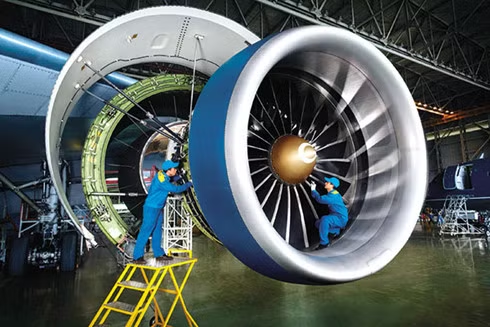 |
GE Aviation then worked with Boeing to retrofit more than 400 GE90-94B jet engines – some of the world’s largest and most powerful engines used in aviation – with the 3D-printed part. The GE90 family of engines powers 777 Boeing planes.
GE also started test flights with the next-generation LEAP jet engine, which holds 19 3D-printed fuel nozzles. The engine, which powers new narrow-body planes like the Boeing 737MAX and the Airbus A320neo, was developed by CFM International, a 50/50 joint venture between GE Aviation and French Safran (Snecma).
GE is also developing 3D-printed fuel nozzles and other parts for the GE9X engine for Boeing’s new 777X aircraft, the largest jet engine ever built.
Besides innovations in 3D printing, which have enabled the company to design and print parts that could not be made otherwise, GE is also pioneering the use of ceramic matrix composites (CMCs) in airplane parts production.
These “super ceramics” are as tough as metals, but only one-third as heavy. They can operate at 2,400 degrees Fahrenheit (1,315.5 degrees Celsius) – 500 degrees Fahrenheit (295.5 degrees Celsius) higher than the most advanced alloys.
This combination allows engineers to design lighter components for engines that don’t need as much cooling, generating more power and burning less fuel.
GE Aviation first used CMC shrouds in the hot section of its F136 fighter jet engine, but their application quickly spread. Static CMC parts are already flying inside the LEAP on Boeing 737 MAX, Airbus A320neo, and Airbus A321neo jets. The LEAP’s manufacturer, CFM International, has received more than 10,800 orders for the engines – which, according to list price, amount to more than $150 billion. 3D-printed parts and components made from advanced ceramics help make the LEAP engine quieter, easier to maintain, and 15 per cent more fuel-efficient than CFM’s current engines.
Flying in tandem with Vietnam
LEAP-1B jet engines, which use 3D-printed components and CMC parts, are now used in the fleet of Vietnam’s only private airline, VietJet Air.
During US President Barack Obama’s first visit to the country in May of this year, GE signed a $3 billion order for 215 LEAP-1B jet engines, which will power a brand-new fleet of 100 next-generation Boeing 737 MAX aircrafts operated by VietJet Air. The airplanes will be delivered to VietJet Air from 2019 until 2023, supporting the company as it extends its domestic and international networks.
According to VietJet Air, the investment in a fleet of Boeing 737 MAXs will help it to grow its planned international route network, which will include long-haul flights.
GE, the world’s leading airline engine manufacturer, has also been co-operating with state-owned carrier Vietnam Airlines for a long time. Much of Vietnam Airlines’ fleet runs on GE’s CFM56-5B, GE90, and GEnx jet engines.
The CFM56-5B is the engine of choice for the Airbus A320 family, having been selected to power the Airbus Corporate Jet (ACJ) and nearly 60 per cent of the A318/A319/A320/A321 aircrafts ordered.
Vietnam Airlines, as one of GE’s earliest customers in the region, has used the CFM56-5B engine since the mid-1990s to power 10 of its Airbus A320 aircrafts. The engines have logged over 129,000 flight hours with no in-flight shutdowns, and have a 99.9 per cent dispatch reliability rate.
The GE90, originally certified in 1995 at 84,700 pounds of thrust (38,419 kilogrammes-force), today powers five different types of Boeing 777 aircraft. At 127,000 pounds of thrust (57,606 kilogrammes-force), the GE90-115B is one of the world’s most powerful jet engines.
Most recently, 14 GE90 engines were selected by Vietnam Airlines for regional use. The GE90-94B-powered Boeing 777 aircraft is the first long-range aircraft utilised by Vietnam Airlines. The engines’ unmatched flexibility and reliability allows for non-stop flights from Hanoi and Ho Chi Minh City straight to Paris, France.
Meanwhile, the GEnx aircraft engine uses the latest generation materials and design processes to reduce weight, improve fuel efficiency, and lower maintenance costs for mid-size, long-range aircrafts, such as the Boeing 787 Dreamliner.
In October 2013, GE provided 40 GEnx jet engines for Vietnam Airlines’ Boeing 787 Dreamliner fleet. The new engines brought a 15 per cent reduction in the fleet’s fuel usage.
In addition to providing equipment, GE offers its customers flexible, customised services and solutions that can meet unique needs. Along with a global network of technical resources to support their operations at the local level, GE offers its customers the means to implement goals associated with flight operations’ quality assurance, including significant fuel efficiency, reduced emissions, and lower noise, as well as improved access to airports.
“GE’s engines have been ensuring that flying in Vietnam is safe and comfortable for passengers, but just as importantly, its technology ensures that air travel remains gentle on the environment. That is how we are working with Vietnam’s airlines to meet the increasing demand for domestic air travel,” said Pham Hong Son, CEO of GE Vietnam.
Clear skies ahead
As Vietnam finds its voice as a prominent global actor, the demand for air travel is rising. According to data published by Civil Aviation Authority of Vietnam, in the first half of this year, Vietnamese airlines transported 25 million passengers, up 30 per cent on-year, and the number of domestic passengers grew by 33 per cent. This is phenomenal growth compared to the previous years’ 15-20 per cent.
The International Air Transport Association has named Vietnam as one of the seven fastest growing air travel markets in the world from 2014 to 2017, both in terms of the number of international passengers and cargo. Meanwhile, the number of domestic passengers is expected to grow at an annual average of 15 per cent in the next few years.
Currently, ASEAN Open Sky – established on January 1, 2016 – is creating a level playing field for all airlines in the region, providing opportunities for Vietnamese airlines to soar.
In this context, GE Aviation is looking to make significant investments in Vietnam, betting on its coming role as a hub in the open skies. The key, as the company sees it, lies in helping its airline partners serve the growing population of business and leisure travelers, primarily relying on the company’s advanced jet engines, which are both easy to maintain and cost-effective.
“GE hopes to foster a strong alliance with Vietnam’s growing airlines as the nation grows into one of the Pacific region’s leading business and tourism destinations,” added Son.