Capital city hopes fees will reduce congestion

The capital city of Hanoi is eyeing fees on personal vehicles entering the city centre in an attempt to curb worsening traffic and pollution.
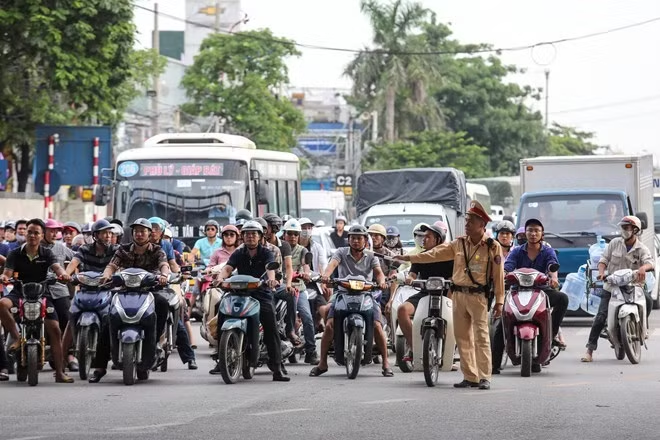
A police officer directs the traffic flow on a street in Hanoi. The capital city is making efforts to curb worsening traffic and pollution (Photo: VNA)

A police officer directs the traffic flow on a street in Hanoi. The capital city is making efforts to curb worsening traffic and pollution (Photo: VNA)

The municipal People’s Committee submitted a plan to Prime Minister Nguyen Xuan Phuc earlier this month, asking for permission to gradually cut the number of vehicles in the central districts of the capital.

The plan details three proposals, including a new fee on vehicles entering the districts in question, an extra fee for pollution and administrative tools to manage electric bicycles and cars.

These are the key strategies Hanoi authorities intend to use to enact the city’s master plan on congestion and pollution management, approved by the Hanoi People’s Council in 2017.

City officials called the proposed vehicle fee a behavioural economics initiative designed to restrict traffic in certain areas.

Several large cities around the world, including London and Singapore, have effectively applied similar methods.

Exactly where drivers will need to pay the fees is still undetermined, but the Hanoi Department of Transport said the first priority is to apply the fee inside city Belt Road No 3.

Belt Road No 3 is a comprised of several continuous roads that split the urban and suburban districts in southwest Hanoi. It runs through roads including Pham Van Dong and Pham Hung, and ends at Thanh Tri Bridge.

The transport department hinted the fee could eventually be expanded to other zones. It will conduct surveys to determine which streets and areas would benefit most from a reduction in traffic.

The department said it is designing an automatic fee collection system to “avoid disturbing drivers”.

As a result, each vehicle owner will need to have a bank account with a special tool equipped to allow a tollbooth to automatically collect the fee.

Vice President of the Hanoi Association of Transport Bui Danh Lien supports the move, but suggested limiting fee collection to the busiest hours to avoid restricting movement too much.

“Congestion only happens in Hanoi during rush hour, so that is when the fee should be applied,” he told the Tien Phong (Vanguard) newspaper.

Lien pointed out Singapore follows this model, only charging a high fee during rush hour. Drivers on the road before six in the morning or after seven in the evening pay a minimal fee, if they are charged at all.

“Hanoi should consider implementing the Singapore model,” he said.  

Vietnam’s capital and the centre of life in the North, Hanoi attracts millions of migrants with many thousands of new arrivals each year. They come to the city seeking a better life. With them, come cars and motorbikes.

Estimates say Hanoi will have over six million motorbikes and 800,000 cars clogging its roads by 2020.

Those numbers will continue to climb, and could hit 7.5 million motorbikes and 1.9 million cars by 2030, threatening to worsen the city’s already poor air quality.

The second proposal, an environmental fee on vehicles with four or more wheels, would be collected whenever a car is re-registered.

If this fee is approved, the transport department would start preparing now to begin collection in 2019.

Lien, however, opposes the move. He called it “a fee on top of another fee” because vehicle users already pay an environmental fee each time they buy petrol. The current tax is at least 3,000 VND (13 US cents) per litre. “It would be inappropriate for Hanoi to add another environmental fee,” he said.

He also pointed out the city’s plan does not distinguish between vehicles in the city centre and those that stay in suburban areas.

“A driver in rural Ba Vi district can’t and shouldn’t pay the same fee as one in Hoan Kiem district,” he said.

VNS/VNA

Other News

Vietnam steps up implementation of ethnic affairs strategy through 2030

Vietnam steps up implementation of ethnic affairs strategy through 2030

To accelerate the implementation of the the Ethnic Affairs Strategy by 2030, with a vision toward 2045, the Prime Minister requested ministries, agencies and local authorities to continue thoroughly carrying out the Party and State’s policies on ethnic affairs, enhancing the effectiveness of State management and strengthening oversight of policy implementation.

Security preparations reviewed for APEC 2027 in Phu Quoc

Security preparations reviewed for APEC 2027 in Phu Quoc

The team examined the APEC 2027 Convention Centre, where main conference activities are scheduled; Sun Serenia Hospital, designated to provide healthcare and emergency medical services for delegates; provincial road DT.975, which connects Phu Quoc International Airport to the convention centre; and the area surrounding Phu Quoc International Airport.

Hanoi accelerates seven Red River bridge projects, many exceed 70% completion

Hanoi accelerates seven Red River bridge projects, many exceed 70% completion

According to the municipal Transport Construction Investment Project Management Board, the city is simultaneously implementing seven projects, namely Tu Lien, Ngoc Hoi, Tran Hung Dao, Thuong Cat, Van Phuc, Hong Ha and Me So bridges. Construction is being carried out on multiple fronts, focusing on bored piles, pile caps, piers and superstructure works.

Dien Bien battlefield legacy powers tourism revival

Dien Bien battlefield legacy powers tourism revival

Seventy-two years after the Dien Bien Phu Victory, its legacy still reverberates. The unity, self-reliance, and resilience forged in that historic triumph remain a powerful internal engine, now propelling Dien Bien toward fast and sustainable development.

Hanoi accelerates shift to green buses, targets 100% by 2030

Hanoi accelerates shift to green buses, targets 100% by 2030

In the 2027–2030 period, the city will accelerate the transition towards the complete phase-out of fossil fuel-powered buses. The share of electric and green energy-fueled buses is projected to reach 79–89% by 2029 and 100% by 2030.

36 fishermen safely rescued after boat breaks down near Truong Sa

36 fishermen safely rescued after boat breaks down near Truong Sa

At 8:00 the same day, KN475 began towing the disabled fishing boat toward Da Tay A island. The towing operation was carried out safely, and by 18:30 both the vessel and its crew had arrived at the island without incident, where repairs and additional support procedures were arranged.

Vietnamese language contest in Laos strengthens youth ties, bilateral friendship

Vietnamese language contest in Laos strengthens youth ties, bilateral friendship

Held in response to the launch of the Vietnamese Language Day among overseas Vietnamese communities, the event aimed to enhance the quality of Vietnamese language teaching and learning in Laos while contributing to the great friendship, special solidarity, comprehensive cooperation and strategic cohesion between the two countries.

Vietnamese language contest in Laos strengthens youth ties, bilateral friendship

Vietnamese language contest in Laos strengthens youth ties, bilateral friendship

Held in response to the launch of the Vietnamese Language Day among overseas Vietnamese communities, the event aimed to enhance the quality of Vietnamese language teaching and learning in Laos while contributing to the great friendship, special solidarity, comprehensive cooperation and strategic cohesion between the two countries.

Hanoi launches 10 electric bus routes from April 1

Hanoi launches 10 electric bus routes from April 1

By the end of April, the number of buses using electricity and other green energy sources in the city is expected to reach 822, including 683 electric buses and 139 compressed natural gas (CNG) buses, representing 42.1% of the total number of vehicles.