
The Ministry of Natural Resources and Environment has asked 38 cities and provinces nationwide to promptly revise the operation of reservoirs to ensure water sources for low-lying areas in this dry season.
In the document sent to each locality, the ministry directed local people’s committees to oversee relevant authorities as they examine the demand for water in low-lying areas. They were also asked to watch the changes of weather and water flows so that water is discharged from the reservoirs according to need.
Currently, 67 reservoirs and dams are under the Government’s reservoir operation regulations for 11 rivers nationwide.
The head of the ministry’s Department of Water Source Management, Hoang Van Bay, said the regulations had helped provide reservoir water for lowland areas in the dry season and prevented floods caused by improper water discharges.
In the previous dry season, thanks to the compliance with the regulations, 65.3 billions of cubic metres of water were discharged to lowland areas nationwide.
In the central region and Central Highlands alone, the two hardest-hit areas of the historic drought caused by the El Nino phenomenon, about 17.4 billion cubic metres of water were discharged to meet the urgent water demand for daily use and production activities.
However, Bay said, the amount of water only solved drought in certain low lying areas due to lax management and coordination among ministries, sectors and localities. As regulated, reservoir owners must set up plans for discharging water and report to the local authority and the ministry in order to get final approval and ensure that the plan does not contradict plans of other areas. However, not every owner asked for the local authority’s permission, leading to ineffective drought prevention nationwide.
Bay said that in order to solve the problem, the department has set up inspection teams to directly supervise the operation of reservoirs. Units in charge of managing reservoirs were required to supply information and data on the reservoirs on their websites for better management.
 |


Although the Political Bureau’s Resolution No. 57-NQ/TW allows pilot schemes for new practical issues and accepts risks and delays in science, technology and innovation, concerns over risks and responsibility persist.

The two projects involve an intelligent autonomous transportation system developed by Phenikaa-X JSC and a technology for producing mixed rare-earth oxides with a purity of over 95% on a semi-industrial scale developed by the Mining Technology and Construction Consultancy JSC.

If the proposed threshold is approved and takes effect, the five largest technology companies could add up to 7.6 trillion VND (291 million USD) in R&D funding annually.

In just a few years, AI has evolved from an experimental technology into an “assistant” for many banks, supporting everything from customer service, credit approval, and fraud detection to risk management. However, as the technological gap between institutions narrows, a new question is emerging: What will determine banks' competitive advantage in the AI era?

A meeting has been held in Bac Ninh to discuss potential cooperation with Plug and Play in developing the northern province’s innovation ecosystem and establishing an artificial intelligence (AI) centre of excellence, with Standing Vice Chairman of the provincial People’s Committee Mai Son receiving a delegation from the global innovation platform.

The project aims to assess the safety, reliability and readiness of autonomous vehicles under real traffic conditions, as well as the effectiveness of autonomous public transport and compatibility with existing systems. Its results will contribute to developing technical standards, operating procedures and management models suited to Hanoi’s traffic conditions.

As Vietnam accelerates digital transformation and high-tech development, Singapore’s experience and the engagement of global technology companies demonstrate that human resources preparation must stay ahead of the curve. The ability to filter knowledge, collaborate, innovate and effectively use AI will increasingly become essential to helping workers adapt to a changing labour market and strengthening the competitiveness of Vietnam’s economy in the new era.

The country needs a long-term approach, sustained investment and a willingness to accept risks, potentially requiring at least 10–20 years of persistent efforts, an expert has said.

Cybersecurity, information security and data security risks must be identified and addressed early and from afar, with appropriate defensive measures ready to neutralise threats and protect national interests in cyberspace, said Lieutenant General Le Xuan Minh, Director of the Ministry of Public Security’s Department of Cybersecurity and Hi-tech Crime Prevention (A05).

Dr. Nguyen Van Quang, Rector of Nam Can Tho University, said the university is developing a value chain covering training, research, technology development, testing, technology transfer and commercialisation. The model is designed to link research more closely with practical needs, ensuring that technologies generate products and products create value for society.

The state visit to New Zealand by Party General Secretary and President To Lam has opened the door to cooperation, and the key task now is turning that opportunity into a pathway for people, students, scientists, and businesses to move forward together.
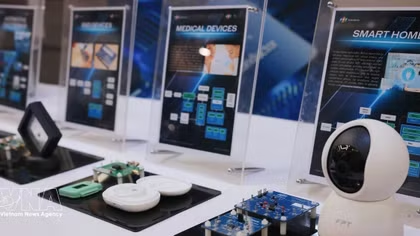
Vietnam should give priority to areas where it has potential to build strengths, particularly manufacturing and packaging.

The WB report identifies Vietnam as one of the few economies outside the European Union (EU) to have adopted a comprehensive AI regulatory framework as early as 2025. Vietnam applies a risk-tiered approach similar to that of the EU AI Act, imposing different obligations depending on whether an AI system poses “unacceptable,” “high,” “low” or “minimal” risks. The approach is viewed as a strategic step towards ensuring safe and transparent AI governance.

Carrying the message 'Verify Before You Trust', the campaign seeks to foster a new public habit: before believing, sharing or making decisions based on information found online, people should take the time to verify the source, context and authenticity of the content.

Since July 2025, immigration authorities have processed 84,831 applications, with Republic of Korean, Chinese and Japanese nationals accounting for the largest numbers of registered users.

Dr. Ho Duc Thang, a full-time member of the National Assembly’s Committee for Cultural and Educational, said productivity is the key to sustaining double-digit economic growth, and AI has greater potential to improve productivity than any previous technology.
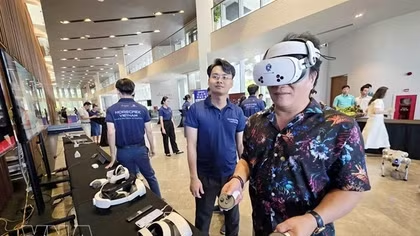
There will also be over 40 discussions focusing on AI applications, sustainable development and human resource development, as well as meetings for companies to find international partners.

To strengthen its competitiveness in attracting global talent, the city has introduced a comprehensive package of incentives, including housing assistance, transportation support, streamlined immigration and work permit procedures, improved research facilities, and favourable working conditions.
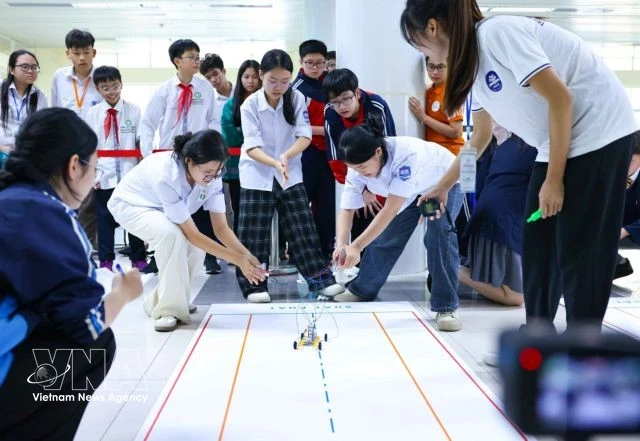
Nearly 467,600 from more than 874,800 university applicants have registered for STEM majors for the 2026 admissions cycle, accounting for 53.45% of all candidates, according to the Ministry of Education and Training.

Vietnam's growth model, long fueled by low-cost labour, resource extraction, contract manufacturing, expanded investment, and capital accumulation, has run out of road. The country now needs a sweeping reform agenda to shift from extensive growth to a model driven by productivity, knowledge, science and technology, innovation, and digital transformation.